Proposed sex ed bill would emphasize abstinence, bar discussion of contraception

Beyond Alaska, News, Uncategorized

Originally published in the Peninsula Clarion

A bill filed in the Alaska State Legislatu

education in schools across the state.

House Bill 7 would encourage teaching abstinence to students and prohibit instruction about “erotic behavior” like homosexuality, gender identity, the use of contraception and sex before marriage. The legislation would also require Alaska instructors to teach that life begins at

re by Rep. George Rauscher, R-Sutton, aims to regulate sex and human reproductive education in schools across the state.

House Bill 7 would encourage teaching abstinence to students and prohibit instruction about “erotic behavior” like homosexuality, gender identity, the use of contraception and sex before marriage. The legislation would also require Alaska instructors to teach that life begins at conception.

In his bill, Rauscher said people who stay abstinent prevent the emotional trauma associated with adolescent sexual activity.

“… [A]bstinence from sexual activity (is) the preferred choice for unmarried students because it is the only 100 percent effective way to prevent pregnancy and sexually transmitted diseases,” the bill said.

The bill states that sexual activity out of wedlock is likely to have harmful psychological or physical effects, and that there may be social, or health benefits to abstaining from sexual activity.

Rauscher also asserts in the bill that adolescent sexual activity increases the likelihood that a student will drop out of school because of sexually transmitted disease or unplanned pregnancy. The legislation would prevent instructors from teaching students about contraceptive methods and devices that may prevent sexually transmitted diseases and pregnancies.

The bill also emphasizes the idea that bearing a child out of wedlock is likely to have harmful consequences for the child, the child’s parents and society.

The Kenai Peninsula Borough School District uses several lesson plans and materials that teach both abstinence, contraceptive use and consent. Curriculum materials come from several resources, including the Homer Peer Education Team at Kachemak Bay Family Planning Clinic and Planned Parenthood.

At the Education Board’s Aug. 6 work session, the board reviewed resources and materials used by district health educators.The school board approves all the materials used in the district, which are all research-based and meet state requirements.

Rauscher, who has been serving as a state representative since 2017, has introduced several bills this session, including one prohibiting state-funded gender reclassification medical procedures and an act relocating the state Legislature to Anchorage.

Nikiski awaits decision on LNG pipeline project location

Alaska, Uncategorized

Originally published in the Peninsula Clarion

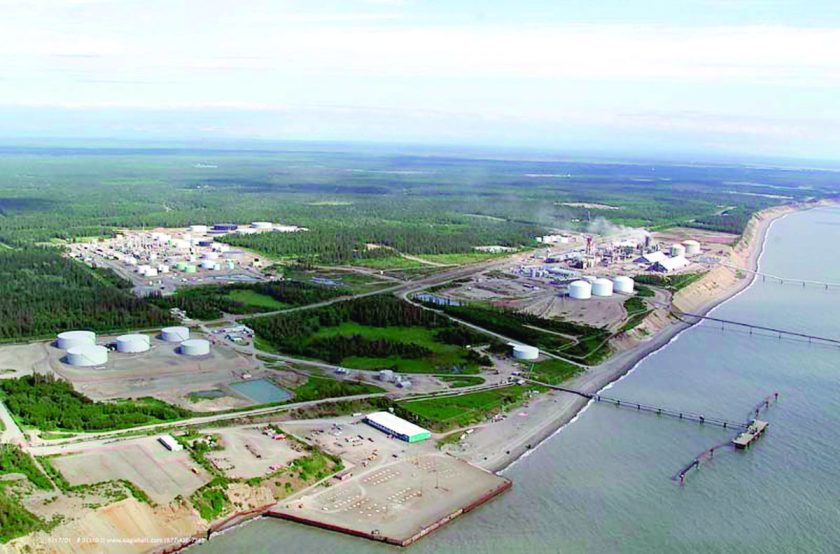
The timeline for the Alaska LNG project — a planned 806-mile pipeline that would carry natural gas from the North Slope to a liquefaction plant and terminal in Nikiski — has not been affected by the federal government shutdown, but progress on the Alaska Stand Alone Pipeline has been halted due to the shutdown, according to a recent community update.

“We’re waiting on a signed record of decision from both the Corps of Engineers and the Bureau of Land Management,” said Lisa Parker, Alaska Gasline Development Corporation’s stakeholder engagement manager, at the Jan. 15 Alaska LNG Advisory Committee meeting. “That has been affected by the shutdown. We don’t know when we will receive those records of decisions. Once we receive them, the only outstanding issues with ASAP would be getting state local permits that would be required.”

Parker also said the Federal Regulatory Commission is requesting more data for the Alaska LNG project.

“We thought we received the last data request, however, our Christmas present on Dec. 26 was a note from FERC with 91 additional data requests,” Parker said.

She said the majority of data requested is engineering related, and they won’t affect the draft environmental impact statement, which is set to be released by the end of February.

Parker said they plan to respond to all of the data requests by June. As of last Tuesday, the project has received 1,655 data requests from FERC. All but 111 data requests have been responded to.

Both Valdez and the Matanuska-Susitna Borough have expressed interest in housing the Alaska LNG project, but the likelihood of the Alaska LNG project staying in Nikiski seemed high after Parker’s update. In the last two months, formal resolutions supporting the Alaska LNG project in Nikiski have been passed borough wide, from the Kenai Peninsula Borough Assembly, the Kenai Peninsula Economic Development District, and the cities of Kenai, Soldotna, Homer, Seward and Seldovia.

“So you have support from Seward to Seldovia that the facility should be located here in your neighborhood,” Parker said.

The draft environmental impact statement coming at the end of February will identify a location for the Alaska LNG project. All of the work that has gone into identifying facilities and infrastructure would need to be replicated in those communities. The Alaska LNG project thus far has already cost tens of millions of dollars, Parker said.

“The draft (environmental impact statement) will identify a location for a liquefaction plant facility, which 99 percent of me says will be Nikiski,” Parker said. “Will there be people that challenge that and say we want it in other places? I suspect yes… I don’t see FERC coming back and identifying a different location.”15224082_web1_50946100_2348129318531823_6143334865862393856_n-1200x800.jpg

Peninsula sees growth in winter tourism

Alaska, Uncategorized

Originally published in the Peninsula Clarion

While the borough’s ports and highways fill up with thousands of visitors from across the world in the summertime, more and more travelers are looking to experience Alaska and the Kenai Peninsula in the fall and wintertime.

Alaska has seen an increase in winter tourism, according to a new report from Anchorage-based research firm, the McDowell Group.

Locally, several chambers across the borough have reported seeing small increases in winter tourism.

In Seward, Cindy Clock, the executive director for the Seward Chamber of Commerce, said in an email that there has been a slight growth in winter tourism in the Seward area.6090701_web1_IMG_2962-1200x800.jpg

“Although we are too far south to promote consistent aurora activity, Silverton Mountain Guides has been offering heli-skiing for the past few years,” Clock said. “Activity, lodging and restaurant businesses have been evolving into year-round businesses as well since they too are aware of this travel trend.”

Cooper Landing has also seen growth similar to Seward’s, with a handful of businesses choosing to stay open longer in the winter, President of the Cooper Landing Chamber of Commerce Stephanie Lesmeister said.

“Several of our members are open this winter and seem to be staying steady,” Lesmeister said. “Local volunteers have been grooming the cross-country ski trails and that seems to draw people to the area. Additionally, fly fishing has been getting more and more popular and we seem to see people out fishing later and later into the winter.”

Lesmeister said Drifters Lodge, Sunrise Inn, Wildmans and The Inn at Tern Lake are a few of the local businesses that have stayed open for the winter.

Tim Dillon, executive director of the Kenai Peninsula Economic Development District, said the winter tourism numbers in the borough are up.

“Borough-wide everybody is pretty pleased with the numbers we’re seeing,” Dillon said. “We’re seeing some growth.”

Over the last three seasons, winter visitation in the state has increased by 2.1 percent. The report said Alaska’s winter tourism has been growing steadily over the last decade, though still far below summer tourist numbers. The report says the number of tourists visiting between the fall and winter season of 2017 and 2018 was up 33 percent from a decade earlier. Data refers to the time period between the months of October and April, and both out-of-state and Alaska residents.

The report notes that the “Chinese market has exploded over the last several seasons.”

“The main draw is the northern lights,” the report said.

The report also notes that Girdwood’s Alyeska Resort reported “unprecedented growth in out-of-state visitation over the last several winter seasons.”

Dillon said local chambers are in a listening mode and are gathering information about what travelers might be interested in doing in the winter.

“Whether it’s northern lights, ice-fishing, snowmobiling, or other winter sports, the peninsula can really accommodate,” Dillon said. “Our tourism industry has really been able to hold its own.”

Soldotna artist honors Dena’ina heritage with Anchorage statue

Alaska, Uncategorized

Originally published in the Peninsula Clarion

Near Anchorage’s Ship Creek, a new bronze statue of an elder named Olga, a Dena’ina matriarch from the village of Eklutna, stands and overlooks land that was once a prosperous Native fish camp.

Soldotna artist Joel Isaak, who is Dena’ina himself, worked on the statue for two and a half years. He said he doesn’t take the opportunity to represent his culture through art lightly.

“It’s a lot of reflection,” Isaak said. “Trying to consolidate the history of cultural annihilation and assimilation in a positive light is tricky. It’s a way to convey that we are still living people.”

Isaak, a Dena’ina language professor at the Kenai Peninsula College, created his proposal for the statue after the village of Eklutna sent out a call for art. The parameters of the project included a piece that was in the likeness of Olga and that it tiedinto the fishing heritage at the site of Ship Creek.

Isaak said it’s always a rare opportunity to himself as an Alaska Native in public art.

“Most of the figurative work, if it is of indigenous people, looks like European people,” Isaak said. “I don’t identify with it from a visual standpoint. Being able to have the opportunity to be able to be a little more in control of the narrative is an honor. It’s exciting to see other people’s excitement at that opportunity.”

Isaak’s work can be found in many places across Alaska. He worked on a beluga whale diorama in Anchorage’s Ted Stevens Airport. Art of Isaak’s can be found in the Sheldon Jackson Museum in Sitka. Locally, Isaak completed statues in front of the Dena’ina Wellness Center and salmon skin bowls in the Kenai Courthouse.

Isaak had two photographs of Olga to base his statue on. The statue has Olga in customary Dena’ina clothing, like fish skin boots and a dress featuring quill work. Isaak said Dena’ina regalia has been important to him to him from an early age.

“Part of my journey in making the bronze statuary is learning how to make the clothing,” Isaak said. “I’ve wanted to learn to make regalia since I was in either first or second grade making paper pilgrim and Indian costume stuff. I researched at museums, and took workshops and learned all the methods needed to produce that clothing so I understood what I was trying to replicate before just looking at a picture in a book and trying to make it look something like that.”

The Dena’ina culture is a matriarchal society. Olga was an elder and a leader in Dena’ina land north of Anchorage. Isaak said the piece was not only honoring Dena’ina history and heritage, but also women in our society.

“Honoring our indigenous women and women everywhere — our society is based off of that model so there’s strong precedent for making an elder and then having the elder be a woman,” Isaak said. “I think it’s poignant in our current situation for the need to honor and respect women in our state and in the world, but especially with the current statistics. Bringing a visual voice to honor the role that women have in our society and culture.”

Born and raised in Soldotna, Isaak has many connections to Dena’ina culture, and even Olga herself. His family comes from the Upper Cook Inlet area in Point Possession. He said he’s distantly related to Olga, going back several generations.

“I’ve always had a strong desire to be connected to my indigenous Native culture and all the different cultures that my family comes from,” Isaak said. “But living here in Soldotna on Dena’ina land there has been a very strong desire from me from a very early age to learn my language and material culture.”

In Dena’ina culture, clothing is used as fine art. Dena’ina people were semi-nomadic or sedentary and would move between summer fish camp and a winter village, which was sometimes in almost the same spot, Isaak said. For this reason, art would move with the people in the form of clothing, which would represent things like where a person was from and what family they belonged to.

“You put (your art) on your clothing and you bring it with you,” Isaak said. “So the quill work design in the shape of the tunic can tell where you’re from — it can tell your clan information. It’s a form of visual written communication that we don’t really have that Rosetta Stone for. It served as a function for that and it also brings in that visual fine art. We just brought it with us everywhere instead of leaving it behind glass or in a frame.”

The statue is near Anchorage’s downtown, which a busy and growing part of the city. Isaak said the statue is a reminder of the area’s past.

“Having it be in Anchorage is making invisible people visible,” Isaak said. “It’s surrounded by this growing city, but we’re still here and making that visual presence.”

Joel Isaak is a Soldotna-based artist who teaches Dena’ina language classes at the Kenai Peninsula College, on Thursday, Jan. 17, 2019, in Kenai, Alaska. (Photo by Victoria Petersen/Peninsula Clarion)Joel Isaak is a Soldotna-based artist who teaches Dena’ina language classes at the Kenai Peninsula College, on Thursday, Jan. 17, 2019, in Kenai, Alaska. (Photo by Victoria Petersen/Peninsula Clarion)

Airport remodel uncovers student mural from the 70s

Alaska, News, Print, Uncategorized

This story originally published in the Peninsula Clarion.

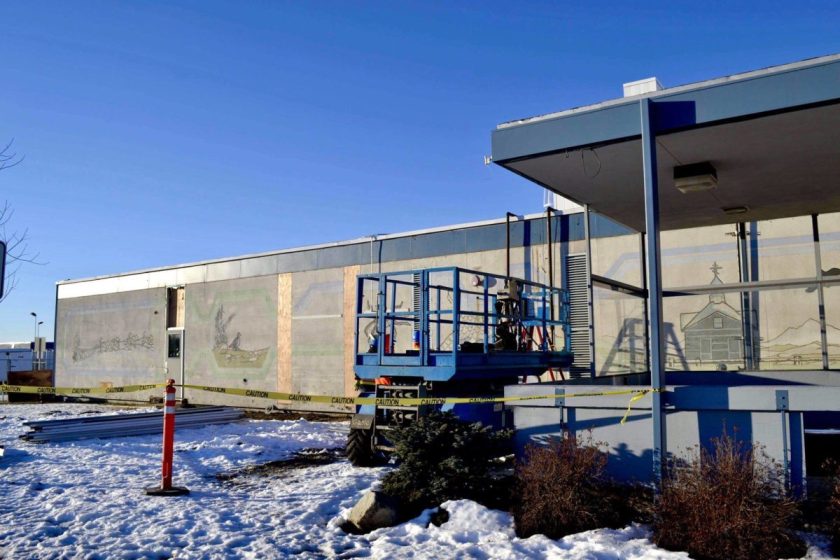
A mural discovered Tuesday by construction crews at the Kenai Municipal Airport is bringing back memories for the former high school students who helped create it four decades ago.

The mural, which depicts peninsula icons, like a Russian Orthodox Church, a dog musher and a fishing net with crab, was designed and painted by an advanced art class taught by Renae Larson at Kenai Central High School in the spring of 1977, according to Clarion archives.

Babbi Goodwin was a senior at Kenai Central when she helped create the mural as part of her advanced art class with Larson. She said she took all of Larson’s classes when she was in high school.

“I had Larson four hours a day my senior year,” Goodwin said. “I was kind of her pet student. (Larson) was really an inspiration to me.”

Goodwin said she helped paint the Russian Orthodox Church and a ptarmigan.

“I thought ‘I can’t paint a bird,’” Goodwin said.

Seeing the mural unveiled this week was a surprise, she said.

“It’s so sad,” Goodwin said. “I know they want to make (the airport) modern, but it’s so neat to see my art and my class’ project. But I understand it needs to modernize.”

Kenai resident Melanie Beverly was also a student in the advanced art class that created the mural. Beverly said she doesn’t remember a whole lot from the experience, but said many of her friends in the class were responsible for the designs.

After searching her high school yearbook, Beverly said she found a note from Larson thanking her for her work at the airport.

“The airport is super,” Larson wrote in Beverly’s yearbook.

The design for the mural was a year in the making. Basic graphics were done by Brad Ambarian, along with designs submitted by Gary Cason, Dawna Kinne, Mike Lindhartsen, Bill McWilliams, Sheryl Rhodes and Becky Roberts, the Clarion previously reported. Twenty five other art students assisted in the making of the mural.

The idea for the mural came from The Greater Kenai Chamber of Commerce, which approached Larson about the project after students of hers executed another mural in the fall of 1976 on the front of Kenai Central, according to Clarion archives.

The mural was discovered Tuesday when crews working on the latest airport remodel removed siding on the building’s facade. The artwork had been covered by metal panels after the airport expanded in the 1980s. Built in 1966, the airport has been remodeled three times — in 1983, in 1988 when the restaurant and lounge were added, and in 2004, when sidewalks, entryways and parking lots were updated.

The current remodel, which began in October, will redesign areas throughout the airport, including the interior, roof and entryway, in an effort to enhance passenger experience, according to Clarion files.

Mark Blanning, with local engineering firm Wince-Corthell-Bryson, is working on the current airport remodel. Blanning confirmed the project does include a complete exterior remodel that would incorporate new siding.

Kenai Airport Manager Mary Bondurant said she remembered there was a hidden mural on the north end of the building, but not the south end. She said the mural wasn’t discussed during renovation plans.

“It’s been great talking to people who were there and helped with the mural,” Bondurant said.

Despite plans for renovation, members of the community are hoping the mural can be saved in some way.

“I would like to see (the mural) stay,” Beverly said.

Jerry Faulkner, who graduated from Kenai Central High School in 1977, also said he’d like to see the mural preserved.

“It’s part of the legacy of my class,” he said.

After construction workers removed siding from the facade of the Kenai Municipal Airport, a mural with iconic Kenai images like fishing nets, the St. Nicholas Russian Orthodox chapel and a dog musher, was revealed on Tuesday, Jan. 15, 2019 in Kenai, Alaska. (Photo by Victoria Petersen/Peninsula Clarion)After construction workers removed siding from the facade of the Kenai Municipal Airport, a mural with iconic Kenai images like fishing nets, the St. Nicholas Russian Orthodox chapel and a dog musher, was revealed on Tuesday, Jan. 15, 2019 in Kenai, Alaska. (Photo by Victoria Petersen/Peninsula Clarion)

After construction workers removed siding from the facade of the Kenai Municipal Airport, a mural with iconic Kenai images like fishing nets, the St. Nicholas Russian Orthodox chapel and a dog musher, was revealed on Tuesday, Jan. 15, 2019 in Kenai, Alaska.(Photo by Victoria Petersen/Peninsula Clarion)After construction workers removed siding from the facade of the Kenai Municipal Airport, a mural with iconic Kenai images like fishing nets, the St. Nicholas Russian Orthodox chapel and a dog musher, was revealed on Tuesday, Jan. 15, 2019 in Kenai, Alaska.(Photo by Victoria Petersen/Peninsula Clarion)

After construction workers removed siding from the facade of the Kenai Municipal Airport, a mural with iconic Kenai images like fishing nets, the St. Nicholas Russian Orthodox chapel and a dog musher, was revealed on Tuesday, Jan. 15, 2019 in Kenai, Alaska. (Photo by Victoria Petersen/Peninsula Clarion)After construction workers removed siding from the facade of the Kenai Municipal Airport, a mural with iconic Kenai images like fishing nets, the St. Nicholas Russian Orthodox chapel and a dog musher, was revealed on Tuesday, Jan. 15, 2019 in Kenai, Alaska. (Photo by Victoria Petersen/Peninsula Clarion)

After construction workers removed siding from the facade of the Kenai Municipal Airport, a mural with iconic Kenai images like fishing nets, the St. Nicholas Russian Orthodox chapel and a dog musher, was revealed on Tuesday, Jan. 15, 2019 in Kenai, Alaska.(Photo by Victoria Petersen/Peninsula Clarion)After construction workers removed siding from the facade of the Kenai Municipal Airport, a mural with iconic Kenai images like fishing nets, the St. Nicholas Russian Orthodox chapel and a dog musher, was revealed on Tuesday, Jan. 15, 2019 in Kenai, Alaska.(Photo by Victoria Petersen/Peninsula Clarion)

A photo of Renae Larson, the art teacher behind the airport mural project, from Melanie Beverly’s Kenai Central High School yearbook. (Photo courtesy of Melanie Beverly)A photo of Renae Larson, the art teacher behind the airport mural project, from Melanie Beverly’s Kenai Central High School yearbook. (Photo courtesy of Melanie Beverly)

Remodel reveals decades-old mural at airport

Alaska, Uncategorized

Originally published in the Peninsula Clarion

A mural not seen for decades has been uncovered on the facade of the Kenai Municipal Airport.

The decades-old mural, which was revealed Tuesday by construction crews working on the airport’s remodel, depicts familiar local icons, such as the St. Nicholas Russian Orthodox chapel, fishing nets and a dog musher.

The Peninsula Clarion was unable to reach the airport manager, however, Chris Parker of K &A Design said the mural dates to the 1960s and was covered up by metal siding in the 1980s.

The airport was built in 1966 and has been renovated three times since. An expansion of the airport took place in 1983, and the restaurant and lounge were added in 1988. In 2004, sidewalks, entryways and parking lots were updated.6087265_web1_50571651_1213481452140869_437117118274600960_n-1200x800.jpg6087265_web1_50519861_2295495957392712_7765628547107913728_n-1200x799.jpg

6087265_web1_50088505_2314372645461041_84066743504338944_n-1200x800.jpg

After construction workers removed siding from the facade of the Kenai Municipal Airport, a mural with iconic Kenai images like fishing nets, the St. Nicholas Russian Orthodox chapel and a dog musher, was revealed on Tuesday, Jan. 15, 2019 in Kenai, Alaska. (Photo by Victoria Petersen/Peninsula Clarion)

After construction workers removed siding from the facade of the Kenai Municipal Airport, a mural with iconic Kenai images like fishing nets, the St. Nicholas Russian Orthodox chapel and a dog musher, was revealed on Tuesday, Jan. 15, 2019 in Kenai, Alaska.

After construction workers removed siding from the facade of the Kenai Municipal Airport, a mural with iconic Kenai images like fishing nets, the St. Nicholas Russian Orthodox chapel and a dog musher, was revealed on Tuesday, Jan. 15, 2019 in Kenai, Alaska. (Photo by Victoria Petersen/Peninsula Clarion)

After construction workers removed siding from the facade of the Kenai Municipal Airport, a mural with iconic Kenai images like fishing nets, the St. Nicholas Russian Orthodox chapel and a dog musher, was revealed on Tuesday, Jan. 15, 2019 in Kenai, Alaska.(Photo by Victoria Petersen/Peninsula Clarion)

After construction workers removed siding from the facade of the Kenai Municipal Airport, a mural with iconic Kenai images like fishing nets, the St. Nicholas Russian Orthodox chapel and a dog musher, was revealed on Tuesday, Jan. 15, 2019 in Kenai, Alaska.(Photo by Victoria Petersen/Peninsula Clarion)


Superintendent Sean Dusek announces retirement

Alaska, Uncategorized

Originally published in the Peninsula Clarion

Kenai Peninsula Borough School District superintendent Sean Dusek announced his retirement on Monday.

Dusek will be leaving the district at the end of the school year, effective June 30.

“I’m resigning for retirement purposes,” Dusek said during Monday’s Kenai Peninsula Borough School District Board of Education work session.

There is no one lined up to replace Dusek. On Monday, the school board discussed plans to create a committee that would begin the process of finding a new superintendent.

Dusek has served as the superintendent for nearly five years.

During Monday’s work sessions, school board member Dan Castimore said the district was large enough to have a CEO instead of a superintendent. The school board’s committee will see what’s the most suitable plan of action for filling the superintendent’s role later this year.6086445_web1_43236109_1857603760943756_7079385076349272064_n.jpg

School district sees increase in OCS referrals, suicide risk assessments

Alaska, Uncategorized

Originally published in the Peninsula Clarion

Editors note: This story has been updated to show there were 110 suicide risk assessments.

The Kenai Peninsula Borough School District has so far this year seen an increased number of suicide risk assessments and referrals to the Office of Children’s Services compared to the previous year.

As of last week, the district has conducted 110 suicide risk assessments on students this year, Assistant Superintendent of Instruction John O’Brien told the school board during a work session on Monday. Last year, the school district reached a record high of 140 suicide risk assessments for the full year. Suicide risk assessments are done on students who have exhibited suicidal ideation.

In recent years, the district has been working to get more counselors and psychologists in schools to help alleviate growing issues with students’ mental health. O’Brien said he was hoping the district would be able to fund four additional counselors, two for the central peninsula, and one each for the southern peninsula and eastern peninsula, which would cost $400,000.

“Administratively and fiscally, on what’s going on with the state, the board was reluctant to come up with an additional $400,000 for those counselors,” O’Brien said at the work session.

The district uses the number of OCS referrals and suicide risk assessments as indicators of student mental health. O’Brien said recent data for the number of referrals and assessments was troubling.

“I hate to continually bring you this kind of data, but it is real,” O’Brien said. “Our school psychologists, counselors and principals, especially schools that don’t have counselors, are the ones who are on the front lines of students dealing with crisis.”

O’Brien said the number of OCS referrals this year has exceeded numbers compared to 2016.

“At this point in the year we already have almost as many OCS referrals as we have had in years past for the entire year,” O’Brien said. “We’re only one semester into the year now.”

School board member Mike Illg said he is going to keep pushing for more counselors in schools.

“I would like to see (more counselors) in the budget, even if it means we have to cut something else,” Illg said. “Our schools are literally on fire, internally. We owe it to these kids to help them where we can.

“This is coming at us hard and fast and it’s only going to get worse if we do not provide the services they need in our schools. $400,00 is a lot of money, but what’s the long game on this?”

The school district is beginning to work on their FY2020 budget. It is unknown if they will fund additional counselors.6086518_web1_49938847_231582904386448_2351427906602795008_n-1200x800.jpg

Borough seeks to increase voter turnout through election stakeholder group

Alaska, Uncategorized

Originally published in the Peninsula Clarion

A resolution to establish an election stakeholders group to explore election models to better serve the peninsula voters was introduced at Tuesday’s Kenai Peninsula Borough Assembly meeting.

The resolution would task the borough clerk in establishing the group, which would maximize accessibility and inclusivity in the voting process.

The stakeholders group would evaluate and solicit constituent comments about various election models to better serve borough and municipal voters.

“While local elections directly impact the everyday lives of borough residents, voter turnout in the borough and municipal elections is typically low and the current election process consumes considerable community resources,” the resolution reads.

The borough conducts regular elections through traditional polling places open on election day and by mail for more remote precincts through absentee and in-person voting sites, according to the resolution.

The stakeholder’s group would also research ways to increase voter turnout in the area.

The group would include a representative of borough administration, one community resident who would represent the interest of people with visual impairments, two members of the borough’s canvas board, one member representing the League of Women Voters, the municipal managers and one council member from each of the borough’s municipalities and two borough assembly members.

The group is slated to form and meet by August 2019.6084655_web1_votecrops-1200x800.jpg

State population decreases, while borough population increases

Alaska, News, Uncategorized

Originally published in the Peninsula Clarion

Alaska’s population decreased for the second year in a row. From July 2017 to July 2018, the state lost 1,608 people, or 0.2 percent of the total population, based on a new report from the Alaska Department of Labor and Workforce Development.

The state’s total population peaked in July 2016 at 739,676. As of July 2018, the population was at 736,239.

Of Alaska’s 29 boroughs, 18 lost population between 2017 and 2018. The Kenai Peninsula Borough gained population during this time.

The biggest losses were in the Municipality of Anchorage with a loss of 2,386 people and the Fairbanks North Star Borough who lost 734 people. The Matanuska-Susitna Borough gained 1,355 people.

Alaska’s population is continuing to grow older. Between July 2017 and July 2018, the population of Alaskans ages 0-64 declined by 0.9 percent while Alaskans age 65-and-older increased over 5 percent.

Alaska has the fastest growing population of people age 65 and older in the country, according to the Alaska Commission on aging. The commission projects the aging populating will double by 2042 before declining. According to the report, the oldest borough was Haines, with a median age of 48.6 years old. The state’s median age is 35.2 years old. The Kenai Peninsula’s median age was 41.5.

According to the state’s report, the Kenai Peninsula Borough, which is home to an estimated 58,471, had a net gain of 361 people between 2017 and 2018, or a growth rate of .62 percent. The borough has seen an increase in population since the 1960s, however, between 2016 and 2017, the borough saw a slight decrease in population. Since 2015, the borough’s population has stayed steady around 58,000 people.

The state released their population projections in 2018, and the Kenai Peninsula is expected to slowly increase to a population of 58,696 by 2020. By 2045, the borough may be home to 63,472 people.

Tim Dillon, executive director of the Kenai Peninsula Economic Development District, said those numbers could increase if certain projects, the Alaska LNG project, are fulfilled.

“A lot depends on potential opportunities we have on the peninsula,” Dillon said.

Dillon said the Alaska LNG project would need 10,000 employees during the construction phase, and then 1,000 permanent employees.

“For every one worker, there is an impact of 20 or more jobs,” Dillon said.

Migration estimates from the U.S. Census show hundreds of borough residents left the borough between 2012 and 2016 and moved to counties in Arkansas, Arizona, California, Florida and Texas. Many residents who moved to the borough between 2012 and 2016 came from many other boroughs in Alaska, including Bethel, Prince of Wales-Hyder Census Area and Anchorage municipality. More than a hundred new borough residents came from Oregon and Colorado during that time.

Shutdown drags on, workers to go without pay

News, Uncategorized

Originally published in the Peninsula Clarion

As 800,000 federal employees face a payless payday Friday, and the president comes closer to declaring a national emergency in order to fund a southern border wall, some Alaska businesses have stepped up to help those who face financial hardship.

Alaska Credit Union 1 released a statement saying affected federal workers can reach out to their bank to request due date extensions on loans, consolidate their loans or even skip a monthly payment.

ENSTAR Natural Gas Company is encouraging impacted federal employees who need assistance with their gas bills to contact their customer service support at 907-27-5551 or email them at cs@enstarnaturalgas.com.

“We’ve put in place a variety of safety measures for our members to help them through this difficult period, so they don’t face long term financial repercussions,” President and CEO of Credit Union 1 James Wileman said in the release.

Some 420,000 federal employees whose work is declared essential are working without pay, including the FBI, TSA and other federal law enforcement officers. Some staff at the State and Homeland Security departments are also working without compensation. An additional 380,000 are staying home without pay. The Senate has approved a bill to provide back pay to federal workers. The House must vote on it. Trump said this week that federal workers will “get their money.” Government contractors, who have been placed indefinitely on unpaid leave, don’t get compensated for lost hours.

Most of the government workers received their last paycheck two weeks ago, and Friday will be the first payday with no money.

The partial government shutdown, which entered its 21st day Thursday, began after lawmakers refused President Donald Trump’s demand for $5 billion in funding for a southern border wall. Since then, lawmakers and Trump have been unable to come to an agreement, with negotiations stalled and the threat of a national emergency declaration looming.

On the peninsula, the shutdown has so far had limited impact on public services but some workers are going without pay.

Federal Aviation Administration employees, which include air traffic controllers and technicians at the Kenai airport, are still performing essential duties, but without pay, Greg Martin, a spokesperson with the FAA, told the Clarion in December after the shutdown began.

Martin said FAA employees in Kenai, and around the nation, remain on the job to retain public safety.

“There’s no operational impact for Kenai because air traffic controllers and technicians remain on the job,” Martin said.

At the Kenai National Wildlife Refuge Visitor’s Center, which has been closed since employees were furloughed at the beginning of the shutdown, trails remained unmaintained Thursday. There were no signs, however, of the vandalism or overflowing trash that have plagued other national parks and wilderness. Activities have been allowed to continue on the refuge, but a sign outside the refuge warned that entrance into the refuge will be at the risk of the visitor.

Both Lake Clark National Park and Kenai Fjords National Park remain accessible to visitors. Access may change without notice and current conditions will not be updated. Visitors should enter at their own risk.

The Kenai office for the United States Department of Agriculture and Rural Development is closed due to the partial government shutdown, according to their office voicemail.

Alaska U.S. Senators Lisa Murkowski and Dan Sullivan spoke out about the shutdown and border security.

“I continue to stress that there is no good reason for a shutdown,” a Wednesday statement from Murkowski’s Twitter read. “The reality is thousands of federal employees and contractors have no paycheck in sight, small businesses that rely on them are suffering and there’s no reason they should be held hostage to a political dispute.”

Sullivan also released a statement Wednesday addressing the shutdown.

“I wish I could tell you when this is going to end — the partial government shutdown,” Sullivan said in his video address. “The good news is we actually, last year, funded the vast majority of the government through the appropriations process. But while this continues, I will continue to work with federal agencies to try to minimize the impact of the shutdown on Alaskans.”

Sullivan said he worked with senior officials at the Department of Commerce to make sure the cod fishery opened on time, and that he will work to make sure future fisheries open in Alaska with federal government support.

“I was able to commend (President Trump’s) team to him for working with us to keep our fisheries open — that’s hundreds of millions of dollars for Alaska communities and hundreds if not thousands of people working in our fishing industry who are out there fishing now,” Sullivan said.

He said he personally encouraged Trump to continue making sure federal agencies are helping Alaskans and Americans.

“I mentioned FEMA — as it continues to work on the recovery from the massive earthquake that hit our state on November 30 — to make sure FEMA is helping Alaskans now to the extent allowed by law,” Sullivan said. “That was an issue I raised with the president today.”

Sullivan also said he introduced a bill that would ensure members of the Coast Guard continue to get paid through the shutdown. The Coast Guard is the only branch of the military not getting paid.

“I know it’s a difficult issue because other federal agency members are not getting paid,” Sullivan said. “But I believe that the brave men and women of the Coast Guard throughout Alaska and our country — who do an amazing job and are risking their lives every day for us protecting the homeland, keeping our fisheries safe and secure — should be getting paid. I know this shutdown is tough for many federal workers and their families in Alaska. They do great work for us and our nation.”

The Associated Press contributed to this report.

Alaska Gasline Development Corporation Board of Directors elects new leadership

Alaska, News, Uncategorized

Originally published in the Peninsula Clarion

The Alaska Gasline Development Corporation Board of Directors elected new leadership at Thursday’s board of directors meeting.

Doug Smith was elected as board chair, Dan Coffey was elected for vice chair and Warren Christian was selected as secretary and treasurer.

Joe Dubler was named interim president for the board. Dubler held senior leadership positions for the corporation between 2010 and 2016, serving as vice president of commercial operations and chief financial officer.

Dubler is replacing the former president of the board, Keith Meyer.

“Joe has the right experience to advance AGDC’s mission of commercializing Alaska’s vast but stranded North Slope gas supply for the benefit of all Alaskans, including access to affordable, cleaner, reliable energy and new revenue to fuel Alaska’s future,” board chair Doug Smith said in a press release about the leadership change.6083473_web1_EE_Keith-Meyercrop-1200x800.jpg

LNG project committee focuses on public input

Alaska, News, Uncategorized

Originally published in the Peninsula Clarion

Chairman for the Alaska LNG Advisory Committee, Tim Johnson, presented an update at Tuesday’s Kenai Peninsula Borough Assembly meeting, saying the group is focusing on potential impacts the proposed project would have on borough communities.

The role of the Alaska LNG Advisory Committee is to monitor the activities and developments related to the Alaska Liquefied Natural Gas project slated for Nikiski. In his presentation, Johnson emphasized the importance of planning and being prepared for when the project comes to fruition.

“Even though there’s not a project now, we need to be working toward having a plan in place if it’s sanctioned,” Johnson said at Tuesday’s meeting.

The borough mayor’s office is currently working on getting feedback from borough communities about potential impacts the LNG project could have across the peninsula. Through their bimonthly meetings, the committee is hoping to elicit more comments from the public regarding the project. Johnson said the committee has heard a lot of public testimony, especially when it comes to concerns about rerouting the Kenai Spur Highway. Currently, the highway passes through the approximately 900-acre footprint of the planned LNG plant, which will liquefy and export gas sent from an 800-mile pipeline from the North Slope.

Johnson said the project is very important to Alaska and the borough.

“We want to get input from service areas, Native corporations and city entities so we can have a full list of what the potential impacts of this project are, how we can start to prioritize them and work together to have a plan,” Johnson said. “If something does advance and develop we can work quickly.”

While the borough collects information about impacts from communities, the committee is working on its own list of impacts the project may have on the peninsula, which they hope to prioritize and plan for this year.

“There is no funded project, but as everyone realizes the size and the magnitude of the project is such that if it were to move forward, we need to be ready,” Johnson said.

Johnson said the committee is made up in large part by Nikiski residents but has expanded to represent a larger portion of peninsula communities.

“I think that’s very important because whether you’re in Homer or Seward, there are going to be major impacts,” Johnson said. “It’s throughout the borough, not just Nikiski and the city of Kenai.”

The next Alaska LNG Advisory Committee will be held 6 p.m. on Jan. 15, at the Nikiski Community Recreation Center. Johnson said key topics at the next meeting will include discussion on payment in lieu of taxes, prioritizing impacts and the project’s environmental impact statement that is scheduled to be completed at the end of February.6082515_web1_AJOC_032518_port-counterport-NIKISKI-photo-1200x792.jpg

Borough works toward collecting sales tax on online purchases

Alaska, News, Uncategorized

Originally published in the Peninsula Clarion

An ordinance introduced at the Kenai Peninsula Borough Assembly meeting would appropriate $10,000 to help set up a work group, which would establish a system for Alaska municipalities to impose a sales tax on online purchases. Once set up, the borough could gain an estimated annual $1.5 million in additional sales tax revenue, according to the ordinance.

The Alaska Municipal League, a nonprofit organization of 165 cities, boroughs, and unified municipalities, is spearheading the effort to collect sales tax from remote sellers, who are vendors not within the borough or state.

At Tuesday’s assembly meeting, borough Mayor Charlie Pierce said he met with city officials from around the borough on Dec. 20, to discuss collecting sales tax through online sales. Pierce said borough attorneys will be involved with the process as it evolves.

“It is coming — it’s the change of the times,” Pierce said at the meeting.

The Alaska Municipal League is requesting contributions from Alaska cities and boroughs to support efforts in establishing an initial working group that will hire a contractor who will implement a statewide, independent online sales tax administration system for sales by remote sellers. The borough plans to make $10,000 available for the Alaska Municipal League.

“(The Alaska Municipal League) has asked us all to pay to play, so we are,” Pierce said at the meeting.

The ordinance states that by contributing to the working group, the borough will be a part of the initial group have direct input on the structure and process.

A recent decision by the United States Supreme Court known as the Wayfair Case now allows municipalities that fulfill certain requirements to tax remote vendors through online sales.

The ordinance will have a public hearing at the Jan. 22 borough assembly meeting.

Micciche files bill addressing ‘Schneider Loopholes’

Alaska, News, Uncategorized

Originally published in the Peninsula Clarion

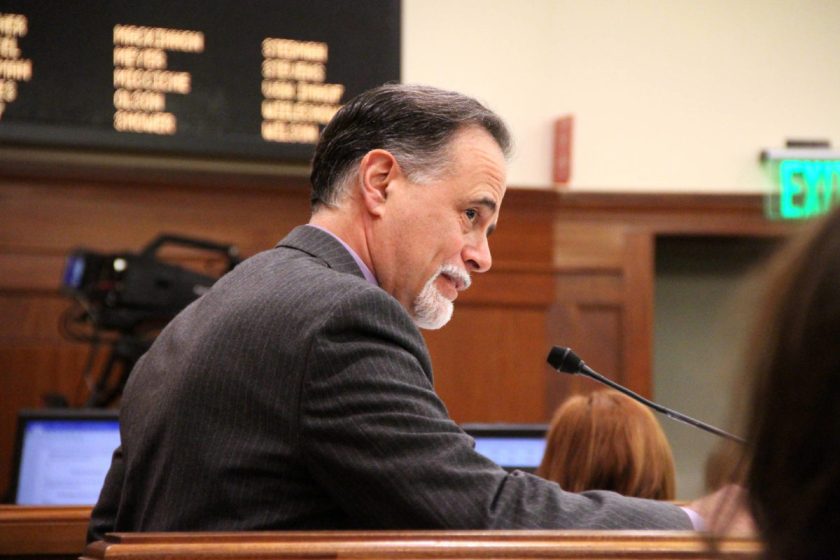
Monday, Sen. Peter Micciche (R-Soldotna) filed SB 12 in an effort to eliminate “Schneider Loopholes” in state criminal code, a press release said.

The early bill-filing came a week before the first session of the Legislature, which begins on Jan. 15.

Micciche’s “Schneider Loopholes” refer to the 2018 case of Justin Schneider, an Anchorage man who served no prison time after strangling a woman unconscious and then masturbating on her.

“Last year, Alaskans were horrified to learn that a guilty violent sexual perpetrator, Justin Schneider, walked without adequate consequences,” Micciche said in the press release.

In September, Schneider was charged with one count of felony kidnapping and three counts of assault, as well as one misdemeanor count of harassment. The case ended with a deal, where Schneider pleaded guilty to one count of second-degree felony assault. Judge Michael Corey sentenced him to two years in prison, with one year suspended, but Schneider was given credit for a year under house arrest. Schneider won’t spend any time in prison.

In his press release, Micciche said the case exposed serious, long-standing shortcomings on how Alaska deals with cases of sexual assault.

“Serious crimes were ignored and an inappropriate plea deal allowed the perpetrator to serve a portion of the sentence of the single conviction at home with his family,” Micciche said in the press release. “In a state number one in the U.S. for sexual assault, we are making the statement that there will be no more free passes for perpetrators of such crimes.”

The bill seeks to improve sexual assault laws by classifying unwanted contact with semen as a sex crime, which would require perpetrators to register as sex offenders for the crime. The bill would require that strangulation to the point of unconsciousness is defined as assault in the first degree, carrying a sentence between five and 20 years in prison. The bill would also eliminate credit toward time served for electronic monitoring for sexual assault convictions.

“SB 12 will clarify for the judicial system that Alaskans stand with victims, expect progress toward a significant reduction of violent sexual assaults in our communities and those violent sexual criminals will be held accountable,” Micciche said in the press release.

The legislative session begins Jan. 15.6080198_web1_180427Micciche-1200x800.jpg

Local Boundary Commission working with Soldotna in annexation efforts

Alaska, News, Uncategorized

Originally published in the Peninsula Clarion

The Alaska State Local Boundary Commission released their 2018 annual report for the upcoming state legislative session, which reviews the Local Boundary Commission’s activities in 2018.

While no local boundaries changed in 2018, several areas across Alaska are seeking to modify or create new borders, including Nikiski, Girdwood and Soldotna.

In June 2018, the Soldotna City Council passed a resolution to start drafting a petition to annex select areas adjacent to city limits, including a 0.6-square-mile area along Kalifornsky Beach Road.

The report said, “Local Boundary Commission staff provided information and documentation to city staff engaged in drafting the petition.”

The report said staff at the Local Boundary Commission has not been informed when the draft petition will be completed.

John Czarnezki, director of economic development and planning for the city of Soldotna, said the city is still working on developing the petition.

Once the draft is complete it will be presented to the Soldotna City Council. Then, if it’s approved, it will be sent to the Local Boundary Commission for consideration.

If the petition is submitted to the Local Boundary Commission, members of the public will be welcomed for public comment. If the Local Boundary Commission approves the city’s petition, the decision to annex will be in the hands of state lawmakers at the following legislative session.

State law allows municipalities to expand their boundaries through the legislative review process or through voter approval. The legislative process requires municipalities to send a petition to the Local Boundary Commission, and from there the Local Boundary Commission may present proposed changes to the legislature during the first 10 days of any regular session. Unless the recommendation is denied, any changes will be approved 45 days after the initial presentation or at the end of the session, whichever comes first.

In 2014, the city of Soldotna began gathering information about changing its boundaries through the legislative process.

In the summer of 2018, the Soldotna City Council voted to draft a petition for the annexation of seven areas surrounding Soldotna. The draft would need to be approved before being sent to the Local Boundary Commission — a process that would not allow residents to vote on the issue.

In September, the Kenai Peninsula Borough passed a resolution opposing the city of Soldotna’s plan to annex surrounding areas without giving residents the ability to vote on the issue.

Former Kenai Lowe’s building sold to U-Haul

Alaska, Uncategorized

Originally published in the Peninsula Clarion

The Kenai warehouse space and former home of Lowe’s Home Improvement has been sold, Fred Braun of Jack White Realty said.

Braun, the main broker for Jack White Realty, said the new owner, U-Haul, gets the keys to the warehouse space Monday.

Braun said he didn’t know what U-Haul planned to do with the building at this time.

The building, located on Marathon Road near WalMart, has been sitting vacant for about eight years since it was last occupied by Lowe’s. In 2008, Lowe’s built the building, but shut its doors in 2011 because the store wasn’t meeting sales expectations, according to the Associated Press.

The warehouse has 111,348-square-feet with an additional 26,568-square-feet of covered-garden center space, according to information on a brochure for the space.

The brochure lists the property at $4.2 million.6078773_web1_66290-1200x800.jpg

Out of the Office: Get outside 2019

Alaska, Uncategorized

Originally published in the Peninsula Clarion

Last New Year’s Eve I was at the same event I was for the two previous New Year’s. I rang in 2018 in a duplex on Anchorage’s Southside where my boyfriend, his roommates, new friends and old friends from high school gathered to drink boxed wine and beer.

This year, my boyfriend and I sat by the wood stove watching “Bob’s Burgers,” and after drinking half a beer, I found myself under my comforter, with the lights off, before 9 p.m. It was a great New Year’s.

New Year’s is anticlimactic. Jan. 1 was just another Tuesday for me.

I’ve never been one to make New Year’s resolutions. I think we have just as valid of an opportunity to set goals for ourselves and make positive changes in our lives any time of the year.

However, this winter season has me extremely goal-oriented for some reason. Maybe now that I’ve graduated college, I am overwhelmed by the world’s possibilities, or maybe I’m less distracted in life because I can’t get internet at my new house.

Before heading to bed early on New Year’s Eve, I was reminiscing with friends over text about the New Year’s Eve of 2013. A group of friends and I took off to Hawaii for a month. Most of the trip was spent at the condo of my friend Kate’s aunt, but for New Year’s we rented a house through Airbnb on the other side of the island.6077526_web1_49759028_223069761905824_2098114399091818496_n.jpg

The house had limited internet, was walking distance away from a black-sand beach, and had a big outdoor garden with citrus trees, several hammocks and a ladder to a flat roof where we laid and watched the stars every evening. It was a magical space.

The night of New Year’s Eve, we made tacos, popped a bottle of champagne and went around the table diving deep into what made us happy in 2013, and what we wanted to improve in the new year. I told my friends I would travel more in 2014. It was the first time I made a real, conscious New Year’s resolution.

Since I told my friends I would travel more, I had to follow through. In 2014, I was living in a small, dry cabin on 40 acres of birch forest in Fairbanks while I was working for the Alaska Railroad. The six months of isolation I experienced sent me on a journey that started with dropping out of college and ended with me getting on a plane to the Philippines. I needed a change of scenery.

I saved all of my summer earnings and traveled for three months by myself down the West Coast of the United States, couch surfing with family and old friends. Once in Los Angeles, I flew over to Japan and the Philippines, stopping in South Korea and Hong Kong. It was my first time leaving North America. I didn’t set out on a soul-searching adventure, but it inevitably turned into that.

I haven’t set a New Year’s goal since 2013. Despite this, I met goals in 2018 I’ve been working toward for years, like getting a full-time reporter job at a daily newspaper, becoming a business owner and finally graduating from college. These accomplishments are propelling me into 2019.

This New Year’s, I’m making some goals for myself, call them resolutions if you wish. I want to read more books. I hope to cook more, which is something I’ve been doing a lot more of since moving from Anchorage to Kenai this year. Most importantly, though, I want to embrace my new home this new year.

Since moving to Kenai, I’ve taken advantage of our newfound solitude. It’s nice to live in a place where we only have one real neighbor and seeing the aurora borealis doesn’t require a drive to Flattop Mountain where the light pollution is minimal. On clear nights the aurora shines right through our bedroom window.

When I got my job at the Clarion, I was excited to move back to the peninsula, a place associated with happy childhood memories of playing through tall stalks of fireweed, beachcombing at Captain Cook State Recreation Area and swimming in Salamatof Lake near my parents’ Nikiski home. However, as a newfound adult, summer days of no responsibility are long gone, even on the peninsula.

Living here these last eight months or so has been difficult. I miss my friends and family in Anchorage. It was almost too easy to spend time with the people I loved. A simple text or call, and within minutes I could find myself at a brewery with friends or making dinner in the kitchen of a family member’s home. I’ve been lucky to make great friends on the peninsula, but it’s not so easy to meet up when we’re spread across cities and schedules are hectic.

Despite living with my boyfriend and our dog, I feel like I’m alone in that Fairbanks cabin again. Some days are better than others, and some days have me searching for the cheapest flight out of here. Every day things get easier because they become more normal. I am finding joy in the peninsula’s outdoor spaces, which are more abundant and more accessible than my Anchorage neighborhood of Spenard. I brought out my old high school cross-country skis in hopes fluffy snow will return so I can explore a trail I found by my house.

Embracing my new home will come when I embrace the quality of alone time, which is probably best spent exploring the outdoors. Get outside 2019.

Ninilchik man competes on Food Network’s ‘Worst Cooks in America’

Alaska, food, Uncategorized

Originally published in the Peninsula Clarion

Ninilchik’s Charles Oakley is one of the Worst Cooks in America. Oakley is the first Alaskan to compete on the Food Network reality TV show, which takes a number of contestants with little skill in the kitchen through a culinary boot camp where they compete to win a cash prize of $25,000 and a Food Network cooking set by presenting the best three-course meal to several food critics.

Oakley’s wife, Melissa, has always had a rule in the house when Charles was cooking: the fire extinguisher must be close by.

“I am the only person in history that has started a gas fire on an electric stove,” Oakley said.

Since competing in season 15 of the Food Network show, Oakley said his wife has loosened the fire extinguisher rule.

While Oakley said he cannot disclose if he won the competition, he said his time on the show exceeded his expectations.

“It was one of the most positive experiences of my life,” Oakley said. “I made friends for life that I talk to on a regular basis. The way I was treated on the show was like family. It was so warm and welcoming.”

Both Oakley and his wife, Melissa, are major fans of Food Network, and it was Melissa who originally suggested that Oakley apply to be on “Worst Cooks in America.”

“She recommended I apply for the safety of our home,” Oakley joked.

Raised on his family’s homestead near Ninilchik, Oakley said his experience with food and cooking was very localized. He said the family rarely traveled to the grocery store, as it was an 80-mile round-trip journey to Soldotna.

“Growing up, we either grew it, hunted it, fished it or raised it,” Oakley said.

Oakley and his family live in Anchorage now, but his dad still maintains the family homestead.

Alaskans may recognize Oakley’s name. He’s a professional artist, with pieces in more than 180 galleries around the state. For those who visit the Alaska State Fair, Oakley is known for his spray-paint art. He said growing up on the Kenai Peninsula has inspired him artistically.

Until competing on the show, Oakley said he never related art and cooking. Now, cooking and art are synonymous.

“Cooking is just like doing artwork — you’ve got processes and materials,” Oakley said. “Once I started thinking of it as art, I (cook) for entertainment now.”

Changing his outlook on the process of cooking was Oakley’s biggest hurdle on the show, he said.

“My biggest challenge was finding the willingness to learn and overcome fears,” Oakley said.

His biggest joy was meeting and working with hosts and chefs, Anne Burrell and Tyler Florence.

“They are two of the finest chefs in America,” Oakley said. “They are artists in their own right.”

Oakley said he’s excited to cook more at home and provide for his family.

“If I have a recipe, I can make anything,” Oakley said. “Sky’s the limit.”

Catch Oakley on Season 15 of “Worst Cooks in America,” which premieres 9 p.m. Eastern time, on Jan. 6 on Food Network.

Addie Camp Train Car Eatery and Wine Bar has grand opening

Alaska, food, Uncategorized

Originally published in the Peninsula Clarion

Soldotna’s newest restaurant, Addie Camp Train Car Eatery and Wine Bar, is having its grand opening today.

Local cookbook author Maya Wilson is the restaurant’s chef. Elements from her popular cookbook, Alaska from Scratch, can be seen throughout the menu, whether it’s the black cod, udon noodle soup or the butterscotch bread pudding.

Wilson said she wanted to develop all-new recipes for the restaurant, but wanted to give a nod to fans of her cookbook.

“There are a couple of familiar things for fans of mine,” Wilson said. “I do adapt them a bit and make them a little chef-ier, a little more upscale from the cookbook, even if they are basically drawn from there.”

For diners who are new to Wilson’s cookbook, signed copies are for sale at the restaurant.

To prepare for the grand opening, the restaurant hosted three soft openings, which Wilson said went great.

“There’s always things that you need to adjust or you discover once you get in the swing of things that aren’t going to work,” Wilson said, “Overall, the reception has been really positive and it’s been very exciting to finally be able to open the doors.”

The menu isn’t set in stone. Wilson said as local food becomes in season and more available, the menu will change to reflect what’s most fresh. Wilson tries to incorporate some element of local food in her menu items, especially the greens and herbs grown in the restaurant’s hydroponic farm, Fresh 365.

“The menu will change seasonally,” Wilson said. “In the summer (local food) will increase because the farms will be open. We’ll also have halibut and salmon and stuff like that.”6076564_web1_49140274_616779722091469_4218080084252164096_n-1200x800.jpg