Back to the roots: A short history of Mountain View

Alaska, News, Print, Uncategorized

Originally published in Mt. View

Michael Dougherty and his family first moved to Mountain View in 1950, when he was only three years old and the city of Anchorage had only two paved streets, one stoplight on Fourth Avenue and a brand new high school: Anchorage High School.

Mountain_View_Anchorage-2-July-1958

“We lived in a small mobile home park in Mountain View,” Dougherty said. “Years later, my wife’s sister bought a house there, and in her backyard was the concrete pad from one of the mobile home sites.”

An appropriate name, Mountain View offers views of the Chugach Mountains. The name was first recorded being used by the Army Map Service in 1941. Homesteaders and construction workers for Elmendorf Air Force Base were the residents of Mountain View in the 1940s.

Consisting of mostly cabins and small houses, the neighborhood was rezoned to allow the construction of multi-family housing in 1965.

The Good Friday Earthquake

As the state population and infrastructure grew rapidly in the 50s and 60s, the Good Friday earthquake brought a brief halt to the development.

When he was 13, Larry Cline’s family home suffered little damage during the 9.2 magnitude earthquake that lasted for nearly five minutes. However, just a block away at a playground behind Mountain View Elementary, the earthquake left a huge crack in the asphalt, Cline said.

“School was out, being Good Friday, and I was home watching TV… Things just started going crazy. The ground was rocking and there was a low roar the whole time. I moved to stand at the front door and my mom stepped outside. She immediately fell on her butt in the snow,” Cline said. “I stayed in the doorway and braced myself.”

Cline said he watched his family’s ‘56 Chevrolet four-door station wagon rocking back and forth until all four wheels were off the ground at the same time.

“It didn’t last but a few minutes, as I recall, but I remember wondering if it was going to go on forever,” Cline said.

From pigs to lions, Mountain View was a wild place

Born and raised on Bragaw Street, Paula Shaw Vincent lived across from what is now the Alaska Native Cultural Charter School in an area that used to be an 80-acre pig farm. The farm was run in Mountain View from 1942 to 1951 by John Vanover, who homesteaded in the area in 1940.

For decades two domesticated lions, Timbo and Princess, also called Mountain View home. They lived in modified trucking trailers that allowed the cats access to views of Mountain View Drive. The trailers were placed between Leon and Lois Brown’s A&W Drive-in and their electric business, Brown’s Electric. Leon — whose late brother George owned the popular Anchorage eatery, The Lucky Wishbone — helped take care of the lions from the late 50s until the late 70s. The lions were then mounted and put on display in Brown’s Electric. After the electric business moved buildings, Leon donated the lions to the Alaska Museum of Science and Nature. There the lions were put on display until moved to storage. The current whereabouts of the lions are unknown. The Alaska Museum could not confirm if the lions were on site.

A diverse history

Today, Mountain View is America’s most diverse neighborhood, according to U.S. Census data research conducted by University of Alaska Anchorage professor Chad Farrell in 2013. The majority of Mountain View’s diverse population came in the late 90s and early 2000s, but since the beginning it was a place for people from all walks of life.

“It was a very diverse neighborhood even back then. Mostly black, white and Native though. Not quite the mix it has now. [There was also] lots of military [people],” said Terri Floyd, who lived in Mountain View from 1956 to 1974. “I think Anchorage as a whole changed a lot with the pipeline. Small neighborhood stores went away, larger grocery stores and malls opening changed the face of Anchorage.”

The neighborhood has seen its fair share of changes since it was annexed to Anchorage in 1954.

Georgiana Criswell Gooch lived in the basement of her church located at 403 N. Hoyt St. At the age of 17, she left home to take a job at Sears in 1970. During this time Gooch lived in a small house across the street from her church.

“It was like a nice urban area where you could see the mountains really well. It was a neighborhood where everyone knew each other, kind of like a small town,” Gooch said.

Gooch left Alaska in 1974 and came back in 2006. Her brother, who lived in Anchorage at the time, told her to stay away from the neighborhood they once called home.

“I was shocked at how small the buildings seemed and how worn down everything had become. The post office was gone. The sports store wasn’t the nice place I recall,” Gooch said. “My brother… got really upset with me when he found out I had driven to Mountain View to look at the old neighborhood. He told me, ‘Don’t ever go back there again. If you must, take someone with a gun. Better yet, just stay away.’ I couldn’t have been more surprised.”

For some, Mountain View has changed for the worse. For others, it hasn’t changed at all.

“Mountain View is not the scary place people think it is,” said Tisha Smith, a current neighborhood resident.

Smith, who grew up in south Mountain View in the 1970s, bought her childhood home from her mother a few years ago. When it was built in 1963, Smith said, her home was part of a pretty nice and new neighborhood, and that pocket of Mountain View has hardly changed at all.

___________________________________

This story appears in the Winter 2018 issue of Mountain View Post magazine: Find copies — including more stories, photos and recipes from Mountain View — at the Mountain View Neighborhood Library and select local businesses.

Meet the teens running a Midtown Anchorage bakery

Alaska, food, News, Print, Uncategorized

Originally published in Anchorage Daily News

When 18-year-old Alisa Louangaphay took ownership of the Midtown Anchorage bakery A Pie Stop in March, she wanted to surround herself with people who were as passionate about baking as she was. So she hired three other teenagers.

“It does sound a bit scary. (But) we aren’t a bunch of delinquents. We all do extracurriculars. We all work hard in school. We all do our best. We try really hard to make sure every customer that leaves here is satisfied,” Louangaphay said.

Newly graduated Lily Rodriguez, 18, and her 16-year-old sister Carolyna are bakers in the shop. Christian Bowers, an 18-year-old senior at Polaris K-12 School, is the bakery’s barista. Louangaphay assists in the baking and, with the help of her grandfather, handles all the business aspects of running A Pie Stop, all while she finishes up her senior year at SAVE High School.


Together, the crew turns out 27 different kinds of pies, plus fruit turnovers, cookies, cinnamon rolls, cheesecakes, brownies, quiches and espresso. Cornish pasties – a hard-to-find meat hand pie – are a popular item, typically selling out around 2 p.m. daily. Gluten-free pies are also available by special order.

Louangaphay may still be a teenager, but she’s been baking for most of her life. She was first introduced to it by her grandfather, Steve Satterlee. When she was very young, she would help him bake at the Chokecherry Inn, a bed-and-breakfast their family owned in Fairbanks.

“She started baking pies with me when she was just 4 years old. She always wanted to help me. That’s all she’s ever wanted to be, is a baker,” Satterlee said.


Louangaphay studied at the King Career Center culinary arts program in 2016. She attended the University of Alaska Anchorage Bakery Boot Camp for several summers in a row and the University of Alaska Fairbanks Business Week, where high-school students learn about entrepreneurship.

Last spring, she spent a semester at A Pie Stop under its previous owners as part of a culinary internship. She had been working there about four months when her grandfather proposed purchasing the bakery for her.

“I was eating (at A Pie Stop) when I overheard a conversation that the shop was for sale. I made the decision to cash out some of my retirement money to make Alisa’s dream come true,” Satterlee said.

Satterlee bought the bakery in March. Both Satterlee and Louangaphay worked for two months with previous owners Dawn Kauffman and Fanny Miller, Amish and Mennonite bakers who taught Louangaphay and Satterlee their recipes. Many of those recipes are still on the menu, including whoopie pies, a traditional Amish dessert. Amish butter shipped from Ohio is also available for purchase at the bakery.

“I’ve always had that dream. I’ve always been set on this path … I wanted to prepare myself for when I got older, for when I actually got to run my dream. I didn’t think it’d happen so soon,” Louangaphay said.

It was through the King Career Center culinary program that Louangaphay met with Bowers and Lily Rodriguez.


“It’s fun working here. It’s a bunch of kids here, so we’re just baking and having fun,” said Rodriguez, who completed a year at the King Career Center culinary program and graduated from Service High School in 2017.

Rodriguez has been the shop’s head baker since August and recruited her younger sister Carolyna, a home-schooled student, to work at A Pie Stop with her in October.

“People are usually surprised to see me working here, like, ‘Wow, I’ve never seen a 16-year-old work at a bakery.’ And yeah, because that really doesn’t happen that much because people don’t want to give them a chance. I got lucky,” Carolyna Rodriguez said.

Carolyna Rodriguez, Louangaphay and Bowers are all receiving school credit for their work in the bakery.

A learning curve

Starting as a new business, Satterlee says they’ve had some stumbles. Whether it’s locking down the perfect recipe for pie crust, removing or adding items to the menu or figuring out how to be efficient during the holiday rush, running the bakery how Louangaphay envisions it has been a learning experience.

“After the previous owners left, business went down. Anytime a business changes ownership, you lose some of those old, loyal customers. We have had to build a new customer base,” said Satterlee, who’s in charge of the bakery’s finances. Before Satterlee retired three years ago, he worked as a purchasing agent for Alyeska Pipeline.


But since then, Satterlee says, they’ve been able to grow their customer base with strategies like radio advertising and contests for free pies.

A recent partnership with The Magpie has also increased business. Since November, The Magpie, which operates a food truck in the summer, has rented kitchen space in A Pie Stop.


Customers can now order breakfast and lunch from The Magpie at the same counter where they get pies and pastries. Plus, Magpie owner, Amanda Cash, is an on-site mentor to the young bakers.

“Amanda is great because, you know, we haven’t been in the culinary field for very long, and if we have any questions about anything we can just ask her,” Carolyna Rodriguez said


In addition to running The Magpie, Cash spent two years as a chef in Denali and served as the executive chef of a restaurant in her home state of Indiana. She also spent several years as a cooking instructor.

Cash has some creative ideas for 2018, including a pie-of-the-month club, creating an area for live music and having pies available to take and bake at home.


As for Louangaphay, once she graduates from high school, she plans to increase her hours and dedicate more of her time to growing her young business.

A Pie Stop

Hours: 8 a.m.-5:30 p.m. Monday-Friday, 10 a.m.-3 p.m. Saturday

Location: 3020 Minnesota Drive, Suite 1

Contact: 907-677-PIES (7437) and apiestop.com

Orphans and canneries: The Spanish flu in Alaska

Alaska, Online, Uncategorized

Historians estimate the Spanish flu killed 50 to 100 million people around the world, roughly 3 to 5 percent of the planet’s population. Per capita, more people died in Alaska, than anywhere else in the world, with the exception of Samoa.

The flu hit Alaska in 1918, but it wasn’t until late 1918 and early 1919 that the pandemic came to Bristol Bay, where it ravaged communities, killing off some villages in their entirety.

“This truly was as close to extinction as people experienced,” Katie Ringsmuth, history professor at the University of Alaska Anchorage and owner of Tundra Vision, a public history consulting business in Alaska, said. “What’s shocking to me is that very few people are talking about this as the anniversary arrives… this was a demographic game-changer. Before there were more native people than neo-Americans. Total annihilation is what this flu represented.”

Ringsmuth, who has been focusing on the history of the Naknek cannery and community has collected documents and records of how the flu affected this small fishing community in Bristol Bay. These documents were collected from the San Francisco-based Alaska Packers Association, who was the largest salmon packer in the state at the time.

Tim Troll, a former resident of Dillingham, used to run the museum there. Troll began to research more about how the flu affected Dillingham and Bristol Bay and was able to hear stories, firsthand, about the canneries role in the pandemic. He describes the Alaska Packers Association as the “Conoco Phillips of the time.”

Ringsmuth describes one story contained in the documents compiled by the Alaska Packers Association:

“The Superintendent of the cannery reports a boat is drifting down the naknek, so he sends out his cannery foreman to go retrieve the boat. And onboard were several people, probably a family, all the adults were dead with the exception of the children. These were the some of the kids they brought to the orphanage,” Ringsmuth said.

There are other stories like this in the documents left by the cannery doctors and nurses. Many children were left without parents, as the Spanish flu most often took the lives of people healthy adults, sparing children and the elderly.

“You tend to think it was the old people, the young the weak, but it didn’t. It killed the 30-year-old’s, the strongest part of the community,” Ringsmuth said.

No one knows how Spanish influenza reached Bristol Bay. Some believe it was brought by ships or by ministers of the Russian Orthodox church.

“This was a worldwide epidemic, and Alaska is always thought of being isolated and out of the way, but not enough to keep this sort of thing out,” Troll said.

At the time, the territorial government of Alaska was overwhelmed with the demand in medical care, and the federal government had exhausted services fighting the pandemic in the Lower 48, and providing for the war effort in World War I.

Bristol Bay’s canneries took the place of government entities and, Rinsgsmuth said, took everyone in and provided medical care to, not only their employees, but to everyone in the villages where they were at. [The canneries] had their doctors and their nurses go into the villages and tend to the sick and bury the dead so they wouldn’t be contagious.

“These canneries had the infrastructure to provide medical care, where the federal and territorial government had absolutely no recourse to deal with this,” Ringsmuth said.

After the flu subsided, the territorial government tried to reimburse the canneries for the services they provided.

“[Alaska Packers Association] went ‘no, no, no,’” Ringsmuth said. “They ended up writing a book about it, which turned into kind of telling the world how awesome they were. They did do something pretty incredible that defies what a lot of people assume, is that they would be uncaring and they only think of money, but the reality is, is that the [Alaska Packers Association] had the hospitals and the infrastructure and they saved a lot of people.”

The canneries also created orphanages for all of the children left behind in the wake of the flu.

“The children left were saved by the canneries. Bristol Bay was repopulated by these kids that were saved,” Troll said.

Ringsmuth saw the Alaska Native adaption after the loss brought with the Spanish flu as a form of strength.

“Instead of laying down and letting the wave of history wash over them, they got up and they adjusted to the systems that were presented to them. I think the Alaska Native people were a lot stronger than our narrative gives them credit for.” Ringsmuth said,” “Not only is it a system of adaptation, but they use that system to empower themselves and lead to nothing else than the Anti-Discrimination Act of 1945, and I see that as a culmination of what happened here.”

What Remains

The canneries provided medical attention for the infected and burials for those who perished with the flu. Due to the high fatality rate, mass graves were made and can be found near infected villages all over Alaska.

“They were overwhelmed, they were digging mass graves, nobody was making coffins or anything like that,” Troll said.

It was mass graves like these that led to the breakthrough report completed in the late 90s that examined the origin and evolution of the viruses genes, suggesting it was mammalian in origin and may have been adapting in humans before 1918.

Ann Reid, micro-biologist and one of the authors of the report, used lung tissue that was taken from the body of a flu victim buried in one of these mass graves, under the permafrost, in Brevig Mission, Alaska.

Reid says that when her partner Johan Hultin was researching burial sites that many of the sites had not remained frozen or had crumbled into the sea. Brevig Mission was the only site that seemed to be intact. She notes that when Hultin first exhumed the victims in 1953, most of the bodies appeared to have been continuously frozen. When he reopened the grave in 1998, there was only one body still in good condition.

“It would seem that the permafrost in Brevig Mission had not remained permanently frozen during the intervening 40 years,” Reid said. “As climate change has affected temperatures in the Arctic more dramatically than anywhere else on Earth, the same is proving true of any other remaining once-permafrost graveyards along the Alaska coast.”

Reid says that the chances are good that if they were doing this project now, they would not have found any still frozen remains.

An anthrax outbreak in Siberia last year killed thousands of reindeer and a couple people in a small village. The anthrax came from infected reindeer that were buried years prior in the permafrost. With the thawing of permafrost in Arctic regions, the reindeer resurfaced and infected the nearby village. This outbreak has raised concerns for people living near the mass graves of the victims of the Spanish flu buried in Alaska’s permafrost.

For villages living in close proximity to these mass graves, Reid says it is extremely unlikely that the virus would be infectious if the bodies were located and exhumed today.

But the viability, or the ability for a virus to cause a disease, is variable, says Reid.

“Some viruses, like smallpox, are large, double-stranded DNA viruses that are relatively stable; that is, they can withstand freezing and thawing and retain their ability to infect cells. Exhuming smallpox victims from permafrost should, therefore, be done with extreme care, or just not done,” Reid said. “Other viruses, and influenza falls into this category, are fragile; influenza is a single-stranded RNA virus and cannot withstand freeze-thaw cycles, sunlight, high humidity etc. Its genetic material is easily damaged and broken into fragments that cannot be reproduced by the host cell.”

As for the outbreak in Siberia, anthrax is a bacterium that have spores that Reid says are extremely resilient.

“Disturbing the bodies of animals that died of [anthrax], or even the surrounding soil, can indeed lead to new infections,” Reid said.

For TNL: Tai Yen Jimmy Kim and the American dream

Alaska, Print, Uncategorized

Originally published in The Northern Light

When Tai Yen Jimmy Kim isn’t at UAA studying for his justice and theater classes, one can find him performing in plays across Anchorage, working at Rustic Goat or at a local open mic rapping about institutionalized racism.

Photo courtesy of Tai Yen Jimmy Kim for The Northern Light

Photo courtesy of Tai Yen Jimmy Kim for The Northern Light

Tai Yen Jimmy Kim is a “dreamer.”

When he was four years old, Kim moved from South Korea to New York. Accompanying Kim was his mother and her family. The family hoped to become citizens with the help of Kim’s grandfather, who had moved to Chicago and became a citizen himself before Kim was born. A petition was put forth by his grandfather to help the family gain citizenship, but unfortunately proved futile for the Kims.

“I can’t help but think if we were able to afford an immigration lawyer in New York years ago, we could be citizens by now,” Kim said.

When Kim was 12 years old, his family moved to Alaska where he’s been ever since. Kim graduated from West High School in Anchorage and now is in his senior year at UAA, where he is double-majoring in theater and justice.

“I spent hundreds of hours participating in the Anchorage Youth Court, a specialized court for minors. That’s when I became interested in law,” Kim said. “I hope to work in rehabilitation rather than become a lawyer. Anchorage is unique in that it has specialized courts for domestic violence, and drug and alcohol abuse, among others. I want to help these individuals reintegrate back into society. I want to find funding for mental health programs for these inmates who need it most.”

Kim is 22 years old and not a U.S. citizen. Kim is protected from deportation and eligible for a work permit because of an Obama-era immigration policy known as Deferred Action for Childhood Arrivals, or DACA. The program has offered protection to nearly 800,000 children who were brought to the U.S. illegally, allowing them to remain in the country without fear of deportation.

Photo courtesy of Tai Yen Jimmy Kim for The Northern Light

Photo courtesy of Tai Yen Jimmy Kim for The Northern Light

DACA recipients must have entered the U.S. before 2007 when they were 16 or younger. The protections of the DACA program are renewable every two years. Earlier this month, the Trump administration announced that they would be rescinding the program, although the future of the program is still up in the air and in the hands of the nation’s lawmakers and politicians.

“Why couldn’t he keep the protections offered by DACA, while pushing Congress to create a more comprehensive bill? It shouldn’t take putting 800,000 young adults in limbo for Congress to do their job,” Kim said. “These immigrants are striving to make this country great. We are hardworking individuals. If you truly believe that we are the reason you can’t get a job, then I can see why you’re unemployed.”

If the Trump administration were to wind-down the program, Kim could be at risk of losing his work permit, or may even be deported back to South Korea.

“I am not worried about deportation. I built an extensive network of kind, intelligent people here. They wouldn’t let that happen. Also, Trump and Homeland Security are a long way from deporting over 800,000 DACA recipients,” Kim said. “I am worried, however, about my ability to work legally and receive scholarship funds for graduate school down the line. My work permit expires in January.”

Kim’s father stayed behind in South Korea. Due to visa restrictions, Kim has not been able to visit his father in nearly a decade. The two have been able to communicate via text and video chats without costly international fees through an app called Line.

Photo courtesy of Tai Yen Jimmy Kim for The Northern Light

Photo courtesy of Tai Yen Jimmy Kim for The Northern Light

“We thought we would be able to visit Korea regularly, but that’s not how it played out… He pays for my college tuition, and I’m incredibly grateful for that. I’m proud of him and worried about him. He works hard for a family he can’t be with,” Kim said.

If Kim traveled to South Korea to visit his father, he would not be allowed re-entry into the U.S.

Kim with his mom and dad in South Korea. Kim has not seen his father in over a decade. Photo courtesy Tai Yen Jimmy Kim.

“My lawyer has informed me that travelling back to Korea would be dangerous, since I wouldn’t be allowed re-entry into the U.S., something my USCIS [United States Citizenship and Immigration Services] issued work permit makes abundantly clear on the bottom front of the card, ‘NOT VALID FOR REENTRY TO U.S.’” Kim said.

Besides his father, the only other connection Kim has to South Korea is the language. Practicing with his mom at home, Kim is able to keep a basic retention of the language.

“It is the only time I get any practice. I can’t speak it at an intellectual level. I won’t be conducting any literary analyses in Korean anytime soon. However, I can keep a conversation for the most part,” Kim said.

One of Kim’s hobbies is rap. He’s had the pleasure of collaborating with friends at open mics and has even rapped on stage with Inspectah Deck, something Kim has said he is very proud of. Although Kim hasn’t rapped about the DACA policy yet, he hopes to write a rap as well as a play about his experiences as a young American immigrant.

For Cruise Critic: Two Days in Anchorage Pre- or Post-Cruise

Alaska, Online, Uncategorized

Originally published on Cruise Critic

People flock to the 49th State to see glaciers, mountains, wildlife and to experience a true last frontier. Trips to Alaska, including cruises, often begin or end in Alaska’s largest city, Anchorage. Home to more than 350,000 people, Anchorage is a sprawling metropolis cradled by the Chugach Mountains and the Cook Inlet. Don’t be fooled by the high-rises and department stores, exploring Anchorage is an Alaskan adventure itself.

Locals like to joke that there’s two seasons in Alaska, winter and construction season. During the short but intense summer season, Alaskans come out of hibernation to enjoy the best of the midnight sun. Explore downtown Anchorage and beyond without having to worry about public transportation or renting a car. Downtown is very walkable and each city block holds a part of Anchorage history all its own. Those wanting to go beyond the borders of downtown Anchorage can find reliable transportation with taxis, Uber and Lyft. The historic Alaska Railroad provides day trips from Anchorage that follow the same tracks as they did in 1914, when the railroad was quite literally building the state of Alaska. Traveling like a local is also a possibility. Air travel is very important in Alaska because only 25 percent of the state is accessible by the road system. One in every 92 people in Alaska has their pilot’s license, which is six times the national average. Depart from Anchorage’s Lake Hood (near the international airport), the largest seaplane base in the world, to get a view from above in a small aircraft.

DAY 1: Downtown Anchorage on Foot

Explore historic downtown Anchorage through food, museums and strolls through shops and art galleries that display Alaska’s diverse influences. Anchorage’s downtown is rather small compared to most American cities, rendering it very walkable and easy to navigate. Chances are, you might stumble upon live music, pop-up festivals and other surprise entertainment from buskers along the street.

Breakfast/Brunch

Casual diners can get an excellent breakfast or brunch at Snow City Cafe (1034 W. Fourth Avenue). Diner food with an Alaskan spin, Snow City Cafe has some of the city’s best pancakes and eggs Benedict. Get your eggs Benny Alaskan-style over a king crabcake or salmon cake. While waiting for a table you can order a coffee or espresso drink that will come in a one-of-a-kind mug. (Open Monday through Friday, 6:30 a.m. to 3 p.m.; Saturday and Sunday, 6:30 a.m. to 4 p.m.)

Red Chair Cafe (337 E. Fourth Avenue) offers creative and delicious morning fare that you’re not likely to find at any other restaurant (try “SteamPunk” potatoes or a beer biscuit with your breakfast). Sit down to dig in or grab something to go from the ever-changing espresso bar where head baker, Barb, is turning out homemade muffins, scones, cookies and other delectables. Much less crowded than Snow City Cafe, Red Chair Cafe is a local favorite. Lemon poppy seed pancakes and excellent coffee keep Anchorageites coming in all year round. (Open Tuesday through Sunday, 7 a.m. to 3 p.m.)

Morning

Art-, history- and science-lovers unite under the roof of the newly renovated Anchorage Museum (625 C Street). Great for all ages, the museum has an Imaginarium where kids can learn all about Alaska’s natural phenomena with the help of interactive exhibits. Peruse hallways full of art by Alaskan artists old and new and learn about Alaska’s earliest inhabitants, settlers and pioneers. (Open daily, 9 a.m. to 6 p.m.)

Enjoy views of Cook Inlet from the Tony Knowles Coastal Trail, an 11-mile paved path that lines the majority of Anchorage’s coast. The trail starts at Second Avenue and goes to Kincaid Park, with the north terminus at W. Second Avenue and H Street. There are plenty of places to enter and exit the trail throughout, and it’s perfect for either a leisurely morning jaunt or a run. For more exploration on the Tony Knowles Coastal Trail, rent a bike from Pablo’s Bicycle Rentals (415 L Street). From tandem bikes to kids’ bikes to bike trailers, Pablo’s can accommodate any coastal trail bike adventure. (Open daily, 8 a.m. to 8 p.m.)

If the season is right and the fish are running, try a late morning or early afternoon of salmon fishing in Ship Creek. Typically, the season for the salmon run is late May and goes until early August, but check with a guide once you get here. Bait Shack at Ship Creek (212 W. Whitney Road) can provide fishing gear rentals, bait, tackle, licenses, processing and vacuum packing — everything you need to catch a king.Open daily, 10 a.m. to 8 p.m.)

Lunch

For a midday meal, stop by one of Anchorage’s many hot dog stands. These stands dot nearly every corner of downtown Anchorage and specialize in the reindeer sausage hot dog. Reindeer meat is a must-try Alaskan food. If it’s not for you, most stands offer beef, Polish and veggie-style sausages as well.

Not all stands are created equal and many include special homemade sauces to entice passersby. Consider b (415 L Street), a new addition to the downtown Anchorage hot dog scene, but a longtime favorite among locals who frequented the stand when it was located in midtown. The stand features many different types of sausages and various add-ons, like caramelized onions, cilantro fries, chipotle sauce and homemade aioli sauces. (Open Monday through Saturday, 10 a.m. to 8 p.m.)

Anchorage’s diversity is showcased at Alaska Reindeer Dog (on the corner of F Street and Fourth Avenue) where East meets West with classic and exotic Asian spins on the reindeer hot dog. This stand offers specialty dogs like the bacon-wrapped dog, and the Korean-inspired bulgogi dogs and kimchi dogs. (This stand runs on its own hours, but you can expect it to be open just about every day from 11 a.m. until the early evening.)

Journey to the east side of downtown to visit a true gem of Old Anchorage. The Lucky Wishbone (1033 E. Fifth Avenue) has been serving American classics like fried chicken, burgers and handmade milkshakes since 1955. The food is tasty and the longtime employees give solid service. The atmosphere is quintessentially Alaskan with pilot paraphernalia covering the walls to celebrate the owner’s (and Alaska’s) love of flying. (Open Monday through Thursday, 10 a.m. to 10 p.m.; Friday and Saturday, 10 a.m. to 11 p.m.)

Afternoon

Journey a little farther after lunch. Take one of the complimentary scheduled shuttles from downtown to the Alaska Native Heritage Center (8800 Heritage Center Drive). The shuttles leave from four scheduled stops in downtown Anchorage. (A timetable with shuttle schedules and stops can be found on the center’s website.) Learn from Alaska Natives about the indigenous people who have called this great land home for thousands of years. Watch traditional dance performances, marvel at demonstrations of Native Games — a true test of strength and agility — and walk through life-size dwellings modeled after six unique native Alaskan groups to get a sense of how these people lived life in the unforgiving Alaskan wilderness. (Open daily, 9 a.m. to 5 p.m.)

Visit Alaska Experience Theatre (333 W. Fourth Avenue) to learn about the state’s turbulent past. The theater is also a history museum, so as you wait for your movie to start, peruse pictures, watch a real seismograph fluctuate and learn about the 1964 earthquake. A 9.2 on the Richter scale, the largest earthquake in North America and the second-largest earthquake ever recorded in world history, lasted over four-and-a-half minutes. Watch the “1964 Earthquake Experience” film to get a more visual idea of the event that shook the state. During climatic parts of the film, the floor of the theater will literally shake beneath you, giving you the feeling of being there during the earthquake. Other films the theater offers include “Journey to Alaska/Northern Lights Adventure,” “Epic Aurora” and “Alaska’s Mind Blowing Aurora.” (Open daily, 9 a.m. to 4 p.m. Check website for movie times.)

Drinks

Feel like a local at F Street Station (325 F Street). Sip on margarita-filled mason jars as you take in the aviation memorabilia surrounding the bar’s interior. Order the best calamari in town here as a late-night snack. (Open every day, 10 a.m. to 1 a.m.)

For a more classy drinking experience, get yourself to speakeasy Blues Central (609 F Street). Getting into the bar is half the fun — Blues Central is on the second floor of Williwaw Social, another popular bar in town. Those wanting to visit Blues Central will have to find the phone booth in Williwaw, pick up the phone and get the password, then walk upstairs, knock on the door and enter the not-so-secret watering hole. Homemade bitters, simple syrups, top-shelf booze and a craft cocktail menu unlike any other makes Blues Central a hit. The Smokey Oso drink, made with spiced pepper syrup, chocolate bitters and loose leaf tea that’s smoked right in front of you, is a guaranteed crowd-pleaser. Black-and-white photos line the walls to pay homage to the original Blues Central of Anchorage, an iconic spot for many years that shut its doors in 2014. (Open Tuesday through Thursday and Saturday, 5 p.m. to midnight; Friday until 12:30 a.m.)

Dinner

After exploring all afternoon, you’ve worked up an Alaska-sized appetite. Stop by Haute Quarter Grill (525 W. Fourth Avenue) to enjoy excellent drinks and fine dining. There’s an extensive wine and beer selection along with plenty of options for fresh seafood, although the gnocchi is a local favorite. Make sure to ask for their specials, as the chef likes to feature seasonal dishes. The location along the main part of Fourth Avenue is convenient for those browsing shops and galleries. (Open Tuesday through Thursday, 4:30 to 9:30 p.m.; Friday and Saturday, 4:30 to 10:30 p.m.)

Make your way to Simon and Seaforts (420 L Street) for a table with a view of Cook Inlet. One of the best places in Anchorage to get seafood, Simon’s has been voted best seafood restaurant in Anchorage as well as restaurant with the friendliest staff. Order the crab and macadamia nut-stuffed halibut for an island twist on the catch of the day, and don’t forget the Key lime pie. (Open for dinner Monday through Thursday, 5 to 9 p.m.; Friday and Saturday from 4:30 to 10 p.m.; and Sunday from 4:30 to 9 p.m.)

For something a little more casual, visit 49th State Brewery (717 W. Third Avenue). Enjoy house-brewed, award-winning beer alongside food that is inspired by Alaska. Many of the restaurant’s menu options feature regional ingredients such as fireweed honey, yak and Yukon Gold potatoes, to name a few. (Open for dinner Tuesday through Saturday, 4 to 11 p.m.; Sunday and Monday, 4 p.m. to 1 a.m.)

Evening

If you saved room for dessert, and you definitely should, visit Wild Scoops (429 E Street). Alaskans eat the most ice cream per capita than anywhere in the United States and one should follow suit while traveling here. Don’t let a line out the door deter you from their mouthwatering homemade ice cream featuring uniquely Alaskan ingredients. Spruce tip and rhubarb crunch are among their best summer flavors. (Open Tuesday through Sunday, noon to 10 p.m.)

Use the rest of the evening as an opportunity to learn more about Anchorage’s darker past. Ghost Tours of Anchorage (tour begins on the corner of Fourth Avenue and L Street) is a guided walk through downtown. Your guide, Rick Goodfellow, is a longtime Alaskan who has gathered stories full of history and mystery. The goal is not to scare or sway people into believing in the paranormal, but rather to teach about Anchorage’s history through spooky tales of both fact and the far-fetched. (Tours operate Tuesday through Sunday at 7:30 p.m., and cost $15. Reservations not necessary.)

DAY 2: Channeling Chugach

Take a day to explore Anchorage’s backyard: Chugach State Park and Chugach National Forest. Most of today’s activities occupy the morning and afternoon, and some constitute a whole day trip. Places to eat include downtown Anchorage, where you can dine before and after your escapades, alongside restaurants that are part of the adventure, further from downtown. Plan accordingly.

Breakfast/Brunch

Build your strength for your day’s adventure at Dark Horse Coffee (646 F Street). This intimately sized cafe in downtown Anchorage serves Heritage coffee, Alaska’s oldest coffee roasting company, from Juneau. In addition to coffee, Dark Horse offers fresh fruit smoothies, pastries, acai berry and fruit bowls, and housemade quiches. It’s a great spot for health-conscious eaters or those looking for a quick and tasty bite. (Open Monday through Friday, 6:45 a.m. to 6 p.m.; Saturday, 8 a.m. to 4 p.m.; and Sunday, 9 a.m. to 2 p.m.)

Morning

Bring your city experience to new heights. Take the Flattop Mountain Shuttle (333 W. Fourth Avenue) to Flattop Mountain, Anchorage’s most popular hiking trail. The shuttle leaves from downtown in the afternoon and will drop you off at the Glen Alps trailhead where you can take off on multiple hikes of various degrees of difficulty. Or just walk around the trailhead where there are plenty of places to sit and enjoy the views from Anchorage’s hillside. A short and paved path affords tremendous views of Anchorage and beyond for visitors who need wheelchair access. The shuttle stays parked at the trailhead for a few hours before bringing visitors back to downtown. ($23 round trip; check the Flattop Shuttle’s website for more details on schedules and group prices.)

Rainy day and you’re not up for a hike? If you’re not already traveling by train as part of a cruisetour, book a day trip on the historic and scenic Alaska Railroad (800-544-0552, 411 W. First Avenue). Take the Glacier Discovery train to Spencer Glacier or stay onboard for a scenic ride through a remote mountain pass to Grandview. At Spencer Glacier you can hop off the train and take a guided stroll with a National Forest ranger who will teach you all about the vegetation, history and geology of the area you are traveling through. For those eager to see the glacier, it is perfectly safe to venture on your own ahead of the ranger and walk down the path leading to the lake. It is roughly 1 mile from where the train drops you off at the whistle-stop to the shore of the lake where the massive Spencer Glacier sits. The trail is gravel and remains flat the whole way through, manageable for those who might need a little extra time to get from point A to point B.

Optional excursions around the glacier are offered through the Alaska Railroad’s reservation service. There’s a small cafe onboard where passengers can buy sandwiches, snacks, alcoholic drinks, local beer and other refreshments, but it’s also acceptable to bring your own food onboard. The Glacier Discovery train and all of its optional excursions can be found and booked on the Alaska Railroad’s website, over the phone or in person at the depot. The Glacier Discovery train leaves from the downtown Anchorage depot at 9:45 a.m. and arrives back in Anchorage at 9:15 p.m. However, for no additional cost, you can arrange with the reservations agent at the Alaska Railroad to get off in Portage and take a motor coach back to Anchorage so you will arrive back at the depot around 6:30 p.m. instead — just in time for dinner.

Lunch

If you are in downtown Anchorage around lunchtime, visit another Alaskan institution (like Lucky Wishbone). The White Spot (109 W. Fourth Avenue) has been turning out their famous burgers and fried halibut since 1946. A true hole-in-the-wall, this is a genuine place for a casual lunch. Finish your meal with their signature blueberry pie in a jar — perfect for a single serving. (Open Monday through Wednesday, 7 a.m. to 3 p.m.; Thursday through Saturday, 7 a.m. to 8 p.m.; closed on Sundays.)

Afternoon

If you have time to spare this afternoon, visit one of the oldest homes in Anchorage. Built in 1915, the Oscar Anderson House Museum (420 M Street) stands an example of how Anchorage’s first residents lived. According to his own account, Oscar Anderson was the 18th person to arrive in the “Tent City” in 1915. The early homesteader made many contributions to the young city of Anchorage, which include investing and leading business in meat-packing, coal production, transportation and the newspaper-publishing industry. Anderson’s widow, Elizabeth Anderson, donated the house to the municipality in 1976, and two years later it was listed on the National Register of Historic Places. Since then, the house has been restored and turned into a museum. Walk-ins are welcome to tour the house Tuesdays through Sundays from noon to 4 p.m. Appointments must be made if you wish to tour the house on Fridays. (Email oscar.anderson.house.museum@gmail.com for appointments.)

Drinks

Grab some local beer at Humpy’s Great Alaskan Alehouse (610 W. Sixth Avenue). Nearly 25 years old, Humpy’s is home to one of Alaska’s largest assortments of beer on tap. As you sip on local saison and snack on king crab nuggets, enjoy people-watching and even some live music if you’re there on the weekends or in the evening. (The bar is open Monday through Thursday, 11 a.m. to 2 a.m.; Friday, 11 a.m. to 2:30 a.m.; Saturday, 10 a.m. to 2:30 a.m.; and Sunday, 10 a.m. to 2 a.m.)

Dinner

Coming back into Anchorage after a long day of exploring? Big adventures deserve a big, rewarding dinner. Treat yourself with a truly Anchorage pizza experience: Moose’s Tooth (3300 Old Seward Highway) is one of the highest-grossing single unit pizzerias in the nation — and for good reason. The restaurant serves a delicious array of unique specialty pizzas like their Spicy Thai pizza, which features roasted chicken, red onions, Alaska-grown bean sprouts, cilantro, mozzarella, provolone and peanut sauce; and their Amazing Apricot pizza, which comes with blackened chicken, cream cheese, apricot sauce, cilantro, mozzarella and provolone. A great selection of tasty salads and beer brewed from their own brewery is also available. It’s important to note that this restaurant is not located in downtown Anchorage; about a 10-minute drive will be necessary if coming from downtown. (Open Monday through Friday, 10:30 a.m. to midnight; Saturday and Sunday, 11 a.m. to midnight.)

Evening

Anchorage is teeming with talented artists. Stumble upon homegrown music almost any night of the week at venues like Williwaw Social (609 F Street), Bernie’s Bungalow (626 D Street) and Alaska Center for the Performing Arts (621 W. Sixth Avenue). If you’re looking to catch a great local band, keep your eyes out for folk-rock group Blackwater Railroad Company, or the Polynesian reggae band H3. Find them on Facebook for updated tour schedules.

If you happen to be in Anchorage on the first Friday of the month, take the opportunity to wander through downtown for its First Friday event and peek in at all the shops, cafes and, of course, the museum, which is the cornerstone of the program. On these days, artists and businesses collaborate to showcase the work of local artists, whether it’s music, painting, photography or native jewelry-making. Time and places vary, but events are typically in the evening and sprinkled throughout downtown.

For Last Frontier Magazine: Spenard: Then and Now

Alaska, Print, Spenard, Uncategorized

Originally published in Last Frontier Magazine

How Anchorage’s disreputable playground became a hub for hipsters and artists.

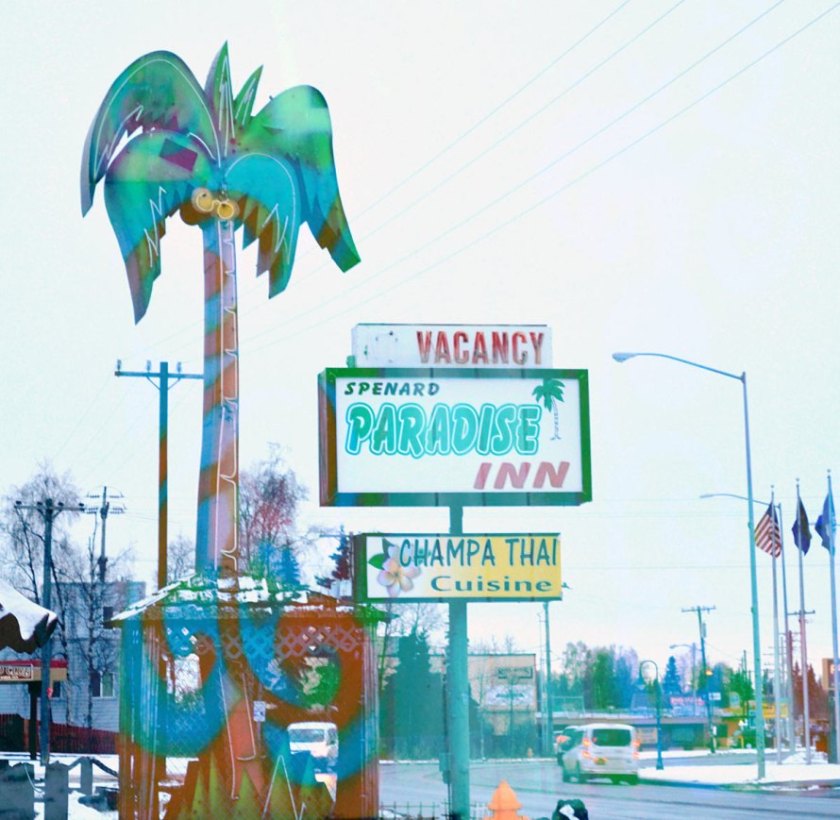
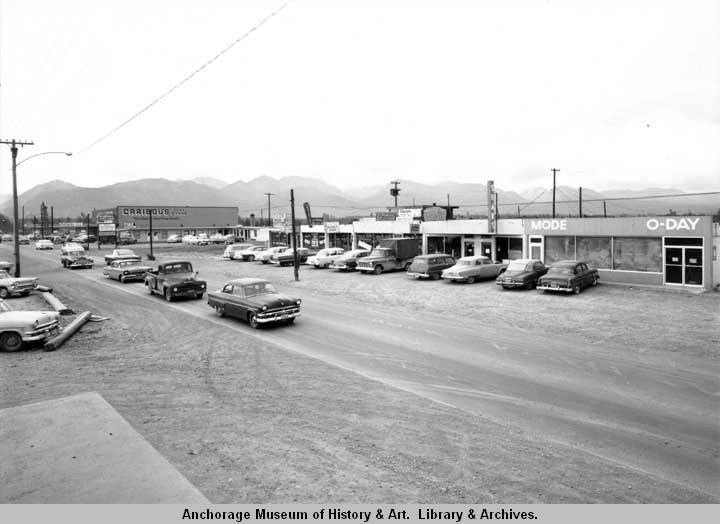
Between Downtown, Midtown and Turnagain, the Spenard neighborhood is and has 
always been a unique part of Anchorage, built for the people.

THEN
Joe Spenard, a Canadian-born entrepreneur, came to Alaska in 1910. Originally looking to get into the railroad business, Spenard found himself in Anchorage in 1916 with a truck from the REO Motor Car Company and a 1915 Ford Model T, which served as the city’s first automobiles. Using his Ford Model T, Spenard started up the city’s first taxicab service. Dressed head to toe in a bright yellow suit and top hat to match, Spenard drew in customers with his flamboyance. He titled his hauling service “City Express,” complete with a catchy slogan, “Time and tide will not wait, but City Express is never late!”

Legend has it that Spenard Road, an unusually curvy road, was paved over the paths of drunken railroad workers stumbling back to camp after a night of debauchery in Spenard. In fact, from the edge of Anchorage, Ninth Avenue and L Street, Spenard created a primitive road to his 160 acre homestead. This dirt path is Spenard Road today.

Just like any boom-town, Spenard became a haven for bars, drugs and prostitution.

Spenard, a sourdough Gatsby of sorts, built a large dance hall in 1916 on the shores of Lake Jeter, which he later named Lake Spenard, as a form of self-promotion. The dance hall and the lake became a recreational hot spot for Anchorage’s early residents. The dance hall and the homestead were sitting on what was then part of the Chugach National Forest. Before the federal government could get after Spenard, the pavilion burned down in 1917. Spenard left shortly after for California where he died in 1934.

As Anchorage grew, Spenard road offered Anchorage residents a way to move out of the city limits, but still have the convenience of jobs, schools and shops in downtown. In 1950, the population of Spenard was 2,108, by 1960 the population grew exponentially to 9,074, and then in 1970 the population almost doubled to 18,089, according to the U.S. Census Bureau.

With the rise of industry, particularly with oil, transplants made their way to Spenard. Just like any boom-town, Spenard became a haven for bars, drugs and prostitution.

Working and hanging around in Spenard since the early ‘70s, Mr. Whitekeys has seen the neighborhood scene calm down.

“Spenard was the sleazy part of Anchorage, and Spenard wasn’t very big. In those days things were just entirely different. There were massage parlors everywhere,” Mr. Whitekeys said. “Everybody in town was single, all single construction workers; it was just guys up there trying to take advantage of the booming construction industry. No one ever intended to stay here. They were here to make a quick buck and then go back outside.”

“We’re moving downtown for the first time in 30 years. The problem was that the legislature moved out of their office building downtown to Spenard, and then that made the neighborhood even too sleazy for us, so we decided to move downtown,” joked Mr. Whitekeys.

Sylvia Butcher, a resident of the Spenard neighborhood since the early ‘60s, said, “It wasn’t until the ‘80s with the oil discovery that you would see prostitutes walking Spenard road … quite a great number of them. This end of Spenard wasn’t really sketchy, but the other end was kind of riff-raff with all the massage parlors. [The prostitutes] didn’t bother you very much, you wouldn’t notice them.”

Spenard became famous for crimes of passion; wives killing their husbands became so common that local colloquialism noted the event as a “Spenard divorce.”

“When I first came here I wondered what the Spenard divorce was and then I found out that’s when a woman gets rid of her husband. My father-in-law was an attorney. He mostly was working on the side of the wife and he had acquired all this clothing that had all these bullet holes in them,” Butcher said.

Living in Alaska for over 50 years, Butcher has lived on each side of Spenard, from near the airport to near West Anchorage High School. Currently residing on the West High side, Butcher has seen the neighborhood go from a quiet neighborhood to a full-blown red light district, to the unique neighborhood it is today.

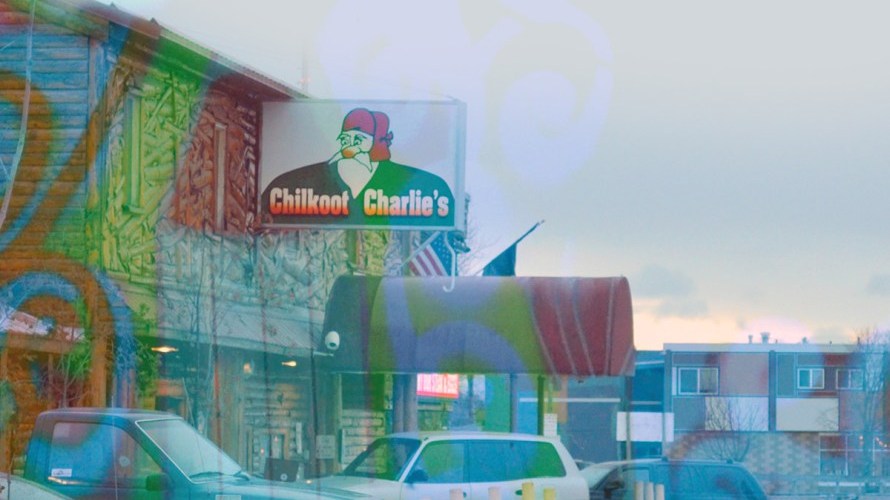
Spenard became a destination with the opening of the world-famous Chilkoot Charlie’s in 1970. People from all around flocked to the Spenard watering-hole.

With close proximity to Anchorage International Airport, Spenard catered to oil men—pockets full of cash, returning from long legs of work in Alaska’s remote regions. This proximity resulted in not only bars and nightclubs, but brothels, gambling centers and other unsavory business ventures.

The city of Spenard became a part of the ever-expanding Anchorage Municipality in 1975. Years later, in the post-pipeline days, the municipality made an effort to rejuvenate the neighborhood—bringing us into the Spenardian Renaissance.

NOW
With boom comes bust and Spenard was no exception. The neighborhood’s bars and nightclubs are still a part of the neighborhood appeal, but while the less-wholesome businesses disappeared or went underground, new businesses made their way into the neighborhood. REI, Alaska Mountaineering and Hiking and numerous bike shops appealed to younger, active crowds. The Denali Theatre became The Bear Tooth Grill, an independent movie theatre with a full service restaurant and bar. A local favorite, the theatre attracted patrons from all over the city to eat gourmet pizza and watch indie films.

web-page-3.jpg

“Bear Tooth has helped make the Spenard area cool. REI helped bring a different kind of people. You saw different things come up with Middle Way [Cafe] and Title Wave [Books] that brought all kinds of different people that didn’t used to be here,” Butcher said.

These days the Hells Angels and Alaskan sourdough types tend to keep quiet, and it consists of mostly hipsters trying their best to gentrify the neighborhood.

The Piggly Wiggly grocery store is gone and divided up into numerous little shops. A used sports equipment store, a popular diner, a soon-to-be marijuana retailer, a yoga studio and a local yarn store/club—the strip mall is as diverse as the neighborhood it inhabits.

Local residents, some with vague memories of Spenard’s past, have observed the neighborhood renaissance in full-force. Whether this is seen as a renaissance or gentrification is up for debate.

web-page-5.jpg

“Some would call it a wretched hive of scum and villainy due to the fact Spenard has always had a rich underbelly of prostitution, crime and drugs. I only caught the tail end of it growing up. These days the Hells Angels and Alaskan sourdough types tend to keep quiet, and it consists of mostly hipsters trying their best to gentrify the neighborhood. Still, at the end of the day Spenard is one of the last bastions of old Alaska, the atmosphere has never left,” Jacob Thompson, a Spenard millennial, said.

The owner and operator of Bella Boutique, Annie Ciszak Pazar, has been working in the neighborhood for nearly ten years. Selling local art and goods out of her boutique, she has seen the neighborhood grow, in a positive way.

web-page-4.jpg

“This section of town is sort of up and coming and I wanted to be a part of the Spenard renaissance and regrowth,” Ciszak Pazar said. “It’s a super diverse neighborhood. It has all sorts of great characters, usually in a good way. It’s one of the only areas in town where you can park your car easily and walk to different things. You can shop, you can eat, and you can see a movie. It’s hard to do that anywhere else in town.”

In October 2016, Buzzfeed named Spenard the most ‘hipster’ neighborhood in the state of Alaska, referencing Black Cup as the place to hang out. Unfortunately, Black Cup is actually in Midtown, but plenty of other things make Spenard hip: the annual Spenard Food Truck Festival, the Spenard Farmer’s Market, the adopted windmill that serves as a beacon to its inhabitants, and the numerous local shops sprinkled around the neighborhood.

“It’s gotten awfully nice and awfully clean in a lot of places, but still it’s sleazier than any other place in Anchorage. It can’t hold a candle to what it used to be,” Mr. Whitekeys said.

Bookstores and art galleries offer venues for local artists to display and sell their work. Unique shops are popping up all around the neighborhood. From Denali Dreams Soap Company, to Dos Manos Art Gallery, to Anchorage House of Hobbies, to the Enlighten Alaska marijuana retail shop—Spenard is specializing.

One notable business that, quite literally, illustrates “out with the old and in with the new” is The Writer’s Block Bookstore and Café. In the summer of 2016, volunteers and artists from around the city and in the neighborhood gutted and cleaned the former “Adults Only,” a porn shop that had existed in the area for decades. The building, which consisted of two trailers pushed together, was occupied by artists for weeks. Local art was put on display for a three day festival and fundraiser, and members of the community were welcomed to walk through. The building sits vacant at the moment, but plans to tear down what many believe to be “the last vestige of old Spenard,” are set to begin in the spring of 2017.

Although his time in Alaska was short-lived, Joe Spenard impacted the neighborhood for generations to come. Whether you consider yourself a hipster or a sourdough, Spenard has something to offer all of us.

Roadside caribou, ramen and wild celery: It’s what’s for dinner

Alaska, food, Online, Uncategorized

Sourcing food, cooking and eating at the end of the Aleutian chain.

Tom Spitner’s dinner plate probably looks like a significantly less elegant dish coming out of the wildly popular Danish restaurant Noma. Fresh fish and foraged flora made the two-michelin star restaurant famous. Spitner has the same idea when he creates meals for his family, but does it virtually for free.

“I like to cook and read about cooking. I like to go out to nice restaurants, I was based in Los Angeles for a long time and I like to cook all kinds of stuff,” Spitner said. “There’s times it would be nice to go to the store and be able to get that stuff, but it makes you be more creative. You read about that Norwegian/Icelandic food craze, that’s just sort of like fish with locally sourced greens. You end up doing things that would probably end up on a restaurant plate for $55 if they knew about it.”

The way people shop, eat and cook here is different than the way of most Americans. Located near the end of the Aleutian chain, 1,200 miles from Anchorage and just over 700 miles from the Russian mainland sits Adak island. There is no real grocery store, no farms and no way off the island five days out of the week. Annual Costco trips stock the pantries of Adak’s residents, while an open year-round hunting season and no bag limit for caribou cows keep their freezers full. Foraged food, CSA boxes coming from thousands of miles away and pet chickens help supply fresh food to some of the island’s residents. Sharing recipes and cuisine is an essential part of the town’s social life and local food economy.

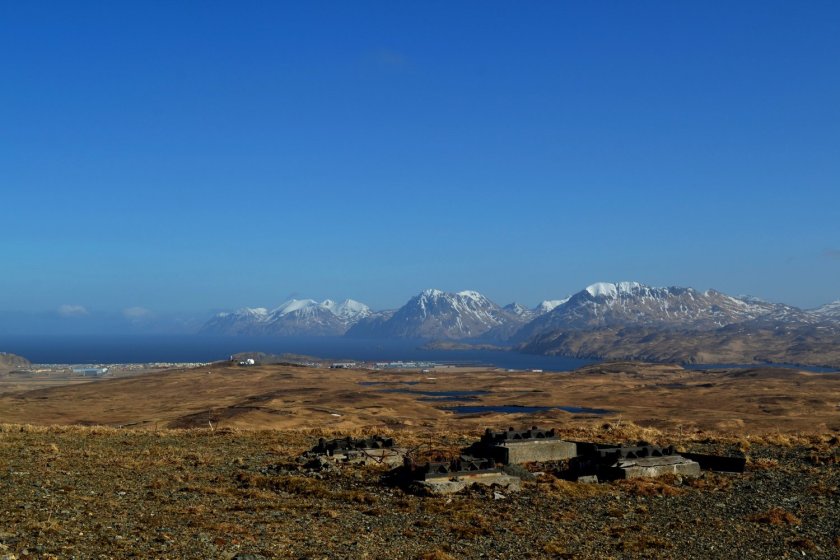
The town of Adak and the Pacific Ocean beyond as seen from White Alice, a Cold War era sattelite site. 

The town of Adak and the Pacific Ocean beyond as seen from White Alice, a Cold War era sattelite site.

The island of Adak was inhabited by the Unanga people, more commonly known as the Aleuts, who abandoned the island around the 19th century to follow the Russian fur trade. The island was still used as an important place to fish for Aleut’s living nearby. After World War II began, American forces created a military base at Adak. Strategically placed, Adak became the American offensive against the Japanese-held Aleutian islands of Attu and Kiska.

Post World War II the island was developed into a Naval air station and a submarine surveillance center during the Cold War. At Adak’s peak, the island was home to over 6,000 military personnel and their families, a college, a McDonald’s, a roller skating rink, a ski lodge and an $18 million hospital was built in 1990. The base was closed in the spring of 1997 for unknown reasons and the island along with its facilities were sold to Aleut Corporation. The hospital, schools, and the island’s restaurants closed along with the Naval base. The city of Adak was incorporated in 2001 and was home to only about 300 residents at the time, according to the U.S. year 2000 census. Today, there’s only around 100 year-round residents.

Spitner, the mayor of Adak and the only person in town who was born on the island, grew up on the island where his dad worked as a contractor at the military base before it ceased operations altogether in 1997. Spitner has no problem cooking for his family. His wife, a biologist, helps track down Adak’s edible bounty. Wild rice, wild celery, bull kelp and strawberries are just some of what Spitner’s family forages from the island. Their family also has a garden that they use to grow apple trees and potatoes in.

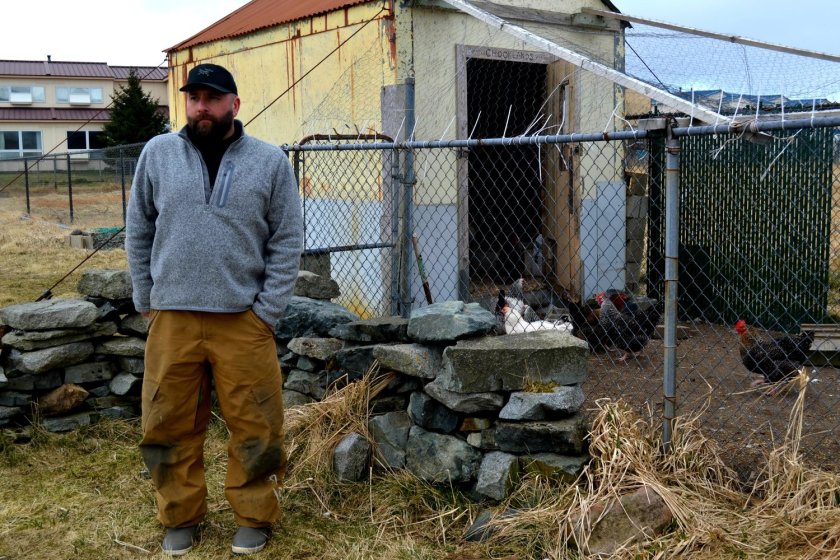
Mayor Tom Spitner with his chickens. 

Mayor Tom Spitner with his chickens.

“It’s nice because we can just go out and about and there’s quite a bit to eat. There’s quite a bit of foraging. I have friends that pickle kelp,” Spitner said. “Our family doesn’t find it hard to eat out here.”

Spitner’s family receives a box from Full Circle every week. The CSA boxes come from an organic farm in North Bend, Washington, nearly 2,500 miles away, to the island every Thursday filled with fresh fruits and vegetables. Prices for these CSA boxes range from $48-$87 a week, depending on the size box you want.

“We are one of two people on the island that get Full Circle. It used to be more, but it is a little expensive. Every week we get our thing on Thursday that’s full of fresh vegetables,” Spitner said. “I’ve probably eaten more kale in the last five years than I ever have before. I’ve grown to really like it.”

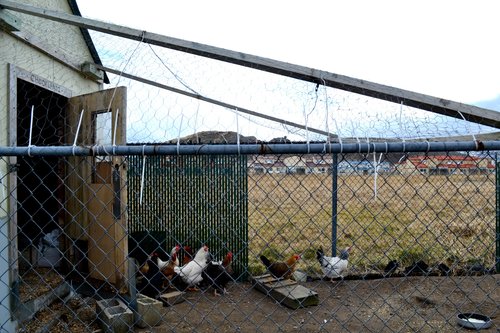
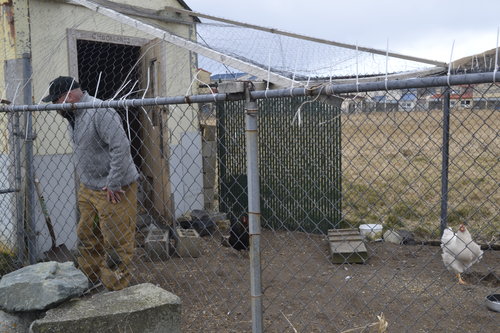
In addition to their garden and foraging, Spitner has a large chicken coop that yields about 8-9 eggs a day. The chickens are a special Icelandic species that are bred to live in a more extreme climate, such as Adak. The chickens came from residents who left the island six years ago, and Spitner’s family has since shared his chickens with the community, helping another family grow their own coop.

“I don’t think there’s a big savings, but you know I’ve got dogs, cats, a rabbit and probably sitting out here with the chickens is my favorite,” Spitner said. “It’s not any harder than having a dog. They need food and a place to run and pee.”

Fresh eggs from Turnbull's chickens.

Fresh eggs from Turnbull’s chickens.

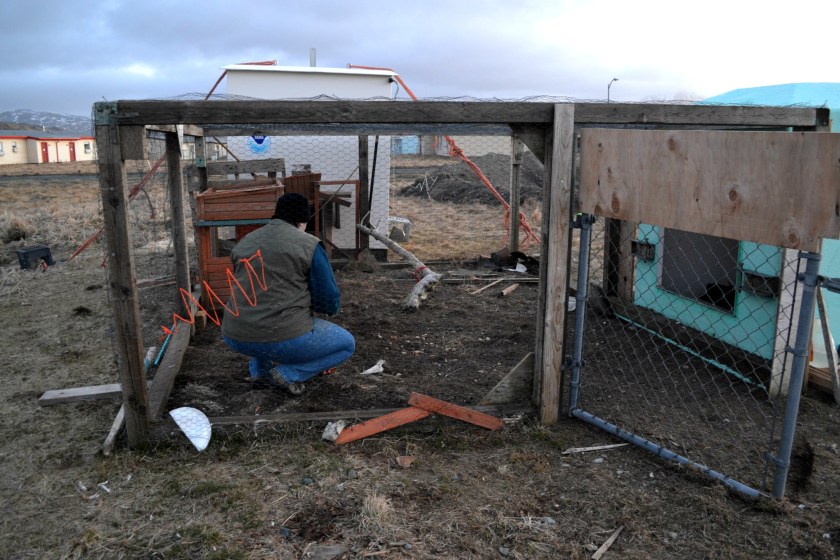
Mik Turnbull, the other Adak resident who has chickens, keeps them in a coop that appears to have been a NOAA scientific research pod of sorts in another life. Turnbull has since recycled this to be her chicken’s home. Arguably the thriftiest woman on the island, Turnbull’s home is filled with furniture, art and equipment that she has pulled from Adak’s abandoned buildings and facilities. Turnbull finds herself “scavenging,” as she calls it, for abandoned things she can find purpose for. Residents have to be creative in all aspects of life, not just in the way they eat.

Today Adak is home to one year-round restaurant, The Blue Bird Cafe. Operating in the home of Michael Rainey and his wife Imelda Cleary, the eatery serves up traditional American fare along with Filipino favorites.

The Blue Bird Cafe.
The Special of the day.

The Special of the day.

Imelda, who is from the Philippines, has introduced her cuisine to the residents of Adak who have fallen in love with her lumpia and pancit dishes, among others. People in the community eat here regularly, sometimes once or twice a week and sometimes for every single meal.

The interior of the Blue Bird Cafe.

The interior of the Blue Bird Cafe.

Imelda isn’t the only person on the island who has had the opportunity to share her culture’s cuisine with the community. Krystle Penitani shares traditional Samoan food with the community through town-wide barbecues and pig roasts. Penitani’s job at Alaska Airline’s offers flight perks that allow her to leave to Anchorage once a month to pick up food for her large family. Penitani doesn’t stress about dinner time because she buys in bulk and six months in advance. There is always something to eat in the Penitani household. Penitani has been living and raising her six kids in Adak for the last eight years. She says the quietness, lack of traffic and lack of crime make Adak a great place to raise children.

Samoan food prepared by Penitani for a community birthday party for her daughter. 

Samoan food prepared by Penitani for a community birthday party for her daughter.

“All the time we fix what we like to eat at home, all the time. We eat a lot of curries, soy sauce, and we always use Hawaiian salt, it makes a difference,” Penitani said. “I buy bulk. I buy stuff big so I don’t have to worry about it. If I run out of fresh vegetables or fresh fruit we just go to the can. We make do with what we have. If I don’t have it we don’t eat it.”

Penitani helping her daughter blow out the candle on her birthday cake. 

Penitani helping her daughter blow out the candle on her birthday cake.

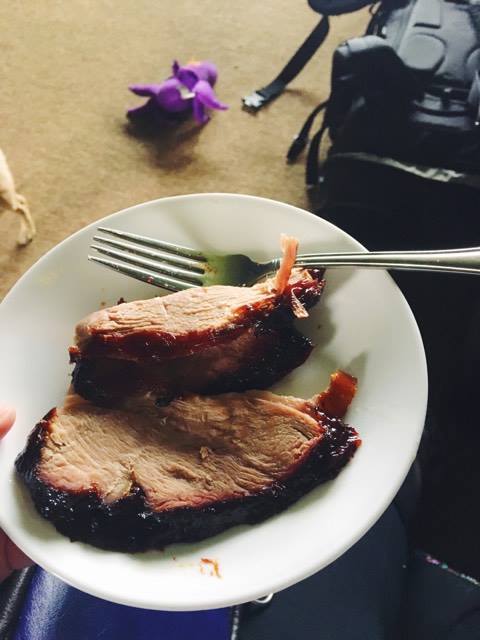
You’ll also likely find a meal in Adak’s “Little Tijuana” neighborhood, as it’s affectionately called by the locals. A single winding road near the North side of town is home to majority of Adak’s Hispanic population- roughly five families call this road home. One “Little Tijuana” resident, George Lopez, who just finished smoking a whole hog in his homemade smoker the day of this interview, has been living, working and eating in Adak for ten years. Lopez works at the fish plant and opens his home and his kitchen to migrant workers coming to the island to work at the fish plant. Lopez takes it upon himself to feed the workers home cooked meals. Lopez used to have a restaurant in town called the Cold Rock Cafe, but had to close it due to high maintenance costs.

Roast pork made by George Lopez. 

Roast pork made by George Lopez.

“I have eight beds in my house and I just started having the crew. I’ll start feeding them .I like cooking. It’s good,” Lopez said. “My house gets crowded, but It’s fine I have my own room.”

Many residents who like to cook are forced to be creative. Makani Zaima came to Adak to be with her dad, who works at the fish plant. Zaima, a health aide in training at the island’s clinic, enjoys finding recipes on Pinterest, but often finds it difficult to gather all the ingredients to make the things she finds.

Makani Zaima waiting for her lunch at the Blue Bird Cafe. 

Makani Zaima waiting for her lunch at the Blue Bird Cafe.

“I always wanna try new stuff, but it’s hard. I have Pinterest, that’s my favorite. If I see something that I really wanna try and make I’ll see if someone I know is coming out on the next flight and be like ‘hey can you pick this up for me at the store?’ and have them bring it out,” Zaima said. “That seems to work.”

At home Zaima cooks between once and twice a week, focusing on Hawaiian and Asian dishes.

“My favorite thing to cook is stir-fry, just because there’s a lot of vegetables. It’s hard to get veggies out here,” Zaima said. “Everytime I leave the island the first thing I do is order a big salad or a big bowl of fruit. I crave vegetables all the time.”

Zaima, who went to high school in Anchorage, never appreciated easily accessible produce until she came to live in Adak.

“I took fresh vegetables for granted when I lived in Anchorage,” Zaima said. “I never really noticed how much I wanted them until I came out here and couldn’t just go to the store and buy an apple.”

This year Zaima cooked an entire Thanksgiving meal for her family, which is not an easy feat in Adak. Zaima shared her meal with the town, who gets together to celebrate big holidays.

“My boss sent us a turkey. I had to get everything else shipped in. I did all the basics, the gravy, the mashed potatoes, the stuffing. I also made this little vegetable bake that I found on Pinterest,” Zaima said.

Adak has one convenience store where residents can buy food and drinks if they need to. The prices are high and the food is cheap. Spam, cake mix, soda pop and candy fill the abandoned elementary school that now acts as the 100 knot store.

“There’s a store here, but you’d see that the prices are pretty extreme and that they sell a lot of sugar and carbs,” Zaima said. “I just went to the store yesterday and bought a thing of cranberry juice, a case of top ramen and a couple other things and it was like $100.”

Residents who order meat place bush orders from Mr. Prime Beef, Mike’s Quality Meats and other south central Alaskan butchers who offer deals to residents of rural communities. Besides fish, locally sourced meat can come from ptarmigan or from the island’s overpopulated caribou herd. The caribou on Adak, brought in the 1950s by the military, have no natural predators and are known to be bigger and heavier than other Alaskan caribou. A year-round open season on caribou cows make it easy for residents to get fresh meat from the island.

“During the winter the caribou come up and you can drive up the back roads and pretty much shoot them from your car.” Zaima said.

Locally sourced greens, meat and fish combined with Adak’s cultural diversity make eating at the end of the world seem more like eating at the center of the world- where food and cuisines intermingle to create a unique food culture.


Makani’s Adak stir fry.

“You can use top ramen for anything. We like to do Japanese style noodle soups, Or if we don’t have regular noodles we use them for stir-fry noodles.” Zaima said.

Ingredients:

1 large boneless chicken breast or beef (cubes)

Ramen noodle package

1 onion

3 garlic cloves

2 tablespoons of peanut oil

Stir fry vegetables

– carrots

-shallots

-green onion

-brocoli

Oyster sauce, soy sauce and sriracha to taste,

Directions:

1. Throw the meat into pan and sauté for 10-15 minutes on medium heat or thoroughly cooked.

2. Next, cook ramen noodles as normal without adding the sauce mix or packets packets, drain the noodles when done

3. Chop 1 onion & fresh garlic cloves.

4. In a large frying pan, heat peanut oil and frozen or fresh veggies on medium high for 10 minutes

5. Toss the noodles and chicken into the pan and mix together. Continue cooking until the veggies are cooked all the way

6. Add oyster sauce to taste and soy sauce, top with sriracha if you like. Dish up & enjoy!

For First We Feast: The best hot dog from every state

Alaska, Beyond Alaska, Online, Uncategorized

Originally published on First we Feast

I helped First We Feast finish their quest to find the best hot dogs in every state. I chose International House of Hot Dogs to represent Alaska.

Alaska-International House of Hot Dogs

Address and phone: 440 E Northern Lights Blvd, Anchorage (907-227-3081)
Website: N/A

Reindeer dogs have been a tradition in Anchorage for at least 20 years, most often found at downtown street carts during the summer. But International House Of Hot Dogs, a trailer serving a variety of specialty dogs, is one of the few places to eat them year round. “The McKinley dog is just one of many reindeer sausage dogs at IHOH and includes a special spicy sauce and caramelized onions,” says our Alaska correspondent Victoria Petersen, who previously covered Anchorage’s reindeer dog scene for The Northern Light. “Spicy and hearty, reindeer sausage is versatile enough to go well with many different flavors and ingredients, but also simple and tasty enough to stand on its own.”—HK

For ADN: Singer Rhonda Ross visits Anchorage to spread message of empowerment

Alaska, Beyond Alaska, Print, Uncategorized

Originally published in Alaska Dispatch News

Rhonda Ross is the daughter of Motown star Diana Ross and record producer Berry Gordy, but there’s no mistaking the fact the musician has a voice that’s all her own.

“My mother raised me and my four siblings to never live in her shadow. She made us know that we are individuals and we are unique. We are not lesser human beings,” Ross said.

“I never had issues with worrying that someone only liked me because of my relationship to my mother and that’s a testament to how she raised us. Because of that I was always reaching for my own sound and reaching for what I want to say in my music.”


Ross is a singer, songwriter, motivational speaker, writer and actress. She appeared in “Another World” from 1997-1999, and was nominated for a Daytime Grammy Award in 1998. In 2004, Ross created a live album with her husband, jazz musician Rodney Kendrick, called “Rhonda Ross Live Featuring Rodney Kendrick.” Her latest album, “In Case You Didn’t Know” was released in July 2016.

“I always knew I was going to be an artist and a storyteller. I was on stage with my mother since I was 6 months old. When you’re around it, that’s what you know and it’s easy to go that way,” Ross said.

Ross describes her music as a new take on the fusion between jazz, funk and neo-soul.

“It’s basically jazz, but it has those other elements musically. But my lyric is important to me,” Ross said. “My songs have lyrical content that I think pop music hasn’t really allowed for. I like to tell real stories that are really encouraging.”

Ross is inspired by powerful women musicians, she said. In addition to her mother, Billie Holiday, Nina Simone, Tina Turner and Abbey Lincoln are some of her musical role models.

“You get these strong, bold, badass women, and that, you know, just takes me out. That’s who I’m really influenced by. Those kinds of women, I just dig them, they move me,” Ross said.

In 2005 Ross took a hiatus from art to focus on starting a family. It was becoming a parent that inspired Ross’ new album and her return to the music industry.

“I had grown and matured, I had become a mother, I had a different perspective on life. I wanted to make a different kind of music than I had been making. I started exploring this new voice inside of me — this new take on life. I’m bringing more to the table now than I was 20 years ago,” Ross said. “I went back to my art because I heard my call. That was why I was put on this planet, to write, to sing, to speak.”

This will be Ross’ second visit to Anchorage. She first came in 2002 to perform in a production of “The Vagina Monologues.” This time, Ross will be performing alongside her husband, which she has not done in about five years.

“This performance in Anchorage is one of the first ones of us bringing ourselves back together and finding this new music, this new conversation that he and I get to have. We are collaborating as parents now,” Ross said.

Also featured in the show will be local musicians Dirk Westfall, Rick Zelinsky and John Damberg. In the last few years Ross has made a point to work with local musicians wherever she tours.

“I’ve found that there’s so much talent, spirit, passion and energy here,” Ross said. “What I found is that the music I write is simple and that when I allow people to bring their perspective and their personalities and gifts and talents to give to the music, the music expands — explodes really. It advances in such an exciting way.”

In addition to her performance at Williwaw, Ross will also be speaking to teens at the AK Hopes and Dreams Summit. The AK Hopes and Dreams Project was founded in 2015 as a way to energize and inspire young Alaskans.

“My message to those teens and to the world, both through music and public speaking, is to spend some time getting to know that call and voice and learning to trust it because it’s right and it’s powerful,” Ross said.

Ross hopes the people of Anchorage won’t seek a second coming of Diana Ross, but that people will come and see what she has to offer.

“Yes, I know that I’m Diana Ross’ daughter … But I am not that. I am me. I’m the first coming of Rhonda Ross, how about that?” Ross said.

“I don’t have the career she has, I don’t have the money she has, but I am very proud of the music I make. I can stand on it. My pride doesn’t come from the size of the career or the paycheck.”

For ADN- At Lucky Kitchen, a sampling of Filipino comfort food

Alaska, food, Print, Uncategorized

Originally published in Alaska Dispatch News

After staying in the Philippines for a month in 2014, I’ve had a craving for classic Filipino dishes, like ube, adobo and lumpia — and you’d think it’d be easy to find them at a good Filipino restaurant in Anchorage.

After all, there’s a big Filipino population here — about half of Asian-Americans in Alaska trace their heritage back to the Philippines, according to 2014 statistics from the Alaska Department of Labor and Workforce Development. Yet the food of the Philippines has remained largely under the radar in Anchorage’s dining scene.

Then, through several of my Filipino friends, I heard about Lucky Kitchen. It’s a small, cafeteria-style restaurant attached to Lucky Market on the corner of International Airport Road and Arctic Boulevard, and I decided to give it a chance to curb my cravings.

For a restaurant that’s part of a grocery store, it’s surprisingly spacious, with comfortable seating for about 30 people. It was clean and well lit, and on a recent visit the smell of freshly made adobo filled the room. Lucky Kitchen features a mix of buffet-style Filipino, Thai and Chinese food, as well as made-to-order options.

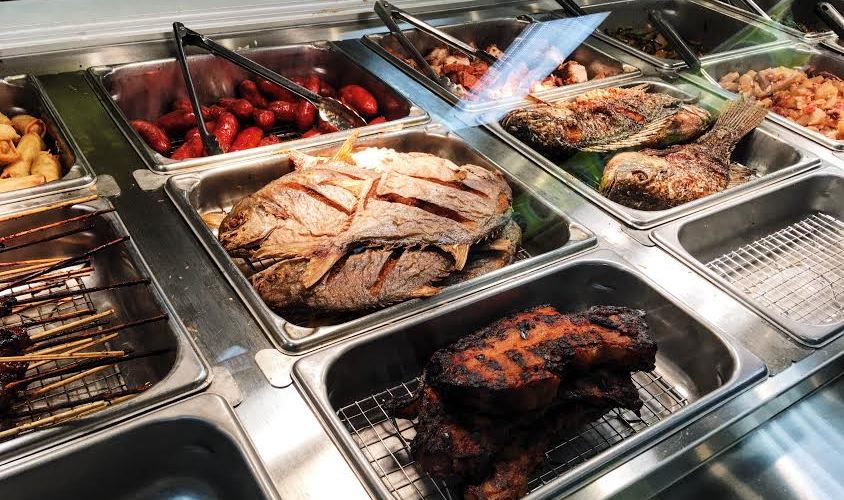
On my first visit I brought three friends, one whom was familiar with Filipino cuisine. We ordered a two-entree combo, which comes with fried rice or lo mein, two main dishes and either a vegetable egg roll or a longanisa sausage ($9.49). We also ordered a whole pompano fish ($6.99), longanisa sausage (89 cents each) and lechon (deep-fried side pork, $11.99 a pound).

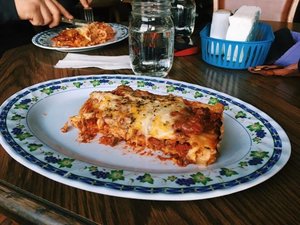
The combo was a pretty good deal, considering it was enough for two people. Ours consisted of fried rice, sesame chicken, pork adobo and a longanisa sausage. The sesame chicken was fine, basically the typical Chinese-American style of the dish. The pork adobo, on the other hand, propelled me straight back to Cebu City.

The two entree combo included steamed rice, longanisa sausage, pork adobo and sesame chicken. 

The two entree combo included steamed rice, longanisa sausage, pork adobo and sesame chicken.

Adobo, the national dish of the Philippines, is typically pork or chicken cooked with vinegar and soy sauce. The dish should be sweet, sour and salty, with none of the flavors overpowering the others. That was how it tasted at Lucky Kitchen, and the peppercorns, my favorite part, were abundant and gave the saucy pork dish a punch of sharp flavor.

The pompano fish was fried and served whole, with just about everything but the eyes. A small fish, the pompano looks similar to tilapia and barely filled the Styrofoam plate we were eating on. Peeling back the skin of the fish revealed a surprising amount of white meat. With our plastic forks, we pulled the meat from the bones and ate the whole thing very carefully. The flavor of the fish was buttery and mild like cod, but slightly fishier.

Pompano fish, tilapia, longanisa sausage and lechon are just few of the grab-and-go items you can get at Lucky Kitchen.

Pompano fish, tilapia, longanisa sausage and lechon are just few of the grab-and-go items you can get at Lucky Kitchen.

Everyone ordered a small longanisa sausage to try. Longanisa is a good representation of Spanish influence in the Philippines; it’s a sausage similar to chorizo, but sweeter and can be made with chicken, beef or even tuna. The sausage varies from region to region, but at Lucky Kitchen it tasted like pork sausage and was more sweet than spicy. My lunch dates fell in love with the tiny sausages.

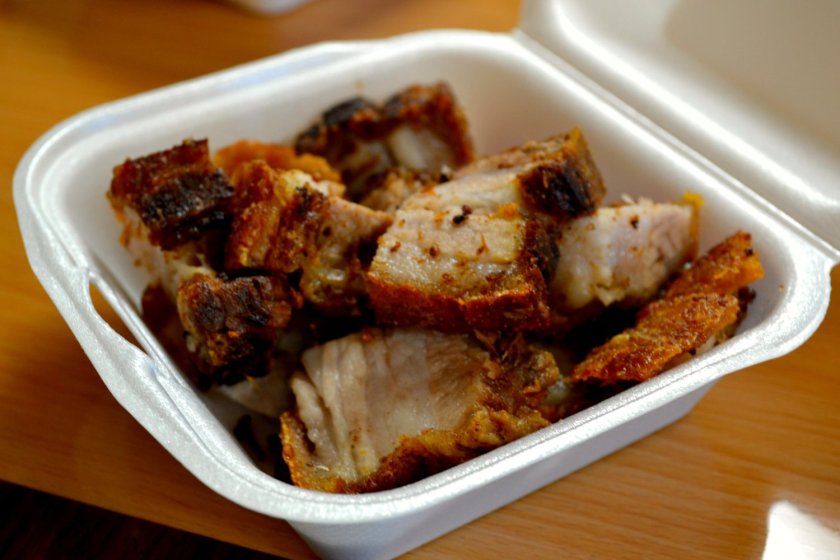
For a snack to share we got an order of lechon from the buffet table. Chopped into bite-sized pieces, the fried outer layer of this dish is extremely crunchy at first and then gives way to juicy, fatty pork. Lechon should ideally be eaten piping hot and accompanied with a dipping sauce of some sort — this lechon, unfortunately, was not hot enough. However, on a follow-up visit I got it made-to-order, and it came out just right. So for the optimal lechon experience at Lucky Kitchen, make sure to ask for sweet and sour sauce and order it made fresh.

Lechon, or deep fried side pork.

Lechon, or deep fried side pork.

Other Filipino dishes Lucky Kitchen brings to the table are pinakbet (a mix of vegetables steamed in fish or shrimp sauce), ginisang upo (bottle gourd sauteed in garlic, onions and tomatoes with pork), ginataang kalabasa (shrimp and vegetable dish cooked in coconut milk) and ginisang ampalaya (sauteed bitter melon). All were $11.99 for a large entree portion.

The most convenient thing about Lucky Kitchen is that if you find something you love in the deli, you can walk next door to Lucky Market and buy what you need to make it at home. For a Philippines-inspired meal or snack, visit the market for a package of longanisa sausage, calamansi juice or even ube cake.

Lucky Kitchen

Hours: 11 a.m.-8 p.m. Monday-Saturday, 12 a.m.-6 p.m. Sunday.

Location: 5011 Arctic Blvd. Suite B.

$$

***

Contact: 907-929-2229 or look on Facebook for “Lucky Kitchen”

For Edible Alaska: Made in Alaska – Ranch Dressing

Alaska, food, Print, Uncategorized

Originally published in Edible Alaska

Invented by plumber-turned-entrepreneur Steve Henson, ranch dressing can trace its origins all the way to rural Alaska. Fulfilling their own version of manifest destiny, Henson and his wife, Gayle, moved from Nebraska to the last frontier in 1949, where he found himself working as a plumbing contractor in the Alaska bush. Because of the remote location, Henson pulled double duty as a cook in order to feed his crew. In an effort to get them to enjoy the salads they were being served, he made an experimental dressing with ingredients he had on hand: buttermilk, mayonnaise, and a handful of herbs and spices. Sure enough, the workers ate their vegetables.

“It’s tough to feed men up in those bush jobs. If they don’t like something, they’re as likely to throw it at the cook as they are to walk out cursing. I had to come up with something to keep them happy,” Henson told Los Angeles Times’ Sergio Ortiz in a 1999 interview about the conception and history of ranch dressing. “And it was then, in Alaska, that what’s now known as ranch dressing came into being.”

Today this quintessentially American condiment that is equal parts creamy and tangy has been used on salads, as dips, and even on pizzas, for nearly 50 years.

Henson and his wife lived and worked in Alaska for three years before moving on to California, where they purchased Sweetwater Ranch in 1954. Changing the name to Hidden Valley, the dude ranch became a popular gathering place where the Hensons served food accompanied by Steve’s crew-pleasing, dairy-rich concoction. The condiment grew so popular at Hidden Valley that Steve and Gayle began charging 75 cents for powdered ranch-mix envelopes that were in high demand all across the country.

Today Hidden Valley Ranch, whose commercials depict a sort of promised land where children frolic in fields of green and eat their vegetables with enthusiasm, is owned by Clorox.  But there’s no doubt the utopian ideal that Hidden Valley has created is still alive for some children who can’t get enough of the gooey, dairy-packed dressing. Henson sold the brand and product for $8 million in 1973 and the dressing was made shelf-friendly, allowing it to be sold in stores across the country and become an American staple.

Ranch dressing, as American as white picket fences and baseball, is America’s go-to for all things dipped and smothered. As the number one dressing shipped to U.S. food service outlets, ranch flavor nearly doubles the volume of the runner up (blue cheese), according to a report published in 2014 by The NPD Group, a leading global consumer market research firm.

Of course ranch dressing(along with seemingly just about everything else these days) has a day dedicated to it. If you’re looking to celebrate, March 10 is the day to indulge by smothering your spring greens in the creamy, piquant, and thick Alaskan-born creation that is ranch.

Homemade Buttermilk Ranch Dressing

It’s easy to create your own tangy and creamy ranch dressing. Perfect for topping fresh greens and spring salads. Fresh herbs and good-quality dairy products enhance this recipe, giving you a more refined and sophisticated take on America’s favorite salad dressing.

Ingredients:

  • 1/2 cup mayonnaise
  • 1/2 cup sour cream
  • 3 tablespoons of fresh minced parsley
  • 1 1/2 teaspoons of fresh minced dill
  • 1/2 teaspoon apple cider vinegar
  • 1/2 teaspoon Worcestershire sauce
  • 1/2 teaspoon garlic powder
  • 1/4 teaspoon onion powder
  • 1/4 teaspoon salt
  • Freshly ground black pepper, to taste
  • 1/2 cup buttermilk

Preparation:

  1. In a large bowl, thoroughly mix all ingredients except for buttermilk.
  2. Once ingredients are mixed well, slowly add in buttermilk. Stir until all buttermilk has been added and all ingredients are combined.
  3. Refrigerate for approximately two hours, then taste and adjust seasonings as necessary before serving. Seal and refrigerate for up to one week.

For ADN: Puddles the clown is in Anchorage to sing pop music covers

Alaska, Beyond Alaska, Print, Uncategorized

Originally published in Alaska Dispatch News

As the clown behind Puddles Pity Party, Mike Geier has chosen not to speak. If Puddles has something to say, it will be sung.

Photo courtesy of Puddles Pity Party for Alaska Dispatch News

Photo courtesy of Puddles Pity Party for Alaska Dispatch News

“I don’t like to talk too much because I always seem to put my big foot in my big mouth. That being said, I find it exhilarating to communicate in ways that don’t involve speaking. (It) forces us to get creative and also keeps us focused on the heart of the matter,” Geier wrote in an email.

Mike Geier is the man behind Puddles Pity Party.

Standing 6 feet 8 inches tall, Geier’s signature look consists of a white clown costume with three big, fluffy black buttons — reminiscent of Pagliacci, the most famous of sad clowns — a crooked gold crown with the letter “P” written on it atop his head, whiteface makeup and a perpetual frown.

In a rich, baritone voice, Puddles sings pop anthems and ballads alike, from “Royals” by Lorde to “My Heart Will Go On,” in a melancholy, cabaret style.

“Even though a lot of the songs I sing are sad, there are also moments of celebration and joy throughout the show. I think sadness and joy go together. Tears and laughter. Laughter and tears. It’s all so cathartic,” Geier said. His repertoire includes covers of Billy Idol, The Beatles, Metallica and ABBA, among others.

“I tend to sing songs that hit ya right in the ticker. Songs that conjure the feels. It’s all about the feels,” Geier said. “And I like a good sing-along, too. I always encourage folks to sing along.”

Puddles the character started in 1998, Geier said, when he was performing karaoke in a flea market. In ’99, he continued the character for his Atlanta band Greasepaint (he also performs as Big Mike Geier in the band Kingsized, also in Atlanta).

In 2013, Puddles’ distinctive voice and unusual act got a bigger audience when he was featured on Scott Bradlee’s Postmodern Jukebox video series, covering the song “Royals” by Lorde. Today the video has reached nearly 18 million views. Geier did several more collaborations with the Postmodern Jukebox, then branched out on his own international tour.

“I feel very fortunate to be able to travel and sing and make new friends. What a world,” Geier said.

What can Anchorage expect from this unusual performer? “Togetherness, fellowship and free cuddles for anybody that wants ’em.”

For ADN: WindSync wants to change the way you think about wind quintets

Alaska, Beyond Alaska, Print, Uncategorized

Originally published in Alaska Dispatch News

Radiohead and Billy Joel might not come to mind when you think of a wind quintet performance, but WindSync is on a mission to expand and modernize the repertoire with new arrangements that span genres.

Each musician, from the flutist to the bassoon player, helps modify the source music — which might have been originally written for a full orchestra, singers, piano or even a rock band.

“We put it all together and we end up with something that sometimes is poppy, sometimes has jazz influence, often draws heavily on the classical tradition, but it’s sort of a different spin on that tradition. It takes extra work, but it’s well worth it,” said Kara LaMoure, WindSync bassoonist.

WindSync has gotten a lot of their recognition from videos of their performances of popular music, especially covers of Billy Joel’s “And So It Goes” and George Gershwin’s “Summertime.” In addition to new and popular music, WindSync also dips into jazz, folk and musical theater.

“For us, if we program top-40 music or anything that’s considered a more popular genre of music it’s because it’s really a key component of our programming. So for us they’re few and far between, but they are important because we do want to celebrate all genres,” LaMoure said.

“We don’t say, ‘Oh, we’re classical musicians so we’ll never play pop music.’ We think of it as just part of our programming.”

LaMoure said WindSync is influenced by American composers like Leonard Bernstein and Aaron Copland, who incorporated different musical traditions in their work.

“We’re really inspired by any music that tells a story or that can relate to a very wide demographic,” LaMoure said. “We’re exploring music that does that with a wide variety of influences: Melodies that can connect across wide audiences.”

The original ensemble was born out of the Rice University music program. Two of the original members — Garrett Hudson on the flute and Anni Hochhalter on the horn — still perform with the group today. Based out of Houston, the current ensemble also includes Emily Tsai on the oboe, Julian Hernandez on the clarinet and Kara LaMoure on the bassoon. Eight years after getting their start, WindSync spends about 100 days out of the year touring across the U.S. and internationally.

“We are dedicated to expanding the quintet repertoire and making a difference in the communities we perform in,” LaMoure said.

WindySync will be performing for students in the Anchorage School District. LaMoure said they want to engage the students through participation in their performance.

“We do ‘Peter and the Wolf’ in elementary schools all the time. When we do it we act out the story, we’re running around the stage. We are even playing our instruments while we’re running around the stage, so that gets crazy and intense,” LaMoure said.

“We also introduce them to how sound is produced on our instruments. We want them to have the beginnings to the idea of how music works.”

WindSync often strays from classical music performance decorum, something LaMoure said is intentional.

“In classical music there’s a lot of issues of ‘don’t clap between the movements,’ wear this specific kind of dress, or, you know, there’s a certain etiquette that’s expected,” LaMoure said. “But for us we kind of want that connection with the music to be more immediate and personal. So if the response is organic then we’re really happy.”

Overall, the ensemble hopes to create a visual experience as well as a listening one.

“Even the most seasoned wind quintet fans will see something new and interesting to them,” LaMoure said.

WindSync

When: 7:30 p.m. Friday

Where: Discovery Theatre

Tickets: $40.25-$54.75 at alaskapac.centertix.net

The Spenardian: Nearly 50 residents displaced by fatal apartment fire

Alaska, News, Online, Spenard, The Spenardian, Uncategorized

Originally published in The Spenardian

Two residents died and 16 others were injured early Wednesday, Feb. 15 after a fire broke out at Royal Suite Apartments on Spenard Road and Minnesota Drive.
The fire is currently under investigation by the U.S. Bureau of Alcohol, Tobacco, Firearms and Explosives.


The fence around the Royal Suite Apartments has transformed into a memorial with teddy bears and signs of hope displayed prominetly against the perimeter of the charred building.

For TNL: Local Lingerie: Anchorage Millennials Create New Niche For Intimates

Alaska, Print, Uncategorized

Originally published in The Northern Light

Growing up in the Philippines, Bea Barth learned to hand sew from her aunt who would ask Barth to help mend their clothes. Now, Barth is launching her own intimates company along with her best friend, Kristina Carlson.

“It’s funny and very ironic because the way I learned to sew as a little girl was when my aunt would make me sew patches on her underwear because we were poor, and now I’m starting this,” Barth said.

Barth and Carlson, who has since relocated from Alaska to North Carolina, contracted a seamstress to help with the task of actually creating the lingerie. All of the garments are made in Alaska, with the idea of keeping the items as ethically produced as possible.

“The biggest thing is the importance of ethically produced lingerie and clothing… We try to source everything from the U.S. or from local places here. We want to support smaller local businesses that are essentially doing the same thing we are,” Barth said.

Love 49 began as an idea for one of Barth’s UAA marketing class finals.

“I had to do a marketing plan, so I did it on this and after I finished my paper I was like, ‘We should do this,’” Barth said.

Barth strives to make use of local talent in all aspects of her new business — even down to the price tags that will adorn the lingerie, made by Assets Incorporated, a small local non-profit printing company that employs residents with disabilities.

Model and UAA justice student Jasmine Alleva found comfort in Love 49’s undergarments.

“I love that this is all local. From the designs to the production. I love supporting local businesses. It makes my heart swell that I can buy lingerie sets and I know that my purchase isn’t hurting anyone in a different country and that the money is going back into the local economy,” Alleva said.

Barth and Carlson, who have been friends since grade school, have always shown a strong interest in fashion.

“One of our favorite things to do in high school was to go to Barnes and Noble and read fashion magazines. We were always really into fashion. We are really into consignment shopping. We aren’t uppity, we’re from Alaska and we want the deals,” Barth said.

Anchorage has very few options for buying lingerie, beyond department stores.

“I’m super excited for another local brand to pop up. I believe everyone who wears lingerie should have the option to shop local and support their economy. I also think it’s super important that people feel comfortable and sexy in what they wear, so it’s great that Alaskans now have another option,” Melinda Moto-Weinstein, UAA psychology student and lingerie saleswoman, said.

Love 49 hopes to fill a niche that hasn’t existed before in Anchorage that will cater to the city and state’s unique fashion sense.

“Our first priority is our audience here in Alaska. We’re just known to go to the nicest restaurants in Sorrels or Bogs and Xtra-tuffs, and no one cares, and that’s just the kind of fashion we have. Maybe the rest of the country looks down on it, but I’m not going to wear my heels outside because it doesn’t make sense,” Barth said. “We’re wearing sweaters half the year anyways, we don’t need push-up bras. I have a down jacket on half the year, I don’t need to show off. Comfort is number one for me. It can still be pretty and super comfortable.”

Currently, Love 49 offers general sizes that range from small to large, and custom sizing where intimates will be tailored to your exact measurements.


“Everything is made to order. You might be a 32, but a 32 DD, and we can make it. We’re not a store that’s already pre-made all of our stuff,” Barth said. “We are here to cater to a wide array of people, not just skinny people, not just models. Everyone is different and everyone needs underwear and deserves to have pretty stuff in their underwear store.”

Love 49 opened their online shop last week and are now taking orders at love49ak.com.

The Spenardian: The windmill

Alaska, college cookbook, Online, Spenard, The Spenardian, Uncategorized

Originally published in The Spenardian

The windmill standing in the old Chilkoot Charlie’s parking lot has created a life for itself as an Anchorage landmark and a symbol of Spenardian culture.

One of the most distinct features of the Spenard area is the old ornamental windmill looming over the Koot’s parking lot. The windmill is decorated with lights of green, red and white. Many remember it always being there at Koot’s, but the windmill’s history extends beyond the parking lot of the infamous watering hole.

12966299_10201652307027190_80932335_n

Anchorage businessman Byron Gillam owned a liquor store on East Fireweed Lane. He was traveling in Southern California when he discovered a build-yourself windmill kit. Gillam bought the kit and installed it in front of his liquor store on East Fireweed Lane in the early 1960s.

The windmill lived on East Fireweed Lane for many years, with different owners as years passed. By the 1970s the windmill was in the hands of a local character known as “Mafia Mike.” Mafia Mike told Mike Gordon, owner of Chilkoot Charlie’s at the time, that he would donate the windmill to him if he paid to have it moved to his parking lot. Part of the contract noted that a plaque be placed on the windmill forever honoring Mafia Mike’s donation. The deed was done and the windmill was installed in the Koot’s parking lot in the early 1980s. The plaque is now missing, but the windmill is here to stay.

When the windmill was first installed in the Koot’s parking lot a celebration occurred and a time capsule was placed underneath the windmill. The community gathered to fill a 55 gallon time capsule with trinkets and other memorabilia. The time capsule still sits under the windmill with no plans on when it will be unearthed.

The windmill currently stands above the Spenard Farmers Market every summer as well as the Spenard Food Truck Carnival. These events use the windmill as a landmark to let locals know the events are- “under the windmill.” Both events stem from local initiative and thrive on the quirky culture of the area.

12992789_10201667562328563_250489568_n


For ADN: Kassik’s earns unprecedented double win at Alaska Beer and Barleywine Festival

Alaska, food, Print, Uncategorized

Originally published in Alaska Dispatch News

Nikiski’s Kassik’s Brewery beat out competitors from across the nation to win first place in both the beer and barleywine categories at the Great Alaska Beer and Barleywine Festival, a first in the 23-year history of the event.

Photo courtesy of Kassik's for Alaska Dispatch News.

Photo courtesy of Kassik’s for Alaska Dispatch News.

Kassik’s 2016 Buffalo Head barleywine came out ahead of 30 other entries — it also won first place at last year’s festival. Kassik’s barrel-aged Statny Statny won the winter seasonal category (there was no second or third place).

San Diego brewery Ballast Point won second place with their Three Sheets barleywine. Third place was taken by Alaska’s 49th State Brewery Outlander barleywine.

Barleywine is made from grain but typically has a higher alcohol content than normal beer — around 8-12 percent by volume, similar to that of wine.

To decide the winners, two rounds of judges analyzed beers for their alcohol content, color, clarity, aroma, flavor and overall impression.

Jim “Dr. Fermento” Roberts, a longtime Anchorage beer columnist and former executive director of Brewers Guild of Alaska, helped judge the first round and best of show round for both competitions.

A barleywine will have a unique essence and aroma, Roberts said.

“Barleywines are usually a dark, heady and potent style of beer. Think leather, tobacco, caramel, chocolate, notes of toffee, coffee, those types of things,” Roberts said. “None of these things should be overwhelming. They would all be in concert with each other. It’s a balancing act and Kassik’s hit it out of the park.”

The Buffalo Head barleywine is barrel-aged and has 13.5 percent alcohol content. “This a strong beer, with big bold flavors and a hop bitterness at the end,” Kassik said.

The winter warmer competition guidelines are broad and loosely defined. It was created to let brewers know what it is the judges are looking for when it comes to the ideal seasonal beer.

“Early in the competition we struggled to define what that meant,” Roberts said. “Think of this: You just got done skiing, you skied all day and your legs are sore. You come in and there’s a big roaring fire and you’re tired and you just want to kick back. What beer would be most pleasing in front of that fire? Think about Christmas in front of the fireplace. You’re gonna have a little snifter of something that’s warming, maybe rich, maybe robust. What would be that style of beer?”

Kassik’s Statny Statny is an imperial stout that’s barrel-aged at 10.5 percent alcohol content and made with licorice root and molasses.

“In my search for beer names I found that the Czech word statny means stout and statny twice comes out to mean ‘musty stout,’ ” Frank Kassik, head brewer of Kassik’s brewery, said.

Kassik said microbreweries have an advantage when making award-winning beer.

“We brew small batches and with these smaller batches we can produce some top-quality ales consistently,” Kassik said.

With 22-ounce bottles available in most liquor stores around the state, Kassik’s is releasing 12-ounce bottles in six packs that are being shipped out across Southcentral Alaska and Fairbanks this week.

“In addition to being in the liquor stores, you can also find us in restaurants and bars across the state. Get us from F Street Station to Suite 100 to Longhorn Saloon; we are everywhere,” Kassik said.

For Great British Chefs in partnership with Celebrity Cruises: TASTEscape: Alaska

Alaska, food, Online, Uncategorized

Originally published on Great British Chefs

Travelling through Alaska’s narrow inside passage can be a whole trip in itself. Destinations become an afterthought when whales, glaciers, mountains and more are to be seen on the journey.

Sandwiched between the Gastineau Channel and the Coast Mountains, the remote capital of Alaska offers visitors a sense of the state’s remoteness. With no roads leading out of town, Juneau can only be reached by air or sea. Those who make the journey to Juneau are treated to a bounty of locally-made delights and natural marvels.

History buff? Transport yourself back in time to the glory days of the Klondike gold rush in Skagway, which by the end of the nineteenth century was the largest city in the territory. Providing provisions to gold miners and dreamers before they made the 500-mile excursion into the Klondike goldfields, Skagway became an important port for the state. Today visitors can explore the restored buildings downtown or travel further on the historic White Pass Yukon Railroad, Alaska’s only narrow-gauge railway.

Taste Juneau

Beer, coffee and dumplings – there’s not much to dislike about the food and drink on offer in Juneau. Seek out these local producers and get a taste of the Alaskan capital.

Enjoy local beers at the Alaskan Brewing Company

The first brewery in Juneau since prohibition, Alaskan Brewing Company specialises in making beer quintessentially Alaskan. Whether they are brewing their signature spruce tip ales or using locally sourced glacial water, the homegrown business sticks to its roots in Juneau. The craft brewery has expanded its distribution to over eighteen states and is spearheading a local craft brewery movement in the heart of Alaska. Located in the same building since they opened in 1986, Alaskan Brewing Co. has a gift shop and on-site tasting room for beer lovers to come and try their latest brews.

Perk up with exciting blends at Alaska’s favourite coffee house

Being one of the most caffeinated states in the nation, it’s no surprise that Alaska boasts many local coffee roasters. Heritage Coffee Roasting Company uses a vintage roaster and supplies wholesale coffee to some of the state’s most remote locales. Continuing to operate cafés in Juneau, the company provides patrons with homemade gelato as well as fresh roasted coffee, which has been voted Juneau’s favourite for over twenty-five years in a row.

Try the dumplings at Pel’meni’s

With no menu and an enduring local following, Pel’meni’s sells the local delicacy of homemade Russian dumplings. Filled with either beef or potato, the dumplings are spiced with curry and garnished with coriander. The small eatery, which is decorated floor to ceiling with vinyl records and a turntable playing softly in the background, stays open extra late on the weekends to feed the late-night bar hoppers.

Natural wonders

It’s hard to put into words just how beautiful Alaska is, with its dramatic glaciers, vast lakes and sprawling forests. Make sure you put some time aside to appreciate the beauty of nature, which can be found in every corner of the state.

Take in the beauty of Mendenhall Glacier

Located in the Tongass National Forest, America’s largest national forest, is Mendenhall Glacier, spanning over thirteen miles. Well-maintained paths lead to picturesque views of the glacier and the lake, and if you sit still you can hear the glacier creak and croak as the ice shifts. Lucky visitors may even get a chance to see the glacier ‘calve’ (when large chunks of ice break off into the water). Originally called ‘Sitaantaago’, meaning ‘The Glacier Behind the Town’ by the indigenous Tlingit people of the area, the glacier was renamed in 1891 to commemorate Thomas Corwin Mendenhall, an American physicist and meteorologist. Visit the Mendenhall Glacier Visitor Centre to make the most of your trip.

Get a bird’s eye view of the state capital

The only aerial tramway in southeast Alaska, the Mt Roberts Tramway offers visitors an excellent way to get their bearings on the landscape around them as well as excellent photo opportunities. Beginning at the cruise ship dock, cars rise 1,800 feet through rainforest and end at the Mountain House, where visitors can get panoramic views of Juneau.

Visit a cabin older than Alaska itself

Rustic architecture and visible spruce logs enhance the Chapel by the Lake, a cabin-turned-Presbyterian-church built years before Alaska became a state. Enjoy peaceful views of Auke Lake (with Mendenhall Glacier in the distance) and take in the beauty of Alaska’s landscape.

Skagway culture

Walking around the town of Skagway is like going back in time – the old shopfronts and relaxed way of life make it a fascinating place to see. Be sure to venture into the surrounding countryside for some spectacular sights.

Hitch a ride on the White Pass Yukon Railroad

Built in 1898 during the Klondike Gold Rush, the White Pass Yukon Railroad survives today to take visitors through some of Alaska and Canada’s most beautiful countryside. Don’t forget your camera; the train travels over historic trestles and alongside waterfalls, gorges and glaciers. One of the only railroads in the state of Alaska, the White Pass Yukon Railroad is a narrow-gauge railroad and runs multiple scenic excursions as well as services for hikers traveling the Chilkoot Trail.

Appreciate art at the Skagway Sculpture Garden

Take a break from historic dates and Klondike antiquity and enjoy Skagway’s modern art at the Skagway Sculpture Garden. Filled with Alaskan-inspired art and local flora, this is the perfect place to come and take a relaxing stroll between more adventurous excursions. The garden is home to a gift shop full of original art by local artists; the perfect place to grab a souvenir.

Transport yourself back to the 1890s at the Red Onion Saloon

Established in 1897 and restored to its original aesthetic, the Red Onion Saloon is a favourite with both locals and visitors. It’s also home to a brothel museum that commemorates the saloon’s more scandalous history. Some even say the Red Onion Saloon is haunted – a blog run by the saloon records the paranormal experiences of guests and patrons. With a bar and restaurant on site, enjoy a bite to eat in the heart of historic downtown Skagway.

Still have time to spare?

– Close to the cruise ship dock, Yakutania Point is a part of Skagway’s scenic shoreline. Humpback whales, orca whales and seals are often seen in the distance, and the walk to the overlook and back is less than a mile and very accessible. The footbridge crosses the Skagway River, and there’s a picnic area at the end that’s perfect for a late afternoon lunch.

– The first stone building in Alaska, the grandiose city hall is home to the Skagway Museum and Archives. Here visitors can peruse artefacts from the indigenous people of the area, including a Tlingit canoe and Bering Sea kayaks. Other artefacts include tools, supplies and paraphernalia of the Klondike Gold Rush of 1898.

– Juneau’s St Nicholas Church was established in 1893 by the indigenous Tlingit people of the area. Members of the Tlingit visited nearby Sitka, where they were met with the Russian Orthodox religion and subsequently baptized. These members came back to their home in the Juneau area and established the church, which is made of local timber and remains the oldest Orthodox structure in continuous use in southeast Alaska. The church is on the National Register of Historic Places and is a popular place for visitors to learn about Alaska’s historical ties with Russia.

For TNL: Checking out furs, skulls and bones in the UAA library

Alaska, Print, Uncategorized

Originally published in The Northern Light

Tucked away in UAA’s own Consortium Library lives the Alaska Resources Library and Information Services, also known as ARLIS. A most peculiar collection, ARLIS allows the public to check out a large variety of Alaskan furs, skulls, bird mounts, fish mounts and hands-on educational kits. ARLIS is known as one of the only libraries who will check these items out to the general public.

“The entire collection is “unusual” in there are few if any libraries that check-out these types of taxidermy items,” Celia Rozen, an Alaska Department of Fish and Game Librarian and ARLIS manager, said.

Formed in 1997, ARLIS is a multi-agency library that is located on the UAA campus in the Consortium Library Building. Funded by state and federal agencies, ARLIS serves the public. The collection comes mainly from the Alaska Department of Fish and Game, with some furs coming from the U.S. Fish and Wildlife Service.

A resource on campus many students don’t know about, ARLIS is not only available to students, but also to the public.

“I’ve never heard of it, which is kind of unfortunate considering that sounds like an interesting resource. I can see it being very useful to nursing students like myself considering, in my experience at least, hands on studying with bones and whatnot makes a world of difference when studying,” Rachel Rotola, a nursing student, said.

The taxidermy and educational kits are used by educators, students, camp counselors, artists and other agencies. Some pieces are more popular, Rozen explains.

“The snowy owl is probably the most popular, especially for Harry Potter-type events. Cub Scouts who are moving up into “wolf” or “bear” borrow the furs for their initiation ceremonies. Artists use the skulls for their creations, and a UAA art class has a project annually that involves checking out skulls and creating a life-like pencil drawing. The items are constantly in use,” Rozen said. “The collection is very popular and is constantly used during the school year to support Alaska curriculum for all grade levels, preschool to high school.”

UAA art professor Garry Mealor, who learned about ARLIS from a fellow art professor, makes use of the resources offered in ARLIS for his own art and for his classes art.

“My Advanced Drawing class is currently working on a project involving skulls from ARLIS. ARLIS arranged over 20 skulls on their counter for students to pick from and supplied a list of additional skulls that they would retrieve if asked. These are real skulls, not imitation,” Mealor said. “The ARLIS collection is a resource that anyone interested in Alaskan wildlife would appreciate. For artists, the collection of bird mounts, skulls… are much preferred over working from a photo or other 2-D references. My painting in the faculty show would not have been possible without the ARLIS collection.”

The resources at ARLIS are available for anyone with a library card, and upon checking out, a contract indicating proper care will be taken is required. Items can be checked out for two weeks at a time, with an opportunity to renew for another two weeks. For an entire list of furs, skulls, and mounts visit http://www.arlis.org.

For ADN: Cherish the Ladies brings a traditional Irish Christmas to Anchorage, Fairbanks

Alaska, Print, Uncategorized

Originally published in Alaska Dispatch News

Growing up in the Bronx, Joanie Madden would listen to her father, an Irish immigrant, play his old accordion. She learned under her father and began playing traditional songs on tin whistle and flute. But it was still a shock to her parents when she decided she was going to become a professional traditional Irish musician.

“I remember my parents had a heart attack when I told them I was going to go into playing Irish music. ‘Are you out of your mind, what are you going to do?’ I told my dad I wanted to be the next Chieftains,” Madden said.

Madden continued her studies, eventually working with traditional Irish musician and scholar Mick Moloney. In 1985, Moloney organized a series of concerts showcasing women from across the country who performed the Irish music.

It was from that concert series — the first of its kind, Madden said — that all-female super group Cherish the Ladies was formed.

“It was something that was never planned, it was something that happened. We got together just doing some concerts in New York City celebrating women playing Irish music. We were all the top women in Irish music around the country. All the shows were sold out. We decided to record an album, that album was named the best folk album of the year by the Library of Congress,” Madden said. “That’s when the band was born.”

Madden found that the women she was playing with also learned the music first from their fathers. They decided to give the band a traditional and fitting name.

“What once had only been a male-only genre, for centuries it was always passed from father to son, but now it’s being passed from father to daughter, so I suggested Cherish the Ladies, an Irish jig we play,” Madden said.

With 16 albums, the band travels to about 100 cities a year. Cherish the Ladies has played in five continents, been named the top North American Celtic group by the Irish Music Awards and was nominated for a Grammy in 1999. The album “Woman of the House” made the top 10 list of the Billboard world music chart when it was released in 2005.

Their success paved the way for other female Irish musicians such as Eileen Ivers, Winifred Horan of Solas, Cathie Ryan and Heidi Talbot.

“In the early days it wasn’t really proper for a woman to be in a pub; nowadays some of the biggest names on the scene are women, without a doubt,” Madden said. “For years, we’ve had to overcome major stereotypes. When we first got together, people used to think ‘oh, little pansies,’ and then they would hear us play and go ‘oh, oh my God, these girls can play.'”

Traditional Irish ensemble Cherish the Ladies will perform in Anchorage and Fairbanks this week.

Madden and Mary Coogan (who plays guitar, mandolin and banjo) have been a part of the band since its beginning in 1985. Despite worldwide critical acclaim during the last three decades, Madden said the approval that still matters most to the band is that of their fathers.

“We would be more worried about what our fathers would think of the records than what the New York Times music critics thought. We are purists very much at heart — 70 percent of the show was composed by us and composed in a traditional idiom,” Madden said.

“They took the music so seriously. When they passed the music down to us, it was the greatest gift that they could give us. We never felt the music needed bass or drums or rock ‘n’ roll to make it sound good.”

Cherish the Ladies will be performing a special Christmas show in Anchorage and Fairbanks this week, sharing songs from their most recent album, “Christmas in Ireland,” and other Christmas music favorites. They’ll be accompanied by traditional Irish step dance.

“It’s always amazing to me how well Irish music and Christmas music gel together,” Madden said. “Our job is to get people in the Christmas spirit. That’s what we hope to achieve here. We’re going to work our behinds off to make sure everyone has a ball.”

When the members of Cherish the Ladies aren’t touring, Madden said, they are teaching.

“To me, this music is beautiful. So many people were turned on to Irish music and became fans. We have people from every ethnic background who follow our music and love Irish music. The virtuosity level among Irish musicians is second to none,” Madden said.

“This music touches people’s soul. This was music that was passed down. We’ve all been handed this music down; we are all keepers of the flame. Now it’s our turn to pass it down.”

Cherish the Ladies

Anchorage
When: 7:30 p.m. Friday, Dec. 9
Where: Atwood Concert Hall
Tickets: $32.50-$66 at alaskapac.centertix.net

Fairbanks
When: 7:30 p.m. Saturday, Dec. 10
Where: Hering Auditorium in Fairbanks
Tickets: Varies depending on membership level; see fairbanksconcert.org