Kenai’s tsunami risk is low, but not impossible

Alaska, News, Uncategorized

Originally published in the Peninsula Clarion

On the morning of Nov. 30, many residents on the Kenai Peninsula received automated tsunami warnings on their cell phones following the magnitude 7.0 earthquake. While Seward and Homer evacuated their schools and braced for impact, some residents in Kenai may have been left confused.

An hour or so after the earthquake rumbled the peninsula, Kenai City Manager Paul Ostrander was on the radio, assuring residents that they had nothing to worry about when it came to a potential tsunami. Shortly after this, the warnings were canceled across the state.

The tsunami warnings, which come from the federal level, were automatically issued to communities in the Cook Inlet region the morning of Nov. 30.

Could a tsunami traveling up Cook Inlet affect the city of Kenai? Scientists say maybe.

Donald More, acting director of the National Tsunami Warning Center in Palmer, said there is a tsunami threat for Kenai, though it’s a small one.

The city of Kenai sits at the crux of the mouth of the Kenai River and the silty salt waters of Cook Inlet. Moore said tsunamis caused by earthquakes will slowly diminish as they travel up Cook Inlet toward Anchorage. He said Kenai is not under threat when it comes to thrust-generated tsunamis.

“Kenai will probably not see significant damage from this kind of tsunami,” Moore said.

Moore said a different kind of tsunami could affect Kenai — one that is caused by landslides, both above and underwater.

In 1883, the southern Cook Inlet volcano St. Augustine erupted, sending a massive chunk of the mountain into the sea. The landslide caused four 20-feet-high waves to crash on the shores of the Kenai Peninsula, according to the Alaska Volcano Observatory.

“The Kenai Peninsula is in risk of this kind of event,” Moore said.

Moore said the National Tsunami Warning Center and the Alaska Volcano Observatory work closely to watch St. Augustine.

“We monitor earthquakes in the vicinity of the volcano,” Moore said. “We have special warnings in place for St. Augustine.”

Moore said these landslide-generated tsunamis are difficult to track and predict.

“You don’t know when or where the land is going to slope,” Moore said. “It could be underwater. It could be an earthquake near the coast that causes a landslide.”

Earthquakes that reach a magnitude 7.1 or higher are typically the threshold for the warning center to start monitoring potential tsunamis, though they could happen with smaller earthquakes as well, he said.

Just like with earthquakes, Moore said there is uncertainty when it comes to predicting and assessing tsunami threats.

In the case of another tsunami warning, the National Tsunami Warning Center encourages residents in coastal communities to seek higher ground or move at least 1 mile inland until there is no longer a threat.

Kenai bluff stabilization project moves forward

Alaska, News, Print, Uncategorized

This story originally published in the Peninsula Clarion.

A project seeking to stabilize Kenai’s bluff has seen development in the last month. On Nov. 16, a director’s report was finalized by the Alaska branch of the Army Corp of Engineers, a project partner with the City of Kenai. The report is a feasibility study.

“It looks to see if it makes sense and if the project is feasible,” Kenai City Manager Paul Ostrander said.

The objective of the project is to stall the 3-feet-per-year erosion on a 1-mile stretch of land starting from North Beach, past the senior center and ending where the original canneries were. The idea is to install a mile-long rock berm, using anchor rocks that would halt the erosion of the ground beneath Old Town Kenai.

This is the first of three milestones in a project the city has been tackling for more than 30 years. The most recent efforts to get the project completed began in 2011.

“It’s been a long effort,” Ostrander said.

Ostrander grew up in the area and said he’s seen the area erode over time.

“There are several buildings that used to be there that are now long gone,” he said.

Besides protecting current properties and buildings in Old Town Kenai, Ostrander said one reason the city is looking to stabilize the bluff is to increase investment opportunities in the historic district, which Ostrander said have been limited in the last few decades.

Now that the feasibility report has been finalized, efforts on the next milestone, the design phase, can begin.

The design phase can be tricky, Ostrander said, because federal funding is needed for the $1 million cost. The city has secured a $350,000 match for the grant they hope the federal government awards them in the next year.

“Getting funding for these projects is highly competitive,” Ostrander said. “We want to position ourselves to get funding as quickly as possible.”

Once the design phase is complete, the construction phase can begin, which Ostrander said has a price tag of approximately $24-40 million.

The Clarion previously reported that the city would cover a 35 percent share of the cost, with $6 million already secured from a $4 million state grant and $2 million in voter-approved bonds. The rest of the project would be funded by the Army Corps of Engineers. The city could apply for other grants or use more bonds to cover the other portions of their share of the bull.

Ostrander said the project timeline is dependent on funding approval from the federal government, but if things go smoothly it could be one to two years before the city can halt the erosion.

Former hockey coach sentenced to 62 years in sex abuse case

Alaska, News, Print, Uncategorized

This story originally published in the Peninsula Clarion.

On Monday, a Sterling resident and former Soldotna High School hockey coach was sentenced to more than 60 years in prison for sexual abuse of six minors and possessing child pornography.

Bradley Elliott, 57, pleaded guilty to 15 charges, including six charges of second-degree sexual abuse of a minor, one charge of possession of child pornography and eight charges of indecent photography, according to Kenai District Attorney Scot Leaders.

Elliott faces 62 years and 240 days in prison, with 42 years suspended and a $300,000 fine, with $240,000 suspended.

Elliott was arrested in 2016 and charged with 34 felony counts, including second-degree sexual abuse of a minor, unlawful exploitation of a minor, indecent exposure and possession and distribution of child pornography. In August, he was charged with four additional counts of second-degree sexual abuse of a minor, and four counts of indecent viewing or photography.

The sexual abuse dates back to 2002, according to the complaints filed against Elliott.

Elliott coached junior varsity hockey from 2008 to 2010 at Soldotna High School, and was an assistant coach for the varsity team for the 2007-2008 season, according to a 2012-2013 Soldotna Hockey Program.

In February, unnamed plaintiffs filed a lawsuit against the Kenai Peninsula Borough School District, the Kenai Peninsula Hockey Association and Elliott seeking damages in excess of $100,000. The suit alleges that through his association with the school and the hockey organization Elliott was able to build relationships with families and gain their trust, and that the hockey association and school district were negligent in their hiring, training and supervision practices.

A status hearing in the case is scheduled for Dec. 18.

Peninsula faces minimal damage after Friday’s quake

Alaska, News, Print, Uncategorized

This story originally published in the Peninsula Clarion.

The Kenai Peninsula sustained minor damage and no life-threatening injuries after Friday’s 7.0 magnitude earthquake.

In a statement released Monday, Kenai Peninsula Borough Mayor Charlie Pierce said the peninsula experienced damage to roads, especially in Nikiski along the Kenai Spur Highway. Some borough buildings and schools had minimal damage, but most of the immediate issues were resolved on Friday, Pierce said in his statement.

“This week we will continue structural evaluations to be sure that none of the buildings have any further issues to be sure and keep our students and residents safe,” Pierce said in the statement.

Pegge Erkeneff, communications liaison with the school district, said the district’s facilities received minimal damage.

“We don’t plan to close any schools; we feel confident that schools are safe, or they wouldn’t be open,” Superintendent Sean Dusek said in a statement. “The two-hour delay start on Monday was weather-related, not from the earthquake.”

Borough maintenance fixed a minor leak in the Kenai Central High School heating system. The school remained in session. Nikiski Middle/High School was released early on Friday following the earthquake because of a loss of water pressure caused by a power outage. A minor water leak in the heating system was also patched. Tebughna School in Tyonek suffered a substantial loss of ceiling tiles in the gym, which caused an early release on Friday. Hope School was released early on Friday, following a water and propane gas leak. Paul Banks Elementary and West Homer Elementary had gas leaks at their boilers, which were isolated, patched and repaired. The schools remained in session.

Chapman School in Ninilchik also reported a minor gas leak, which was repaired, Erkeneff said.

Erkeneff said most of the damage at borough schools was addressed on Friday.

“All damage except the ceiling damage was either repaired or patched by the end of the day,” Erkeneff said. “Permanent repairs for temporary patches will be completed within the next few weeks.”

She said several schools have minor cracking and will be looked over by borough maintenance and a structural engineer, which will take several weeks.

Jack Blackwell is the superintendent for the State Parks Department in the Kenai Peninsula and Prince William Sound area. He said the Eagle Rock Boat Launch access road, in between Kenai and Soldotna, was damaged by a landslide, triggered by the earthquake.

“Half of the hill slid into the wetlands below,” Blackwell said. “We were closed for the season so there were no vehicles or people in the area.”

He said the State Parks Department engineers will look over the damaged road and assess further damage.

Mayor Pierce said the borough will continue to improve emergency response in the case of another similar event in the future. Pierce said residents can help by being prepared, keeping emergency supplies at home, vehicles fueled and helping each other during times of emergency.

If residents see any significant damage to property, including their own, reach out to www.kpb.us/emergency or call 262-4910. The borough encourages residents to take photos or videos of any damage or losses. Additional assistance from the state may become available.

Borough chooses to not appeal court decision, updates invocation policy

Alaska, News, Print, Uncategorized

This story originally published in the Peninsula Clarion.

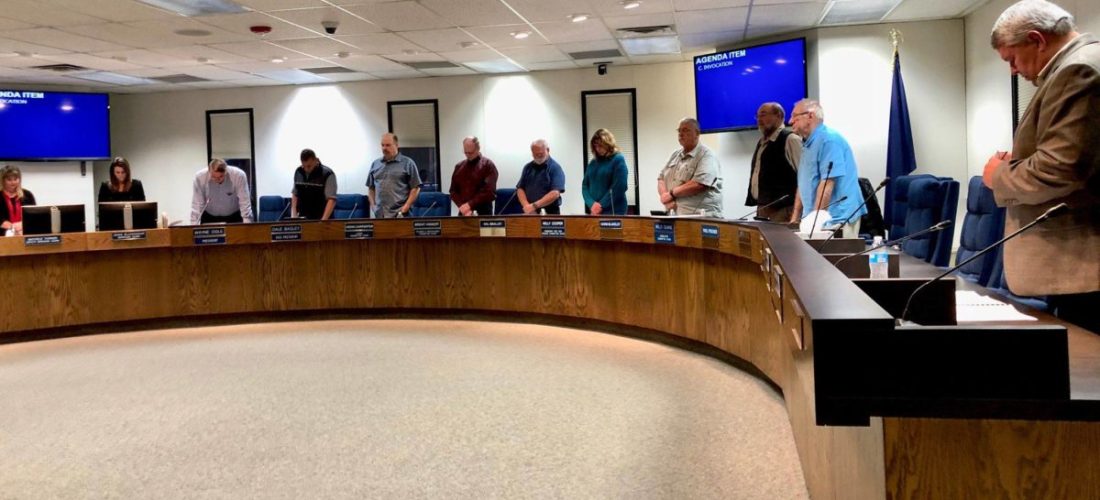
Tuesday night, the Kenai Peninsula Borough Assembly voted to not appeal a Superior Court decision that cited the borough’s invocation policy as unconstitutional. The assembly also passed a resolution changing current invocation policy to allow a wider group of people the ability to offer invocations.

Last month, the borough lost a lawsuit against plaintiffs represented by the American Civil Liberties Union of Alaska in a fight over its invocation policy, which allows certain groups and individuals to offer an invocation at the beginning of each meeting. The plaintiffs, Lance Hunt, an atheist, Iris Fontana, a member of The Satanic Temple, and Elise Boyer, a member of the Jewish community in Homer, all applied to give invocations after the policy was established in 2016. All three were denied because they did not belong to official organizations with an established presence on the peninsula. They sued and the ACLU Alaska agreed to represent them.

Peterson ruled the invocation policy, passed in 2016, violates the Alaska Constitution’s establishment clause, which is a mandate banning government from establishing an official religion or the favoring of one belief over another. Article 1, Section 4 of the constitution provides that “no law shall be made respecting an establishment of religion.”

“The Resolution is inclusive of tax-exempt religious associations serving residents of the borough,” Peterson wrote. “It is not inclusive of every religious view or belief practiced by the residents of the Kenai Peninsula.”

Kieth Hamilton of Alaska Christian College gave an invocation at the beginning of Tuesday’s meeting. During public testimony, he urged the assembly to appeal the Superior Court’s decision regarding the borough’s current invocation policy.

“This isn’t an agenda item to check off the list or a political-charged speech given during a meeting, but rather a solemn time to remember our Lord’s call for us to pray for our nation,” Hamilton said.

He read from the Old Testament, 2 Chronicle 7:14, which says, “People, who are called by my name, will humble themselves and pray, and seek my face, and trim of their wicked ways, and I will hear from heaven and forgive their sin and heal their land.”

“I want our land to be healed, and I want peace and prosperity on our peninsula specifically,” Hamilton told the assembly. “I believe each of you has been appointed to the solemn task of governing us as you’re elected to this office. These invocations bring us all to a place of dependence, not just on ourselves, but to God who created us and gives us wisdom beyond ourselves to govern.”

Greg Andersen from Kenai spoke in opposition to appealing the court’s decision.

“Countless hours have been wasted on this,” Andersen said. “The borough will be receiving the bill from the ACLU in the next two weeks for their lawyer fees. That dollar amount is an unknown, but I’m sure it will be a considerable amount that the borough will have to pay. Think of all the services that those funds could have paid for? I work very hard in order to pay my property taxes. Gambling on the unknown with these tax dollars is unacceptable. These tax dollars need to be spent on services for the borough. It is time to move on.”

Shawn Rice of Kenai said pursuing an appeal would waste taxpayer money and time.

“The waste of time and money at the point is shameful,” Rice said. “Those of you who have voted to keep this process going, you have had at least probably six or eight opportunities to end this, to end the discrimination, to end the bigotry based on ancient texts. Whether it’s my opinion or your opinion as to what the reality of our existence here is, is irrelevant. This is a government facility; this is tax dollars.”

Some members of the public felt they weren’t being heard by the assembly. Amanda Bird from Kenai said she wanted her comments on the record either way.

“I’ll be brief because I’ve come to enough of these to realize public opinion doesn’t appear to factor into the decisions that you all make,” Bird said. “I just would like it to be on record that as a citizen of this borough, I am appalled by the voting record on this item and I wanted to come up and let you all know it’s a mistake to appeal this.”

Assembly member Kelly Cooper reassured the crowd that public opinion does matter.

“I do hear you,” Cooper said. “We are tasked with governing and making the best decision for the majority. One of the things about this body is that we bring our own personal beliefs and our own personal experiences to this, but that shouldn’t be how you vote. That’s just part of your guidance in making that decision.”

When it came time for assembly comment, Blakely said he’s heard several comments from citizens outside of Tuesday’s meeting who support the appeal.

“I would say a lot of the people I am associated with, and who I talk to, would like this appealed, “ Blakely said. “Everyone that is here and has made their concerns known, I would like you to know there are other people in the world. I’m sure you understand that. Those people would see this go in a different direction.”

Assembly member Willy Dunne opposed an appeal, saying he didn’t like wasting or gambling with taxpayer dollars.

The assembly narrowly voted, 5-4 to not appeal the court’s decision. Assembly members Paul Fischer, Brent Hibbert, Dale Bagley, and Norm Blakely voted to advance to the appeals process.

Next on the agenda was an amendment of the current invocation policy that would “broaden the scope of eligible invocation providers to better reflect the diversity of beliefs in the borough,” the resolution stated.

Many members of the public supported the amendment, but offered suggestions on how to enhance it, such as giving invocation speakers time limits, barring those who don’t show up for their scheduled slot from giving an invocation for a year, limiting the ability to provide invocations to once per year, per provider and to have no commercial message of any kind. None of the suggestions were added to the amendment.

Peggy Peterson of Sterling said she was concerned invocation providers wouldn’t show up to assembly meetings and suggested no-shows be taken off the list of eligible invocation providers for a year.

“Many times this last year a person was scheduled to give an invocation, but didn’t show up,” Peterson said. “So Mr. Ogle gave it instead. This meant that others on the list were denied the opportunity. As this new resolution is written, the same thing could happen unless there’s some kind of provision to stop it.”

Rice spoke in support of the new amendments, saying the new policy was less discriminatory.

“If you’re trying to maintain the moral high road, then not excluding people is essentially your wheelhouse, so I don’t know how it wound up here in this form,” Rice said of the former policy. “What’s before you now is inclusive. Anybody can do it. And guess what? Every now and then you’re going to hear something you don’t agree with in these chambers. Every now and then you’re going to hear a representative of the Satanic Temple and you’re going to hear an atheist and you’re just going to have to deal with it.”

Bagley responded to Rice and said if you were a Muslim or a Jewish person that you could offer invocation in the previous policy, but that the individual had to be a part of a group, present on the peninsula.

Rice responded by asking Bagley where the local groups for Islam and Judaism were.

“They don’t exist, which means those people are excluded,” Rice said. “Now those people can speak in a non-invocation moment, but as far as being allowed or selected to present an invocation, those people were discriminated against because those groups don’t exist here.”

Fischer asked Rice if he thought the person giving invocation had to be a resident of the borough. The policy includes a residency requirement.

Rice said that being a resident was a fair guideline.

“So you discriminate that way,” Fischer said. “How about age? Can someone who’s 16 sign up?”

“To say I’m discriminating against people outside of the borough isn’t to say that I’m discriminating against religion,” Rice said to Fischer. “In reality, fine. If someone from Talkeetna wants to come give the invocation here, open it to that.”

Several members of the public said they would prefer a moment of silence.

“I believe the new policy is a step in the right direction, but in my reading, there are at least 12 portions (of the amendment) that I see as sketchy or open to interpretation,” Daniel Lynch of Soldotna said. “A moment of silence gives us all a chance and we’re all involved. I got two minutes left and I’m going to take a moment of silence right now just so we can get used to it.”

Thirty seconds later, Lynch ended the silence saying the moment “didn’t hurt anybody.”

The new amendment passed with 7 in support and 2 in opposition. Both Fischer and Blakey voted against the policy amendment.

The borough has one meeting left before 2019. Starting next year, the assembly will begin taking volunteers to provide meeting invocations.

Peninsula teachers looking for extra income, second jobs

Alaska, Education, News, Print, Uncategorized

This story originally published in the Peninsula Clarion.

Arin Bowen starts her morning at Soldotna Montessori where she works as an interventionist. In the afternoon, she works as the Quest teacher at Redoubt Elementary. Her workday doesn’t end there though. She works as a referee for high school volleyball and works at Challenger Learning Center running missions and educational programs.

“I have had my other jobs for several years and I just kept them to help pay for daycare and other fun bills adults get to pay,” Bowen said.

While Bowen said she enjoys her side gigs, she also said she’s expecting her third child this spring, and that working long nights and on the weekends might be hard on her family.

“(The extra jobs) might make it harder to be gone for during those long nights and weekend days with two young ones and a fifth-grader at home,” Bowen said.

She said her husband and parents are teachers too.

“We do what we need to do,” Bowen said.

Bowen isn’t the only educator who has taken up a second job. In fact, Bowen said she remembers her parents always having summer and weekend jobs, as well.

“It’s nothing new for me,” Bowen said. “It’s kind of what I have always known.”

Roughly 1 in 5 teachers in the U.S. have a second job, according to the Federal Bureau of Labor Statistics. The most recent National Teacher and Principal survey from the U.S. Dept. of Education shows that 18 percent of teachers have a job outside of their school system.

According to the National Education Association, average starting salaries for educators in 2016-17 was $38,617.

Salaries for teachers in the Kenai Peninsula Borough School District start at around $48,000 a year and can grow to near $100,000 a year, Pegge Erkeneff, communications liaison for the district said. Salaries can grow depending on education and number of years with the district.

Winter Marshall-Allen, who works as a special education teacher at Homer High School, said she took up a second job to balance her high cost of living.

“I have two degrees and I live to teach, but the cost of living is expensive,” she said.

Alaska has the 10th highest housing wage in the nation, according to 2018 Out of Reach study conducted by the National Low Income Housing Coalition. A housing wage is an hourly wage a full-time worker must earn to afford a modest rental home while spending no more than 30 percent of their income on rent and utilities. In 2018, the national housing wage is $22.10 an hour, according to the Out of Reach study. In Alaska, one needs to make $24.80 an hour to afford a two-bedroom rental home. In Hawaii, the highest housing wage in the nation, renters need to make $36.13 an hour to afford a similar two-bedroom home.

Marshall-Allen said she’s had more than one job for six out of the 10 years she’s been teaching.

“I have also tutored, been a personal trainer and provided life coach support for individuals with developmental disabilities,” Marshall-Allen said.

David Brighton, president of the Kenai Peninsula Education Association, said he believes the percentage of teachers on the Kenai Peninsula who work second jobs may be higher than the national average because of employment opportunities Alaska has in the summer.

“I know a number of teachers who work in fishing or in tourism during the summer,” Brighton said.

Brighton said his biggest concern for teachers lies in the rising cost of health care.

“Health care is our major concern and we are trying to find a way forward with that,” Brighton said.

Many teachers also use their own money to supplement their classroom. Nationwide, teachers spend $480 a year, of which $250 is tax deductible, on school supplies for their students, according to a study released this year by the National Center on Education Statistics.

Teacher and support staff unions are still waiting to come to an agreement with employee contracts with the school district.

Where do you draw the line?

Alaska, Online, Spenard, The Spenardian, Uncategorized

Originally published in The Spenardian

Spenard is a part of my identity. My great-grandparents homesteaded near Romig Hill. My parents met at local watering hole, Chilkoot Charlies. I made my pilgrimage there 21 years later. I had my first kiss in the history section of Title Wave. When I was born, I was brought to a home that sits on Garfield Street. I started Kindergarten at Northwood Elementary and when I lived with my grandma, we could sit on the deck and see the white windmill, standing as a beacon of our Spenardom.

I’ve never considered another Anchorage neighborhood home, and I never would. However, the Federation of Community Councils might. Depending on who you talk to, my great-grandparents homestead, and the home my grandparents built sitting near the confluence of Spenard Road and Fireweed Lane is not in the neighborhood of Spenard, but instead, North Star. A small community council area encompassing the neighborhood surrounding North Star Elementary.

“What do they know?” My grandma, Sylvia Butcher, asked after I told her we were apparently residents of North Star. “Those cheechakos can’t tell me this isn’t Spenard.”

My neighborhood, my pride and my identity came into question when I wanted to join the Spenard Community Council. I wanted to work in an entity that was going to make where I live a better place. Elections were coming up and I had been encouraged to run. When I put my name in the hat for consideration, I was met with utter disappointment. Apparently, my grandma’s house, my residence, was less than a hundred feet out of bounds for the Spenard neighborhood. I cried. Fireweed Lane: twenty-some odd feet of pavement was keeping me from the opportunity to make my home a more beautiful and safer place to live.

When I reached out to the manager of the Federation of Community Councils, Mark Butler, said that why the borders were drawn the way they were is a bit unclear. The community councils were created in the 70s when the Anchorage borough and the city merged into the Anchorage Municipality, with four original neighborhoods, Fairview, Mt. View, Government hill and South Addition. The community councils were created so every neighborhood would have an entity to give guidance to the Anchorage Assembly and the mayor on issues at the time.

“The boundaries of Spenard are fuzzy,” Butler said. “The boundary used to go all the way to Old Seward Highway, where Sears Mall now is. Midtown as a community council did not exist.”

Butler said it wasn’t until the 80s when the term Midtown was formally used, it was just considered Spenard. In recent times, Butler said Midtown Community Council has had difficulty maintaining members. A primarily business district, few people actually live within the Midtown Community Council borders. Butler said a push to merge Midtown with North Star and Spenard was recently shut down by the Anchorage Assembly, who has the authority to manipulate community council borders.

Butler lives near Chester Creek, which he calls Lower Spenard. He noted that there are pockets of land that are inexplicably a part of one neighborhood, but officially are a part of another. Spenardigan, for example, is a grey area between Spenard and Turnagain.

Now, this arbitrary border means nothing to me. Anyone who knows me, who knows Spenard, knows that Bosco’s, Franz Bakery and all the homes down the north end of Spenard Road, where it meets with Hillcrest Drive, are a part of the neighborhood.

Spenard isn’t a neighborhood made up of arbitrary borders. It’s a feeling and a sense of place. For me, there are neighborhoods within the Spenard neighborhood. They have their own personalities and geographical characteristics. Deep Spenard comprises the neighborhood of the Barbra Park valley, the Heights is where my grandma calls home. The president’s neighborhood, where my mom grew up on Lincoln Avenue, is the area of Spenard where the streets are all named after, you guessed it, presidents. There’s new Spenard and there’s old Spenard. These days, it seems you’d be hard pressed to find the two mix. I’d like to see biker gangs and prostitutes, whose birth certificates say ‘Spenard,’ drinking soju cocktails off 24th Avenue or sipping on $9 fresh-pressed juice, while they peruse kayaks and hammocks at REI after brunch at Middleway. But, maybe you would. Spenard surprises you like that.

We asked our readers on Facebook where they drew the line of Spenard’s borders.

Andrea Redeker said she thinks the Spenard borders are north of International Airport Road, and Tudor Road, east of Wisconsin Street, west of Arctic Boulevard and south of Hillcrest Drive.

Joe Lisool says the east and south side of Wisconsin Street, south of Fireweed Lane, west of Arctic Boulevard and north of Tudor Road. Scott Woodham said he mostly agreed, but that he adds it all the way to International Airport Road to include Lake Hood.

Local agencies have similar maps. The Spenard Chamber of Commerce has a map of their boundaries on their website, along with a guide saying where the boundaries generally are.


Kenai Peninsula Borough Assembly continues invocations, despite court ruling

Alaska, News, Print, Uncategorized

This story published in the Peninsula Clarion.

Editor’s note: This article has been updated to clarify details about the court ruling on the borough assembly’s invocation policy.

Tuesday’s Kenai Peninsula Borough Assembly meeting was just like any other, starting with the pledge of allegiance and an invocation. Two weeks ago, however, the borough lost a lawsuit against the American Civil Liberties Union of Alaska in a fight over its invocation policy, which allows certain groups and individuals to offer an invocation at the beginning of each meeting.

The Superior Court ruled the invocation policy, passed in 2016, violates the Alaska Constitution’s establishment clause, which is a mandate banning government from establishing an official religion or the favoring of one belief over another’s.

Since then, assembly meetings have two weeks in a row begun with an invocation or an appeal to a higher authority for the benefit of the assembly.

The borough’s resolution allows a chaplain serving the military, law enforcement agencies, fire departments, hospitals or other similar organizations to give invocations before Kenai Peninsula Borough Assembly meetings, as well as people who are members of a religious organization with an “established presence” in the borough that meets regularly.

Tuesday’s invocation was given by Borough Assembly President Wayne Ogle, who gave thanks to “Father God” and offered a number of prayers.

The ACLU of Alaska represented Lance Hunt, an atheist, Iris Fontana, a member of The Satanic Temple, and Elise Boyer, a member of a small Jewish community in Homer. Each submitted applications to give invocations after the resolution passed in 2016, which were denied because they did not belong to official organizations with an established presence on the peninsula.

“Plaintiffs allege that the invocation selection policy implemented through the Resolution violates the prohibition against the establishment of religion, denies them of their freedom of speech and freedom of association, and denies them of their entitlement to equal rights, opportunities, and protection,” the court decision states.

Several members of the community came to the meeting to testify on the issue. Keith Hamilton, who lives in the K-Beach area, encouraged the assembly to appeal the court’s decision.

“Recently a judge has struck down our policy as it is in its current status,” Hamilton said. “Doing what we believe is considered right and appropriate by the far majority of our residents, assembly leaders should not let others divert you for what is best for the borough in keeping these policies as is. Please don’t back down. Please stand firm and know that we are with you. I encourage you to appeal this court decision and take it to the next court. The first amendment protects us from these threats, for which I’m grateful as both an American and an Alaskan.”

Leslie Rohr is the executive director of Love INC, a community program that represents a network of more than 40 area churches of different denominations. She spoke to the assembly on behalf of herself and Love INC.

“My prayer this evening is that the voice of the majority will not be drowned out by the minority,” Rohr said. “There are so many real issues in our community that we could be spending this time addressing. It makes me sad to think that we have people who are in crisis in our community and we are arguing whether or not there should be an invocation when what we need is to restore the moral culture in our community. How better to do that than to have an invocation to call upon our higher power to bless and guide our elected officials as they make decisions that affect each and every one of us.”

Not everyone who spoke felt the borough should appeal the court’s decision. Ed Martin Jr. from Cooper Landing said he personally believed in prayer, but felt the assembly should not seek an appeal.

“I believe this assembly and many of us in this room need prayer,” Martin said. “Now, there are some in this room who may not welcome it. We as prayer givers should accept the fact that we should have some tolerance. So, in my opinion, I don’t believe the assembly should appeal this case. It’s been clear that you’ve been tested by a Superior Court.”

Greg Andersen of Kenai said he’s concerned the legal fight is a poor use of tax dollars.

“It is time to stop spending taxpayer dollars trying to pursue keeping the present policy in place,” Andersen said. “Tens of thousands have been spent so far and I have a feeling since the borough lost they will be on the hook for the ACLU’s legal fees as well. How many tens of thousands will it add up to? A hundred thousand more? Two hundred thousand more when you add what the borough has spent so far? I would love to see the invocation policy eliminated completely, but I have a feeling that it will be fought tooth and nail by some members of the assembly.”

Andersen suggested the assembly have a moment of silence for people to use as they please.

“Last year, there was a suggestion to have a moment of silence to use as you see fit, which would have ended the lawsuit, but was ignored by most members of the assembly,” Andersen said. “My question is: why not use that now? It is simple and everyone qualifies. No lawsuits. I find it reprehensible that my tax dollars have been spent on this. It has to stop. Appealing the court’s decision would be criminal in my opinion.”

During the assembly meeting, Ogle said the borough hasn’t decided to appeal the court’s decision.

Students get firsthand account of Soldotna’s homesteading history

Alaska, News, Print, Uncategorized

This story originally published in the Peninsula Clarion.

Third graders at Soldotna Elementary are learning all about their community. Marge Mullen, one of the city’s first homesteaders, it invited every year to teach students about what life was like in the early days on the peninsula.

Mullen showed the students around Soldotna’s historic post office, where she used to receive mail. She visited the students in their classroom earlier last week to talk about her own homestead.

“I took some survey tape and made a 14- by 16-foot square on the floor to show them that my homestead could have fit inside their school room,” Mullen said.

Third-grade teacher at Soldotna Elementary, Shaya Straw said having Mullen speak to the students is a great opportunity.

“I think it’s cool they get to have this first-hand account of history here,” Straw said.

Marge Mullen shows a group of third graders around the Howard Lee Homestead, which was used as the city’s first post office when she first homesteaded in Soldotna, on Wednesday, Oct. 17, 2018, in Soldotna, AK. (Photo by Victoria Petersen/Peninsula Clarion)Marge Mullen shows a group of third graders around the Howard Lee Homestead, which was used as the city’s first post office when she first homesteaded in Soldotna, on Wednesday, Oct. 17, 2018, in Soldotna, AK. (Photo by Victoria Petersen/Peninsula Clarion)

Marge Mullen shows a group of third graders around the Howard Lee Homestead, which was used as the city’s first post office when she first homesteaded in Soldotna, on Wednesday, Oct. 17, 2018, in Soldotna, AK. (Photo by Victoria Petersen/Peninsula Clarion)Marge Mullen shows a group of third graders around the Howard Lee Homestead, which was used as the city’s first post office when she first homesteaded in Soldotna, on Wednesday, Oct. 17, 2018, in Soldotna, AK. (Photo by Victoria Petersen/Peninsula Clarion)

Marge Mullen shows a group of third graders around the Howard Lee Homestead, which was used as the city’s first post office when she first homesteaded in Soldotna, on Wednesday, Oct. 17, 2018, in Soldotna, AK. (Photo by Victoria Petersen/Peninsula Clarion)Marge Mullen shows a group of third graders around the Howard Lee Homestead, which was used as the city’s first post office when she first homesteaded in Soldotna, on Wednesday, Oct. 17, 2018, in Soldotna, AK. (Photo by Victoria Petersen/Peninsula Clarion)

Marge Mullen shows a group of third graders around the Howard Lee Homestead, which was used as the city’s first post office when she first homesteaded in Soldotna, on Wednesday, Oct. 17, 2018, in Soldotna, AK. (Photo by Victoria Petersen/Peninsula Clarion)Marge Mullen shows a group of third graders around the Howard Lee Homestead, which was used as the city’s first post office when she first homesteaded in Soldotna, on Wednesday, Oct. 17, 2018, in Soldotna, AK. (Photo by Victoria Petersen/Peninsula Clarion)

Marge Mullen shows a group of third graders around the Howard Lee Homestead, which was used as the city’s first post office when she first homesteaded in Soldotna, on Wednesday, Oct. 17, 2018, in Soldotna, AK. (Photo by Victoria Petersen/Peninsula Clarion)Marge Mullen shows a group of third graders around the Howard Lee Homestead, which was used as the city’s first post office when she first homesteaded in Soldotna, on Wednesday, Oct. 17, 2018, in Soldotna, AK. (Photo by Victoria Petersen/Peninsula Clarion)

Henu’ Community Wellness Court honors first graduates

Alaska, News, Print, Uncategorized

This story originally published in the Peninsula Clarion.

The Kenaitze Indian Tribe Henu’ Community Wellness Court celebrated the program’s first graduates Friday afternoon at the Tyotkas Elder Center.

The Henu’ Community Wellness Court is a joint-jurisdiction therapeutic court, operated by the Kenaitze Indian Tribe and the State of Alaska Court System. The court serves offenders who face legal trouble stemming from substance use.

Kenaitze Tribal Court Chief Judge Susan Wells says the program is about transforming lives.

“When we talk about transforming lives, that’s really what it is,” Wells said. “Most people that come into the program really want to sober up and be clean.”

The program’s first graduates, Dale Vaughn and Eli Darien, were awarded many celebratory tokens, including a piece of Dentalia, which Wells said was historically used as money in the area and shows the participants they have value. Graduates also received Chaga tea, a spruce hen feather and an agate rock, which all hold important cultural significance.

Vaughn said the program has been amazing.

“Eighteen months ago, I had three years hanging over my head,” Vaughn said. “It was either do the three years or get out with no license. I’d probably be in the same boat, in and out of jail, like I was before, but this program came along. I decided to give it a try. Now look at me. It’s all been worth it.”

Darien also said his experience in the program was phenomenal.

“I had some rough spots, but I got over them,” Darien said. “It’s been just a wonderful experience. When I started the program, I pretty much didn’t have anything. Now it seems I have everything at my fingertips.”

Henu’ uses rehabilitation to reduce recidivism rates and improve the lives and the communities of program participants. The program is 18 months long and goes through a series of phases. One phase is the trust phase, where participants and the tribal court learn to trust each other through the process.

“It’s not so much that we learn to trust them to do what they’re supposed to be doing, it’s them trusting us to help them,” Wells said.

To be in the program, people must go through an interview process with tribal probation officers. Wells said they focus on people who are high risk and have high needs. Priority is given to people who have children involved. Members of the program cannot have a distribution charge.

The program is individualized for the needs of each person’s recovery, but it takes at least 18 months to complete, and sometimes even longer if the participant relapses. Wells said the 18 months is necessary to regain complete sobriety.

“They want that clean, sober life, but they can’t because of the chemicals in their brains until they can get them out,” Wells said. “A six-week program just doesn’t work; it’s not enough time. It doesn’t take care of that addictive brain. We realized early on in this program if the person is addicted or just getting out of jail and they’ve been sober for a month or six weeks, their addiction is a lot of work.”

Wells credits part of the program’s success to the Dena’ina Wellness Center and its clinicians, as well as asking the right questions.

“We have to change the questions,” Wells said. “It’s not ‘what’s wrong with you? Why aren’t you stopping? You want to. You say you want to. What’s the matter with you?’ We are asking the wrong question, and what we need to do is look deeper at what happened to you to get you on this path, and what can we do to help you get back. It’s not about us catching them doing something wrong; it’s about catching them do something right and helping them continue on this path of sobriety.”

Wells said she believed the program can help change lives and communities.

“We want to stop the recidivism, and I think we can,” Wells said.

Both Vaughn and Darien said they are excited to see what opportunities the future has in store for them.

“I can get on with my life,” Vaughn said. “I can drive legally without looking over my shoulder, you know.”

“I’m just going to keep on this path on recovery,” Darien said. “So many good things have happened to me already.”

The Kenatize Indian Tribe held their inaugural graduation for the Henu’ Community Wellness Court program on Friday, Oct. 19, 2018, in Kenai, AK. (Photo by Victoria Petersen/Peninsula Clarion)The Kenatize Indian Tribe held their inaugural graduation for the Henu’ Community Wellness Court program on Friday, Oct. 19, 2018, in Kenai, AK. (Photo by Victoria Petersen/Peninsula Clarion)

What’s next for K-Selo?

Alaska, Education, News, Print, Uncategorized

This story originally published in the Peninsula Clarion.

Bonds to build a new school in the Old Believer village of Kachemak Selo, east of Homer, were voted down last week, but the effort to build K-Selo a school is not over.

Brenda Ahlberg is the community and fiscal project manager for the Kenai Peninsula Borough. She said the borough will be working with several entities to make sure the community of K-Selo gets the facility and education they need.

“It’s important to know the voters have spoken, and respect that,” Ahlberg said. “That doesn’t mean we won’t continue to try and provide a quality education and facility for K-Selo.”

Pegge Erkeneff, communications liaison for the Kenai Peninsula Borough School District, said the district is disappointed with the results of the school bond vote.

K-Selo has been in need of a new school for nearly 10 years. In 2011, the village petitioned the school board for a new facility. In 2016, the state appropriated approximately $10 million for construction of the school, but in order to proceed the borough needed to provide a match. Borough residents voted down the match bond package, which was nearly $5.5 million, this last Tuesday.

The current school in Kachemak-Selo is made up of three borough-leased buildings and serves about 46 students. Erkeneff said the school has deteriorated beyond useful capacity. The buildings are converted homes, and students and school district officials have said the buildings are unsafe and leak in the winter, among other issues.

One of the largest cost drivers comes from the remote nature of the village. The village sits at the bottom of a steep bluff only accessible by a dirt switchback trail, too narrow and steep for most vehicles to traverse. The borough initially considered upgrading the road to borough standards but found it would be too expensive.

Some voters and assembly have expressed concern about the $16 million price tag for the school, given its remoteness and small student population. However, a state statute based on the number of students dictates the size of the school, and the borough does not have the flexibility to downsize the building. Shipping in materials is also expected to increase the cost.

With no backup plan, Ahlberg said the borough will reconvene with the school district, the K-Selo community, the state Department of Education and Early Development and the state legislature to discuss what’s next for the project.

“This project is not going to die,” Ahlberg said. “We will work with DEED and the state legislature on the current grant, so we can try to flesh out all options and we can build a school for this community.”

The $10 million grant the borough received from the state expires next year.

The borough is still required to provide a suitable school for the children of K-Selo and may have to fit the bill if the grant expires without any matching funds.

Future of Kenai bowling alley in limbo

Alaska, News, Print, Uncategorized

This story originally published in the Peninsula Clarion.

Members of the public came out Wednesday night to urge Kenai City Council members to support Charlotte Yamada’s effort to reopen Kenai’s bowling alley.

Yamada updated the council on recent actions she’s taken to gather funding for the bowling alley, which would help fund equipment updates. Yamada has been working towards reopening the bowling alley since it closed in late 2015.

“It is taking a long time to get this process done,” Yamada said. “It’s a very specific business we are trying to get back up and on its feet, and that in and of itself is kind of what we are fighting against.”

Because of the specificity of the business, and because there are so few bowling alleys in the state, getting funding to update the building to code and to buy equipment is proving difficult.

The Kenai City Council held an executive session at the end of their Wednesday meeting to discuss a request for renegotiation of terms regarding the sale of the bowling alley property. The council unanimously passed a motion authorizing the city manager to renegotiate the terms of the bowling alley opportunity. The administration came to no decision but said at the meeting they are going to continue negotiating with the owner of the building, Sue Chang, and her business partner Yamada.

Yamada said Thursday that progress with the bowling alley is up in the air. At Wednesday’s meeting, she was optimistic about the bowling alley’s potential.

“It does lend itself to being just what our community needs,” Yamada said. “I’m just crazy enough to jump on board.”

The bowling alley was built in 1984 as Kenai Bowl. It sat on city-owned land in Kenai’s airport reserve, and the owners paid an annual lease, which went to support the Kenai Municipal Airport. Most recently, Ken Liedes, who operated the business as Alaskalanes, owned the bowling alley. The Clarion previously reported his annual lease to the city was $27,000, which he defaulted on before shutting the alley’s doors in late 2015. The city reclaimed the building and sold it for $450,000 in February of last year to Anchorage-based commercial real estate consultant Dean You.

Kenai resident Teea Winger also spoke to the council in support of the bowling business. She said bowling league dues alone would offer a significant profit to the bowling alley. Winger said it would cost her $2,500 in dues for one bowling season. With 12 lanes and four to five people on a team in each lane, she said the bowling alley would have a strong market.

“We’re trying to definitely build up the city of Kenai,” Winger said. “Between this, and the arcade that’s going in, this will really give a lot more activity to the Kenai area than we’ve seen in the past.”

Jeanie Carter, Yamada’s aunt, said the bowling alley would be another place for young people to hang out in the community.

“It’s really nice to know that there’s going to be somewhere else you can go as a couple or as a family besides the movies or out to eat,” Carter said. “That starts adding up dollar wise and weight wise. I have two special needs kids that are very active and I would love to see another place for them to go.”

RaeEllen Kurzendoerfer is a Kenai resident, mother and educator. She also sees the bowling alley as another option for the community’s youth.

“I have six children of my own… My two younger boys are always asking me ‘mom when can we bowling?’ andIhave to tell them that we have to go all the way to Anchorage to go bowling,” Kurzendoefer said. “It’s been a huge part of our community and I think with the Yamadas running the business it will flourish for the youth in our community.”

Voters reject K-Selo bond proposition; oust incumbents in municipal elections

Alaska, News, Print, Uncategorized

This story originally published in the Peninsula Calrion

Peninsula voters shot down a controversial proposition to fund a new school, passed another to move the border between the Central and South Peninsula Hospital Service Areas to the true midway point, and elected some fresh faces to both the borough assembly, school board and city councils.

Tuesday night’s unofficial results, with all 28 precincts reporting, show Proposition 1 failing by nearly 60 percent and Proposition 2 succeeding by 65 percent.

Many candidate races on the central peninsula were uncontested, while some were more competitive. In Kenai, three candidates, Robert Peterkin II, Teea Winger and Bob Molloy were running for two vacant city council seats.

Carol Baumer, a retired Kenai resident, said voting for Teea Winger for the Kenai City Council brought her to the polls Tuesday.

“It’s a chance to sort of do something different,” Baumer said. “We’re all aging. It’d be nice to kind of get newer people in as the rest of us age-out.”

Newcomer Peterkin II was elected to the Kenai City Council, along with incumbent Molloy. Winger fell short by only 49 votes.

“I certainly appreciate the confidence of the voters and congratulate both Robert Peterkin and Teea Winger on a really good race,” Molloy said. “I’m looking forward to working with Peterkin and the other city council members.”

In Soldotna, all three candidates ran unopposed for the three open council seats.

Todd Paxton came out on top in the Nikiski Fire Service Area board member race against Peter Ribbens.

In the contentious southern peninsula Borough Assembly race, incumbent Willy Dunne beat out Troy Jones with 626 votes against 541 votes.

In the central peninsula, both borough assembly candidates ran unopposed. District 1 candidate Hibbert came in with 426 votes for the Kalifornsky area. For District 6, which includes Seward, Hope, Moose Pass and north Sterling, Kenn Carpenter received 669 votes.

Greg Madden leads the four-way District 5 School Board race, with over 163 votes ahead of 15-year incumbent Marty Anderson.

“Congratulations to Madden,” Anderson said. “It was a privilege to serve on the school board for 15 years. It was the longest I’ve ever done anything. I hope Mr. Madden learns quickly because there’s a lot of things coming up for the school district. I wish him well.”

Nine-year incumbent Tim Navarre lost by 43 votes to Matthew Morse, in the District 2 School Board race.

“I’m happy to win and I hope to do some great things for the school district,” Morse said.

At polls from Sterling to Ninilchik, voter turnout seemed somewhat sparse, with intermittent bursts of activity that kept poll workers on their toes.

Preliminary numbers showed 9,113 voters turned out for the elections this year, down from recent years. Unofficial results show 9,113 ballots were cast, out of 47,158 registered voters — approximately 19 percent of the population. In the 2017 Regular Election, 15,177 of the 44,951 registered voters cast ballots — approximately 34 percent of the population. Only about 21 percent of registered voters cast ballots in the 2015 regular elections.

On the central peninsula, voters seemed most concerned with the K-Selo bond proposition, which would provide $5,390,000 to help build a new school in Kachemak-Selo, an Old Believer village east of Homer. The Kenai Peninsula Borough was awarded a $10,010,000 grant through the 2016-2017 state capital budget. Under the grant program, the borough must provide a 35 percent match of $5,390,000. Some voters said the K-Selo bond proposition was the primary reason they showed up at the polls.

In Kenai, Kaye Reed said she came out to vote because it was her civic duty. She said she supported the K-Selo bonds because it means the peninsula is growing.

“If we’re needing to build a new school, that means we’re having growth, and that means we should be building new schools,” Reed said.

In Soldotna, teacher Bristol Demeter said supporting education by approving the K-Selo bonds was the main reason she came out to vote. Chad Sorenson, also in Soldotna, said he came out to vote because it was his civic duty. He said he also supported the K-Selo Bond issue.

“I think the school bond is important,” Sorenson said. “It’s just the right thing to do for the little kiddos.”

In Sterling, Ted Moran said he came out specifically to vote against the K-Selo bond proposition.

“I think it’s just a waste of money for such a small area,” Moran said.

In Ninilchik, Marti Chapman also visited the polls to support the bond.

The bonds failed with 4,431 ‘no’ votes.

Although the K-Selo bond was the focus of many ballots on the central peninsula, many were ambivalent when it came to Proposition 2, which moves the common boundary between Central Peninsula Hospital Service Area and the South Kenai Peninsula Hospital Service Area 15 miles south. The boundary between the two hospitals has always been at the Clam Gulch Tower along the Sterling Highway, which is 14.5 miles closer to the Central Peninsula Hospital than the true midway point. Chapman said she spent more time reading up on other issues.

“I didn’t do enough reading on that,” Chapman said. “I’ve been educating myself mostly on what’s coming up (in the mid-term election), with proposition 1.”

The proposition to move the border to the midway point was successful with over 65 percent of voters supporting it.

Reach Victoria Petersen at vpetersen@peninsulaclarion.com.

Kenai City Council candidate Teea Winger and her husband hold campaign signs for passing motorists along the Kenai Spur Highway on Tuesday, Oct. 2, 2018 in Kenai, Alaska. (Photo by Erin Thompson/Peninsula Clarion)

Kenai City Council candidate Teea Winger and her husband hold campaign signs for passing motorists along the Kenai Spur Highway on Tuesday, Oct. 2, 2018 in Kenai, Alaska. (Photo by Erin Thompson/Peninsula Clarion)

A supporter of Robert Peterkin, who ran for Kenai City Council, campaigns along the Kenai Spur Highway on Tuesday, Oct. 2 in Kenai, Alaska. (Photo by Victoria Petersen/Peninsula Clarion)A supporter of Robert Peterkin, who ran for Kenai City Council, campaigns along the Kenai Spur Highway on Tuesday, Oct. 2 in Kenai, Alaska. (Photo by Victoria Petersen/Peninsula Clarion)

School district sees rise in homeless students

Alaska, Education, News, Print, Uncategorized

This story originally published in the Peninsula Clarion.

The Kenai Peninsula Borough School District has seen a 42-percent increase in their Students in Transition program from this time last year. The 16-year-old program provides services to homeless students and students no longer in the custody of their parent or legal guardian.

As of Sept. 12, there have been 98 students referred to the program. There were 69 students identified at this time last year.

“These are only the students we know of, not necessarily all the homeless students present within our District,” Kelly King, the district’s Students in Transition coordinator, said. “We work very hard to identify and support as many as we can, but we know there are more that we aren’t aware of, for a variety of reasons.”

King has been the coordinator for nearly 11 years, and works with Jane Dunn, a liaison in Homer who serves the southern peninsula.

“Our job is to identify homeless students within the school district,” King said.

Referrals come from a variety of places, including students, parents and school staff. When a student is referred, King does a needs assessment to make sure the child qualifies for the federal definition of homelessness. After a student is enrolled, they are enrolled for the entire school year. Youth enrolled in the program must be attending school. Needs relating to school attendance are addressed by the program, including school supplies, hygiene products, free meals, transportation to and from school and all of those things that can be a big stressor for a family when they’re housing situation is vulnerable, King said.

“Our whole goal is to make sure students have access to education and that they can have everything they need to succeed while they are there,” King said.

Enrollment in the program is always high at the beginning of the year. However, King said she couldn’t attribute any one thing to the rise in enrollment this year, compared to last year. There is no carrying over from one year to the next — each student must re-enter the program every year.

“Are staff and teachers getting better at identifying students?” Pegge Erkeneff, the district’s communications liaison, said. “Kelly said ‘no,’ it’s nothing specific.”

Erkeneff said the spike in enrollment is interesting because of the nicer fall weather the area has been experiencing.

“We always see a spike when the weather gets cold,” Erkeneff said. “So, in the fall when it gets colder, numbers jump. Or as soon as we have our first big cold spells in October and November, we’ll see a spike. But now, it’s warm. The weather is nice. For people who are tent camping, the weather isn’t affecting them that much, yet.”

King said families will often do the best they can until the cold hits, after which those families tend to reach out to available resources.

Enrollment will continue to grow all the way until the last day of school. On average, the program serves around 250 students per year.

“Even if a student becomes permanently housed, the chances of them becoming homeless again are very high, “ King said. “We really try to follow with the support and services for the entire year.”

King said the central peninsula is one of the only communities of its size that does not have a family or youth shelter in place.

“We’re not driving by those facilities on the Kenai, because they don’t exist,” King said. “It takes our attention away from an issue that is actually happening. Bringing awareness that homelessness is even a problem in our community is huge because it’s rather invisible.”

Homelessness within the district is spread out. In areas with a larger population like Homer and Soldotna, more students are enrolled in the program.

In Nikiski, there are six students enrolled in the Students in Transition program. In Kenai, that number is more than double, with 15 enrolled. Seven Kasilof students are enrolled in the program. In Soldotna and Sterling, there are 22 students enrolled. Six Seward students are enrolled in the program. Homer has 27 students enrolled, and the combined area of Anchor Point, Ninilchik, Nanwalek, Port Graham and Seldovia has 15 students enrolled in the program.

The district used to hold a vigil for homelessness to bring awareness to the issue. One year, an anonymous donor donated $10,000 to the program, Erkeneff said.

People who are interested in donating to the program can help in two ways. There is a donations account set up for the program that becomes useful after grants run out, which King said is usually around Christmas. Another way is to support the agencies that support the children outside of the district like the Kenai Peninsula Food Bank, Love INC, and the LeeShore Center.

King said students and families become homeless for a variety of reasons, including domestic violence, natural disaster, illness or disease and little-to-no health insurance, lack of affordable housing within a community, divorce or death in a family, substance abuse or mental health disorders, loss of a job or lack of employment or abandonment.

“There is no single reason why people experience homelessness, despite certain stereotypes that are often presented,” King said.

Farm to food bank: Equipment rental leads to community benefit

Alaska, food, News, Print, Uncategorized

This story published in the Peninsula Clarion and picked up by the Associated Press.

Kenai Soil and Water Conservation District are expanding their catalog of affordable agricultural rental equipment through a charitable project that benefits both farmers and the community.

Three pieces of equipment, which includes a potato digger, a potato washer and a potato planter, were purchased with the assistance of grants from the Kenai Peninsula Foundation, the Rasmuson Foundation and Western SARE. The equipment can be rented to small-scale farmers for $25 day, plus a donation of 25 pounds of potatoes to the Kenai Peninsula Food Bank. It’s a small price to pay for equipment that could cost a single farmer thousands.

“I couldn’t afford to buy a new potato digger,” Abby Ala, owner of Ridgeway Farms, said.

The equipment works on a single row of potatoes, or another root crop, and is “infinitely faster” than the old fashioned way, Ala said.

“I would harvest on my hands and knees,” Ala said. “I’m 71 years old. It would take me an hour to go halfway down one row.”

Many small-scale farmers don’t have the funds to invest in such expensive equipment. Kenai Soil and Water Conservation District is trying to make small-scale agriculture easier and more accessible.

It took three years to get the potato digger, washer and planter equipment.

“We’ve been hearing from small-scale potato farmers for years that a single row potato digger would make life so much easier,” Chay said. “I first spotted the equipment at an expo in Michigan and said ‘we could really use those.’”

Kenai Soil and Water Conservation District rent out farm equipment of all kinds.

“They have more than just the potato digger,” Ala said. “They have everything a farmer might need. It is too expensive for every farmer in the area to buy this and buy that. I’m really impressed with soil and water for doing that.”

Chay said five farms have shown initial interest. Ala at Ridgeway Farms was among the first to try out the potato digger. The potato planter will be used in the spring.

Chay said Kenai Soil and Water Conservation District and the farms are excited about the new equipment.

“One farmer told me that he’s never digging a row of potatoes by hand again,” Chay said.

Food on the go: Trucks help local chefs make restaurants a reality

Alaska, food, Print, Uncategorized

This story originally published in the Peninsula Clarion.

The peninsula food scene Joe Spady grew up with is much different than the food scene in the area now. The 30-year-old, who opened Joe’s Meatball Shoppe in Soldotna earlier this summer, said he’s seeing more local food, different kinds of food and an increase in the number of food trucks in his hometown.

“The food scene is growing amazingly,” Spady said. “It was a different food scene than I grew up in, which was just the same four identical restaurants.”

Spady recalls area restaurants selling ubiquitous fare, like burgers, fries, tacos and pizza, but not much else. It didn’t seem people were craving much else, Spady said.

“It’s neat to see the shift in people really wanting more,” Spady said. “It’s not that we simply didn’t have it, it’s that people weren’t asking for it.”

These days, peninsula palates are hungry for something new. Wanna Kane lives in Nikiski. Last June, she opened up her food truck, Tuk Tuk Express where she sells Thai-style street food. There are only a handful of restaurants in Nikiski, and Tuk Tuk Express offers something less typical than what’s found in the area. Kane was able to find a spot to park near her home, where she is open Monday through Friday, and has partnered with local brewery, Kassik’s, to provide sustenance for beer-drinkers on Friday nights. Kane said even in the short time she’s been in business, she’s seen her business grow and the community welcome her.

“When I first opened it was slow, but very steady,” Kane said. “People are used to us being here now. It is just a different variety for Nikiski. People seem to like the quick, pick-up-and-go (style) of a food truck. We don’t see many food trucks out in Nikiski. Most are in Kenai and Soldotna, but I’ve seen growth, even in the short time I have been in business.”

When trying to come up with the concept of his food truck, Spady brainstormed food not readily available in the area.

“We don’t have a meatball shop,” Spady said. “In New York, there’s a pretty popular shop called ‘The Meatball Shop.’ I loved that place when I lived in New York. So I was thinking, what if I do that and kind of just transition all my sandwiches into meatball form… it’s fun to be a specific niche, while still doing what I’m passionate about.”

Once he created his menu and brand, Spady was ready for business. For many, the cost of a food truck is often what holds aspiring cooks back from their mobile eatery dreams. The Kenai Soil and Water Conservation District offers an affordable way for new business ventures to feel the industry out through the rental of a small trailer equipped with a kitchen: the ideal starter food truck.

“I was originally going to get a booth and rent a kitchen, but the opportunity to have it all in one was so nice,” Spady said. “It’s crazy affordable. So many people are like ‘oh you’re starting a food truck. How fun. I’ve always dreamt of starting a food truck.’ That’s when I’m like, ‘our state is so good for small business and with this opportunity, literally $100 and you can start your food truck this week.’”

Heidi Chay, district manager of Kenai Soil and Water Conservation District, said the trailer, which was acquired in 2007, was originally set up as a test kitchen and a small business incubator. The Kenai Soil and Water Conservation District rents out other equipment that can help small businesses, especially farmers. The trailer is used at the Kenai Peninsula Fair for the 4-H barbecue, fundraisers and small businesses who want to test new products. Since Spady started Joe’s Meatball Shop, Chay said she’s received several inquiries for the trailer from people interested in developing their small business ideas.

“Turns out a lot of people have this food truck dream,” Chay said. “This has been the turnaround year because Joe is so generous about telling people about us.”

Andy Heuiser is the events and program director at the Soldotna Chamber of Commerce. He’s been working closely with food vendors through events put on by the chamber, including the Wednesday market, which sees perhaps the largest concentration of food trucks in the area. He said the food vendor scene really took off around 2014, just around the time Music in the Park was starting.

“When Music in the Park started, I think it really helped those food vendors quite a bit,” Heuiser said. ”They have a good customer base with the lunch rush and then with the evening rush.”

Originally, Spady was hoping to set up Joe’s Meatball Shop at the Wednesday Market, only to find there was a waitlist for food trucks.

“Professionally, I’m (upset), but personally, I’m so excited for our community,” Spady said. “What a wonderful problem to have. There’s so much variety. The variety of food trucks we have is way bigger than the variety of restaurants we have in town, which is so cool.”

To accommodate this new type of eatery, the city of Soldotna had to modify its regulations in 2015 to make it simpler for mobile food vendors to do business. Director of Economic Development and Planning for the City of Soldotna, John Czarnezki said he thinks the updated codes have been well-received by businesses.

“I can’t say whether the code changes have promoted small business — we have no way to measure,” Czarnezki said. “But, anecdotally we have noticed a large number and variety of food trucks in the area.”

Czarnezki said there are many factors that can influence food truck growth, like the number and type of events and venues where they can operate, the status of brick and mortar restaurants, and the health of the local economy.

In Kenai, where Tammy Olson runs Double O food truck, there are far fewer food trucks operating. Olson said this is because of ordinances maintained by the city that make it difficult to run a food truck.

“Kenai needs to change its ordinances,” Olson said. “They are not food truck friendly.”

Double O started in April of 2015. The food truck moved its business into the airport in 2016. The business left the airport restaurant location this year, and continues to operate out of the Double O trailer, where Olson said they make triple the business compared to the airport.

“It seems people enjoy food trucks more than a restaurant,” Olson said.

Elsewhere on the peninsula, food trucks have appeared in even the smallest of communities. In Cooper Landing, David Bond opened up Blue Yeti in 2015 in front of the grocery store. When Bond first opened, two other trucks also opened in the area. One truck went out of business, and the other is Libby’s Bites on the Fly, which sits near Wildman’s.

“I thought that I had a great idea, only to find out two more trucks were opening at the same time,” Bond said.

He said he had his fair share of challenges starting his truck in Cooper Landing. Finding a spot to park that had visibility, a power source, a restroom nearby and parking with the ability to turn around was difficult for Bond. Blue Yeti is also a solo project for him.

“My biggest challenge is working alone,” Bond said. “I do the planning, purchasing, preparation, order taking, cooking and all the washing by myself. It’s a one-man show, but that may be some of the appeal.”

Despite these challenges Bond says the experience is a blast.

“I get to sit in the center of town and visit with many of my customers, who are good friends as well,” Bond said. “The opportunity to do quality, small-batch cooking is also fun for me. I like to pass the goodness onto others.”

Spady said he’s learned a lot since starting Joe’s Meatball Shop, and that it’s been challenging due to space. He said he plans to be open through the end of summer and then will most likely move Joe’s Meatball Shop into its own brick and mortar this winter.

Reach Victoria Petersen at vpetersen@peninsulaclarion.com.


Solar power growing on peninsula

Alaska, News, Print, Uncategorized

This story published in the Peninsula Clarion.

Stephen Trimble wants everyone to know that the business of solar power is growing. His company, Arctic Solar Ventures Corporation, has been installing more and more solar panels on the central peninsula.

In 2016, when Trimble’s company first started, it put up around 120 panels. In 2017 that number ticked up to set more than 1,000, and so far this year they have already surpassed a thousand.

‘We’ve seen a huge uptick in volume,” Trimble said. “There’s a lot of different tangible outcomes that come from solar.”

One of Arctic Solar Ventures’ recent customers is Dale Bagley, one of the owners of Redoubt Realty. On July 14, he installed 48 panels on the Redoubt Realty building on Kalifornsky Beach Road. He said he was interested in solar power because of the cost savings. The panels cost him a total of $50,000, but he’s expecting to save over $3,000 a year.

Bagley was awarded a $13,800 grant to help pay for the cost of the panels on his commercial property. He says there’s a lot of tax benefits and government rebates for those interested in getting into solar.

“I can’t say I ever thought two hoots about doing solar,” Bagley said. “I was never part of that group, but now I’m in it for the savings perspective.”

On an average day, Bagley’s building uses roughly 50-kilowatt hours, which is the total amount of energy used in an hour of time. So far, his best day for solar energy production has been 100-kilowatt hours, which is twice as much energy as he needs. The excess energy can’t be stored, and it goes back into the grid to help power neighboring buildings. Bagley then receives credit on his electricity bill for the energy he put back on to the grid.

When Bagley was first looking into solar, one of his biggest worries was how clunky chrome and flashy equipment on the roof of his building would look, he said. However, Arctic Solar Ventures uses a matte black set up to attract the sun and the heat. This is most useful in the wintertime when snowfall might cover the panels.

“All the panels are black with black hardware,” Trimble said. “(The panel) absorbs more heat to help melt the snow off of them. Also, building the panels vertically gets rid of the snow problem.”

Trimble said one of the biggest myths about solar power in Alaska is panels don’t work well in the cold.

“Our seasons have changed quite a bit and there’s less snow on the ground, which has improved viability for solar,” Trimble said. “Solar panels produce more electricity the colder it gets. In places like Arizona, where people think solar can crank for days, they get damaged by the heat. Colder air is a secret advantage we have.”

Voltage levels and the value of solar power is diminished in the darker months of December and January, Trimble said.

Though interest in solar energy has been gaining traction recently, it’s not brand new. Anchorage-based renewable energy company Lime Solar, which was founded in 2013, maintains an office in Homer. Soldotna-area contractor Gary Dawkins has been installing wind turbines and solar panels for 28 years for a variety of homes and businesses, including some on the remote west side of Cook Inlet. For the last four years, the city of Seward and the Seward Sustainable Energy Group have hosted a Seward Energy Forum and Fair focusing on renewable energy sources — including solar —in Alaska.

The Kenai National Wildlife Refuge’s new visitor center has been investing in solar power since it first opened its doors in May 2015. The center uses a pair of 60 square meter solar arrays, which are expected to provide between 3 and 10 percent of the headquarters building’s power with more during summer months.

On a community level, there’s new potential for solar power. Homer Electric Association has been seriously looking into solar power over the last year. Bruce Shelley, director of member relations at HEA, said awarding the contract for the community solar project, which would be Alaska’s highest-capacity solar farm, was brought to a standstill with a tie vote at HEA’s March 12 board meeting. The proposed solar farm would be positioned at HEA’s Anchor Point substation and would take place through a purchase tower agreement, which means a contractor provides a bid to build an 800,000-watt system, and HEA purchases the power from it.

However, Shelley said HEA isn’t done yet. After HEA’s annual meeting on May 3, a member survey, which asks for a $10 pledge of support, has been distributed as a way to gauge interest in introducing solar power.

“We’ve been encouraging members to make pledges, and so far almost 50 people have signed up and have pledged,” Shelley said. “We are pushing it hard.”

In the fall, the board members will vote again if they want to award a contract for the solar project.

Also on July 14, borough assembly member and owner of Alaska Cab Brent Hibbert had Arctic Solar Ventures place 30 panels on his home. He said solar power could help him become more self-sufficient and that he’s already noticed a difference.

“I hope (solar power) is growing,” he said. “It’s a little expensive to get into, but it pays for itself.”

State mistake triggers Medicaid repayments from providers

Alaska, News, Print, Uncategorized

Originally published in the Peninsula Clarion.

Speech pathologist Carma Shay will have to find a way to reimburse the Alaska Department of Health and Social Services an estimated $8,000 in Medicaid payments the state said it paid in error.

The state is seeking about $15 million in Medicaid funds that were paid in error to over 1,000 healthcare providers in the state.

“This is just horrible,” Shay said. “How are we supposed to continue to serve our clients when all of the sudden we’re being told, ‘You know what? We need to go back and make you pay back 10 percent?’”

Shay is the owner and sole provider of Take Home Speech, a Kenai speech pathology clinic focusing on speech and swallowing health in children. Shay said 90 percent of her clients use Medicaid and that she’s the only Medicaid speech therapy provider on the central peninsula that offers in-home care for her patients.

“It’s important for a child to feel comfortable, especially when I’m demanding they do something really hard, like talk when they can’t, so I like working where they are comfortable,” Shay said. “The clients really need these services, but they are unable to pay (without Medicaid).”

Medicaid is a public insurance available to children and adults who meet the income or health condition requirements. The funds for the program are appropriated by the Legislature each year. About 28 percent of Alaska’s population were on Medicaid as of May 2018, according to the Center for Medicare and Medicaid Services.

The state is still calculating the exact figures each provider owes, but Shay said she’s expecting to pay back around $8,000. The recoupments are based on services billed to Medicaid between October 2017 and the end of June when the Department of Health and Social Services realized it was paying too much.

In preparation for the fiscal year 2018 budget, the state reduced Medicaid rates by 10.3 percent as a cost-saving measure, said Jon Sherwood, deputy commissioner for Medicaid and health care policy for the department. However, the reduction, which was supposed to be implemented Oct. 1, 2017, wasn’t applied until June 11 of this year because of an administrative oversight, he said.

“We did not submit the work order required to implement it,” Sherwood said.

Since the oversight, Sherwood said the department has updated its policies and procedures to reiterate staff responsibilities. Sherwood also said that nothing like this, that he knows of, has happened before.

Now, the state is asking for the money back.

“We recognize this is going to potentially put a financial burden on our providers, and we deeply regret the oversight,” Sherwood said.

Providers were notified on June 29 about the recoupment, and Sherwood said the department will very soon be reaching out to providers by letter and phone call to update the amount owed and to discuss a plan for payment. There will be several ways providers can pay: either as a lump sum or through installments. Hardship waivers are also available upon request and approval.

Shay said she doesn’t have $8,000 saved up for this.

“If I knew this was coming I would have stashed some money away,” Shay said.

Central Peninsula Hospital in Soldotna is expecting to pay more, somewhere between $200,000 and $300,000, according to the hospital’s government and external affairs director, Bruce Richards.

“It was a surprise,” Richards said. “But I certainly understand how this happens. It’s not a make or break issue for the hospital.”

Both Shay and Richards said the recoupment or the rate adjustments won’t affect the number of Medicaid clients they take on in the future.

“For me personally, it’s definitely not going to stop me from providing services to the clients, because they need it,” Shay said. “These are usually clients that don’t have the financial ability to pay for it.”

However, the recoupment and the 10.3 percent readjustment that was implemented this summer is creating, what Shay calls, “a scary time” in her practice.

“It’s cut back on my time with the families,” Shay said. “I used to offer one-hour sessions, and now I just can’t do that anymore. I offer half-hour sessions. It’s kind of disappointing because I’m cutting back on the time I’m spending with clients, but all of my families have been really understanding.”

Homecoming planned for Paradise Inn palm tree

Alaska, News, Online, Spenard, The Spenardian, Uncategorized

Originally published in The Spenardian.

After a federal seizing, a legal battle, an auction and more, Spenardians have an idea for where they want the Paradise Inn palm tree to rest. The 22-foot-tall broken neon symbol of Spenardian pride will be welcomed with a homecoming parade in the near future.

Melissa Rustemov Lohr and Mike Linz both said in comments on our Facebook poll that they’d like to see it parked near food trucks, situated next to its sister symbol, the Koot’s windmill. While others have said the palm tree represents a dark history. Kim Whitaker, the president of the recovery group Real About Addiction, told KTVA news that the palm tree is evil. “If it was up to me, it would be shattered — like the lives that have been shattered and taken advantage of here. And the families of the loved ones that were here that have been traumatized,” Whitaker said.

Jay Stange, president of the Spenard Community Council and local high school teacher, has purchased the palm tree from federal auction using donations he raised from 59 people in a GoFundMe campaign. The goal was to bring the palm back home to Spenard.

37775428_10205049624638007_4871320772905271296_n
Legal documentation of the purchase of the Paradise Inn palm tree. Photo by Jay Stange.

“I think the palm tree is a symbol of Spenard,” Stange said. “Whoever made it put hundreds of hours and love into it. I want to restore it, just like Spenard.”

The palm tree sat at the site of the Paradise Inn, which was built in 1962 as the South Seas Hotel and Lounge. The hotel and even the palm tree were sisters to a bar and lounge of the same name, which sat on Fourth Avenue and G Street in the 1940s. There, a smaller, curvier neon palm tree in the same California tiki-style, sat on top of the bar’s sign. Anchorage Daily News reported the hotel was built during a time when Anchorage was in need of accommodation options for growing number of tourists.

After new ownership, the Paradise Inn began to attract sex trafficking, drug dealing and other criminal activity. In 2014, Kyong Taek Song, former owner of the Paradise Inn, was sentenced to prison after he sold meth to a government informant in the basement of the Spenard hotel. The Paradise Inn is now evicted, boarded up and in the hands of the United States Marshals Service, tree and all.

A legal battle, a crowdsourcing effort and more would decide the historic palm’s fate. Denali Disposal, a local waste removal business, was contracted by the Marshals to remove 12 30-foot dumpsters and two 24-foot trucks of garbage from the building, in which the government paid $37,000 to remove. While removing the trash, Denali Disposal’s Bernadette Wilson was told she could take the tree. Screenshots of text message correspondence can be found on the company’s website. Then, the Marshals said they made a mistake, and that the tree was to be auctioned. In April 2018, the battle ended in court and in the favor of the Marshals who repossessed the palm tree and placed it for auction with a starting bid of $4,500.

Stange created the GoFundMe campaign to raise the $4,500 needed to buy the tree at auction. When the deadline came Stange had only raised $2,700. The auctioneers, Gaston and Sheehan, created a new auction with a minimum bid of $2,700. Stange used the donations and won the bid with no other competition. Stange will house the palm tree behind the Church of Love until he can find a company to restore it. Then, he said he wants to place it in Spenard as a public art piece.

“If we put it on private land, it might disappear again,” Stange said.

37729371_10205049583516979_5082764783141257216_n
Jay Stange and his children pose next to the palm tree. Photo by Tyler Robinson of Cook Inlet Housing Authority.

Currently, the palm tree is waiting to be picked up at Vulcan towing. The owner, Justin Creech, donated his time and equipment to help Stange transfer the tree to the Church of Love. However, the truck and equipment weren’t able to fit through the back lot. Now, Stange is working with Cook Inlet Housing on finding a new spot, while also exploring other ideas. One idea would be to put the tree back where it was and have the city purchase the Paradise Inn to create a public space.

Once the tree is somewhere secure, neon repair workers will come to look and appraise the restoration of the tree.

Funny River Festival supports community’s ‘great big living room’

Alaska, Print, Uncategorized

Originally published in the Peninsula Clarion.

Mary Youngman describes the Funny River Community Center as the area’s big great living room.

She’s the advertising chairwoman for the Funny River Community Association, which is hosting the Funny River Festival this weekend.

The festival is the only big event the community association organizes, with the proceeds going towards keeping the community center running.

“It’s kind of our only real big money maker,” Linda Vizenor, who is helping plan the festival, said. “It’s what supports us.”

The small building on Pioneer Access Road, about 13 miles down Funny River Road, sits near the community’s new playground, paved walking trail, basketball court, pickleball court and sledding hill. During the 2014 Funny River fire the community center quickly expanded into a disaster relief center for area residents affected.

The community center offers events for the public nearly every day of the week, including a cards night, a quilters meeting, craft groups, an exercise group and on the first and third Friday of every month a volunteer cooks soup for the center.

Youngman moved to Funny River from North Pole about seven years ago. She’s been attending the quilting club at the community center almost as long.

“(The community center) really serves as the gathering spot for the residents here and the community,” Youngman said. “The community center is really special for me.”

Youngman said she’s hoping the festival generates enough funds to keep the community center’s lights on and doors open.

“We’re working towards just keeping a place for the community, you know as we age we don’t just sit home and rock and read, or watch TV,” Youngman said. “We get involved with people.”

The Funny River community has been traditionally home to retirees and seasonal residents. The 2010 census shows that 50.2 percent of the population is 45 or older, with a median age of 45. However, both Youngman and Vizenor are seeing younger families move in.

“There’s a lot of young families building out here or have moved in here,” Vizenor said. “We can only tell by seeing how many kids use the playground we built.”

Vizenor moved from Eagle River to retire in Funny River 11 years ago. She worked on getting the playground installed near the community center, which some residents didn’t necessarily see a need for.

“I know when we first started looking to try to put the playground in there were a lot of people that said, ‘Well, there just isn’t anybody to use it,’” Vizenor said. “I had come from a parks background and I said, ‘If you build it, they’ll come.’ It’s been amazing to see. When we were playing bingo the other night, a group of teens came and played basketball all evening. I was so thrilled to see them.”

Vizenor and Youngman both said that the winter population is growing as well.

“The population drops in half in winter, but now there’s a lot of people moving in, and those of us that are used to having our roads to ourselves are going to have to learn to share,” Vizenor said.

To celebrate their growing community, Youngman said the Funny River Festival is a place where neighbors can catch up with each other while participating in games, tournaments, an auction and other events.

“It’s more of an old-fashioned get-together,” Vizenor said

The events begin Friday with a golf tournament at 10 a.m. and playing card tournaments for cribbage, nickels and pinochle at 6 p.m., with a split the pot raffle to end the night.

Saturday starts at noon with an opening ceremony, more games, arts and craft vendors and a cake walk. There will be a kid run for children 8 and under at 1 p.m. and a brisket dinner at 5:30 p.m., followed by bingo at 7:30 p.m.

Sunday starts at 9 a.m. with a pancake breakfast, a live auction at noon, with the festival’s main raffle to follow.

Main raffle prizes include a chest freezer filled with 175 pounds of meat, a Traeger grill, a chainsaw and more. There will daily snack bars and door prizes. Live music will be played throughout the weekend, as well.

The festival is Aug. 3, 4 and 5 at the Funny River Community Center, 35850 Pioneer Access Road.