Satanic Temple invocation prompts protest, walkouts at assembly meeting

Alaska, News, Online, Print, Uncategorized

This story originally published in the Peninsula Clarion.

A member of the Satanic Temple offered an invocation at Tuesday’s Kenai Peninsula Borough Assembly meeting, prompting walkouts from about a dozen attendees and borough officials, and a protest outside the building.

The invocation was the first given by the Satanic Temple since the borough changed its invocation policy in November. The new policy allows for anyone in the borough to offer an invocation, no matter their religion. The change in policy came after the Alaska Superior Court found the former policy unconstitutional and in violation of the state’s constitution’s establishment clause.

In her invocation, Iris Fontana — a member of the Satanic Temple and the prevailing plaintiff in the lawsuit against the borough — called the room to be present, and for attendees to clear their minds. She asked listeners to embrace the impulse to eat from the tree of knowledge of good and evil.

“Let us demand that humans be judged for their actions,” she said.

No one is required to participate in assembly invocations. Assembly members Norm Blakeley and Paul Fischer stepped out of the assembly chambers, along with chief of staff James Baisden and Mayor Charlie Pierce — as well as a handful of audience members.

Two Soldotna police officers were present for the invocation, staying in the assembly chambers entryway.

About 40 people, some holding signs reading “reject Satan and his works” and “know Jesus and his love,” demonstrated outside the borough building before and during the meeting.

In October, the borough lost a lawsuit against plaintiffs represented by the American Civil Liberties Union of Alaska in a fight over its invocation policy, which allowed certain groups and individuals to offer an invocation at the beginning of each meeting. The plaintiffs, Lance Hunt, an atheist, Fontana and Elise Boyer, a member of the Jewish community in Homer, all applied to give invocations after the policy was established in 2016. All three were denied because they didn’t belong to official organizations with an established presence on the peninsula. They sued and the ACLU Alaska agreed to represent them.

Anchorage Superior Court Judge Andrew Peterson ruled the invocation policy violated the Alaska Constitution’s establishment clause, which is a mandate banning government from establishing an official religion or the favoring of one belief over another. Article 1, Section 4 of the constitution provides that “no law shall be made respecting an establishment of religion.”

In November, the assembly voted against appealing the Superior Court decision and passed an updated invocation policy allowing more people the ability to give invocations at assembly meetings.

Several people addressed the borough’s invocation policy during the meeting’s allotted time for public comment. Michele Hartline and Paul Huber, both from Nikiski, offered their own Christian prayers during public comment.

Barrett Fletcher, who is the pastor of the First Lower Peninsula Congregation of Pastafarians, said the borough should do away with invocations and “stop offending people.”

“I’m sure when I give the invocation in Homer in September there will be people that are offended by the idea of a creator of the universe, the Great Flying Spaghetti Monster, being invoked,” Fletcher said.

Greg Andersen, Kenai resident, also spoke to the policy during his public comment. He warned the room he’ll be giving the next invocation.

“This is just some advanced notice for those of you who have a hard time accepting that some people have beliefs that are different than your own,” Andersen said. “You can turn your back and walk out like I witnessed this evening.”

Gravel pit controversy continues in Anchor Point

Alaska, News, Online, Print, Uncategorized

This story originally published in the Peninsula Clarion.

From Hans Bilben’s back deck, one can see Mount Redoubt, waves from Cook Inlet crashing on the beach at Anchor Point and hillsides dotted with a handful of homes. Perched on the side of a natural amphitheater, Bilben’s house also overlooks a patch of undeveloped forest that extends across the valley below.

Bilben, his wife Jeanne and many of their neighbors fear that their scenic view will be damaged if a proposed gravel pit moves in next door.

Emmitt Trimble — owner of Coastal Realty, whose family has been developing and selling property in the area for around 40 years — manages Beachcomber LLC, a company that’s been working for a year to excavate gravel on 27 acres of his property. The property, totaling around 40 acres, sits at the bottom of the natural amphitheater, 500 feet from the Anchor River and near several state parks and campgrounds. As a developer, Trimble said one of his major costs is gravel. He said he wants the property’s 40 or so acres to be multi-use, where 27 acres is used to mine gravel, and the oceanfront parcels remain untouched, as a legacy property for his daughters.

The Kenai Peninsula Borough Planning Commission rarely denies gravel pit permits, but last July, Trimble’s application to excavate his Anchor Point property was denied after hours of public testimony raised concerns about potential disturbances created by the gravel pit, including damaged views, noise, dust, truck traffic and the property values of adjacent property owners, the Clarion previously reported. Commissioners who voted to deny the permit said it wouldn’t meet the noise and visual impact conditions even with additional buffers, according to Clarion archives.

“If you are willing to meet the conditions required, you get the permit,” Trimble said. “Unfortunately, the planning commission went off on its own and did whatever it wanted. It cost us a lot of money and a year.”

After his permit was denied, Trimble applied for a smaller permit — one that doesn’t require a public hearing — to excavate on a 2.5-acre section of the property. Last August, Trimble decided to appeal the commission’s decision, which will be heard again June 10. Some concerned neighbors hope the appeal for a permit is denied again at the hearing.

Trimble has full faith in the project. He touted the family’s 40-year track record with property development, and said he’s intending to redevelop the land after the lifespan of the pit comes to an end.

“I’m always looking to develop and redevelop,” Trimble said. “It’s not like I’m going to dig the gravel up and leave a hole sitting there.”

The excavation would happen in three phases, and has an estimated lifespan of 15 years or more, and could result in up to 50,000 cubic yards of gravel per year, according to the application. Bilben estimates this could require thousands of trucks a year traveling the neighborhood’s roads, which provide the only access to a handful of state parks and serve as the main access road for the area beach. The required route also includes a narrow bridge over the Anchor River with an 11-ton weight limit, a similar weight to an empty 10-yard dump truck.

Trimble’s efforts to mine the gravel on his property is well within the law, if the permit is granted. But, balancing the rights of property owners and neighbors in unzoned areas can be tricky. For property owners in unzoned areas interested in mining gravel, certain conditions in borough code must be met to get a permit, including buffers, barriers and regulations for when heavy machinery like rockcrushers can be operated. If these conditions are met, permits can be issued, despite how the conditions required in the code adequately protect neighbors.

“It’s always the people who are closest to it, who don’t want it,” Trimble said. “It’s that simple, but that’s not the way it works in unincorporated, unzoned areas.”

Bilben doesn’t believe current borough code would minimize his, or many of his neighbors’ properties from sight and sound impacts coming from the proposed pit. Bilben’s house sits 90 feet above the proposed pit, while the home of another neighbor, Pete Kineen, sits roughly 70 feet above the proposed pit. Six-foot-tall berms are required by the borough, but to block the view for many neighbors, Bilben estimates those berms would need to be at least 52 feet high.

“Say you’re gong down the road in Kansas or Florida where it’s flat,” Kineen said. “A 6-foot fence, 6 feet is sufficient and that’s all there is to it. Here in this amphitheater, I’m about 70 feet and Hans (Bilben) are 90 feet above. There’s nothing they can do to screen this off. The effective height of the fence would have to be 52 feet.”

“We wouldn’t even see the berm because we’re so far over it,” Bilben said.

Kineen called the proposed pit an “intrusion into paradise.”

“I’m concerned that the entire point of being here would be destroyed,” Kineen said. “Everything else is just a detail. It would destroy the whole atmosphere here. The noise would be overwhelming, the dust would be uncontrollable. The view — I didn’t move down from Anchorage just to look at a gravel pit.”

Neighbors opposing the proposed pit said they think the borough could be doing more to protect homeowners.

“Basically, the homeowners have no protections,” Bilben said. “If somebody comes into your neighborhood, buys a piece of land and says, ‘I want a gravel pit there,’ they get it unless they don’t submit the reclamation plan or if there is a body water that’s going to be affected.”

In January of 2018, the borough created the Material Site Workgroup, a council of stakeholders tasked with reexamining borough gravel pit regulations. The group was supposed to wrap up, with possible recommendations and improvements to the code, six months later. The group ended 15 months later this May. Their new proposal will be reviewed by the planning commission and then the assembly. Some neighbors opposed to the Trimble pit are not satisfied with new code recommendations, which they believe don’t offer sufficient barriers to protect nearby homeowners from noise and visual impacts of the mine.

Assembly member Willy Dunne, who represents the residents in Anchor Point, said he was disappointed the Material Site Workgroup took so long. He says the assembly will most likely be addressing the code proposal in late July. He’s heard lots of concerns from residents about proposed gravel pits in the area, and said he hasn’t had an opportunity as an assembly member to directly address those concerns.

“My main role would be to address the proposed changes through the ordinance that’s coming up,” he said. “I’m following the issue. I’m talking with residents. I’ve heard from people both for and against the gravel pit.”

He said there are some deficiencies in current borough code.

“In certain situations the buffers might not be adequate,” he said.

To invite the public to learn more about the Trimbles’ efforts and plans for the property, the family hosted an open house June 1, where people could tour the property, learn about the pit and ask questions. The land, which Trimble has owned since 2016, is the remainder of the Kyllonen family homestead, established in 1946. During the tour, Buzz Kyllonen gave a presentation on Anchor Point’s history in front of his mother’s homestead, which the Trimbles plan to preserve as a historical site, Allison Trimble Paparoa, Emmit Trimble’s daughter, said.

“This was a very positive event and the Trimbles are very grateful to the people who attended with an open mind,” Trimble-Paparoa said. “A wonderful time was had by all. This is the Anchor Point community we know and love.”

Neighbors opposing the pit say they are not against the gravel industry. Building in Alaska often requires gravel, and Lynn Whitmore, a neighbor to the proposed Beachcomber LLC gravel pit, said the gravel industry is huge in Anchor Point — noting the entire town of Homer was built using gravel brought from the Anchor Point area. He occasionally works for gravel companies, in permitting, and said he’s noticed some companies buying property “out in the sticks” to get away from the controversy that comes with mining near homes.

“If you buy property around a gravel pit, you ought to expect the interference from a gravel pit, but you if buy property with a nice view down from the beach here, and (the gravel pit) comes in — we want to stop the next guy from going through this,” Whitmore said. “The neighbors are stuck seeing it and hearing it for a long time.”

In a document submitted by Bilben to the borough’s Material Site Workgroup, he outlines property value concerns of the proposed pit’s neighbors. Using assessed property values of the proposed pit, and 45 neighboring parcels, Bilben estimated the neighboring property values could drop by 30%, a potential loss of $2,343,960 in assessed valuation dollars for the borough.

Trimble-Paparoa, who is an owner and managing broker with her family at Coastal Realty and who helps run the business in Washington state, said the last thing her family wants to do is negatively impact property values. She said the property is part of her family’s legacy, and eventually, the family hopes to retire there. Her sister is already living near the property where the proposed gravel pit would be.

The planning commission will have a public hearing June 10.

Gray whale found dead in Clam Gulch, 4th in Alaska so far this year

Alaska, News, Online, Print, Uncategorized

This story originally published in the Peninsula Clarion.

A gray whale was found dead near Clam Gulch late Thursday. It’s the fourth gray whale found dead in Alaska and the second gray whale found dead in Cook Inlet this year.

The cause of death is still unknown. Since Monday, a team of biologists have been waiting for a minus tide to reach the whale so they can perform a necropsy, Julie Speegle, public affairs officer with the Alaska regional office of the National Oceanic and Atmospheric Administration, said.

The Clam Gulch whale is the most recent in a series of whale beachings this month, including one spotted last week near Kodiak, one near Cordova two weeks ago and one in Turnagain Arm earlier in May. Last month, a young humpback whale was stranded twice on the shores of Turnagain Arm.

Speegle said for the last 18 years, between January and May, normal records have indicated between zero and three gray whale deaths a year.

“We’re slightly above that now,” Speegle said.

Speegle said the whale was a sub-adult, or not fully an adult, and is estimated to be between 20 and 24 feet long.

Kenai’s historic chapel gets makeover

Alaska, News, Online, Print, Uncategorized

This story originally published in the Peninsula Clarion.

Visitors to Kenai’s Old Town may have noticed some construction at the Saint Nicholas Memorial Chapel. Restoration efforts are underway.

At the beginning of the month, restoration experts began patching up and waterproofing the roof of the iconic chapel in Kenai’s Old Town, which sits across the street from the Holy Assumption of the Virgin Mary Church.

Dorothy Gray is the treasurer of the nonprofit group Russian Orthodox Sacred Sites in Alaska, the secretary and treasurer for Holy Assumption of the Virgin Mary Russian Orthodox Church in Kenai and a lifelong member of the church. She said the chapel is in great need of repair.

The restoration efforts are broken up into three phases. The first is to repair the roof, and to waterproof it for years to come. The original cedar shakes will be replaced with cedar shingles, slowing the wood’s deterioration at the walls and corners of the building. Gray said the roof phase should be finished soon. The second phase should begin later this summer, with an assessment of the condition of the chapel’s logs. The third phase, which will come at a later date, will address the church’s foundation and fence.

The chapel received two grants to help renovate the National Historic Landmark. In 2017, the chapel received a $13,000 donation grant from the Fellowship of Orthodox Christians in America. Last September, the Alaska Historical Commission awarded a $14,964 grant to the chapel. Gray said a private donor has also recently provided additional funds.

The chapel is one of the most recognized landmarks in Kenai, and is featured on the city’s seal. The chapel has been sitting in Old Town since 1906.

Gray said the chapel recognizes the first Christian influence on the Kenai Peninsula.

“This place matters because it is the final resting place of the first Christian missionary here,” Gray said. “He brought the smallpox vaccine responsible for saving people’s lives far beyond Kenai.”

Gray said the chapel is also a poplar tourist attraction.

“It’s one of the most highly photographed places on the Kenai,” Gray said.

The Saint Nicholas Memorial Chapel is getting restored with a new, waterproof roof this summer, Friday, May 17, 2019, in Old Town Kenai, Alaska. (Photo by Victoria Petersen/Peninsula Clarion.The Saint Nicholas Memorial Chapel is getting restored with a new, waterproof roof this summer, Friday, May 17, 2019, in Old Town Kenai, Alaska. (Photo by Victoria Petersen/Peninsula Clarion.

John Wachtel, a former National Parks Service employee, places new cedar shingles on the roof of the Saint Nicholas Memorial Chapel as part of new restorative efforts, on Tuesday, May 21, 2019, in Old Town Kenai, Alaska. (Photo by Victoria Petersen/Peninsula Clarion)John Wachtel, a former National Parks Service employee, places new cedar shingles on the roof of the Saint Nicholas Memorial Chapel as part of new restorative efforts, on Tuesday, May 21, 2019, in Old Town Kenai, Alaska. (Photo by Victoria Petersen/Peninsula Clarion)

More than 200 students enrolled in homeless assistance program

Alaska, Education, News, Online, Print, Uncategorized

This story originally published in the Peninsula Clarion.

As of May 10, 218 students were enrolled in the Kenai Peninsula Borough School District’s Students in Transition Program, Kelly King, program coordinator for the district, said. The 16-year-old program provides services to homeless students and students no longer in the custody of their parent or legal guardian.

The number puts the 2018-2019 school year roughly on track to match previous years. On average, the program serves around 250 students per year.

At the beginning of the school year, the program saw a 42% increase from previous years in the number of students the program was serving, with 98 students referred by mid-September.

In comparison, 69 students were identified as homeless at the same time in 2017, prompting fears of a spike in student homelessness.

At the beginning of the school year, King said she couldn’t attribute any one thing to the enrollment rise in September, the Clarion previously reported. She said the homelessness issue on the central peninsula often goes unnoticed, due to how spread out communities are. Enrollment is always high at the beginning of the year, and continues to grow throughout the year.

The Students in Transition Program provides a number of resources to students, including school supplies, hygiene products, free meals, transportation to and from school and other things that can be a stressor for a family when their housing situation is vulnerable.

King has been the coordinator for nearly 11 years, and works with Jane Dunn, a liaison in Homer who serves the southern peninsula. Their jobs are to help identify homeless students within the district. The program takes referrals until the last day of school.

With the end of the school year, comes the end of the program’s ability to provide services for students.

“Both district liaisons work at linking students to as many supports and services as possible before the school year ends,” King said.

Referrals come from a variety of places, including students, parents and school staff. When a student is referred, King does a needs assessment to make sure the child qualifies for the federal definition of homelessness. After a student is enrolled, they are enrolled for the entire school year. Youth enrolled in the program must be attending school.

“It’s critical for the public to understand that KPBSD strategically uses all available sources to support students on the peninsula, but are required to follow the specific requirements of individual funding sources,” Tim Vlasak, director of K-12 schools, assessment, and federal programs, said.

The program is required by law to define homelessness using the federal law standards provided in the McKinney-Vento Act, an act passed in 1987 providing federal money for homeless shelters and programs.

“It’s important for people to understand this definition isn’t something KPBSD came up with,” King said. “We are required to use the definition given by the McKinney-Vento Act, which is a federal law. This is the same definition districts across Alaska and the country are using to identify students experiencing homelessness.”

King said residents interested in giving a helping hand during the summer can help by supporting local service agencies.

“We always encourage community members to look at ways they can support local service agencies that assist our students and families, such as local food pantries and food banks or Love, INC of the Kenai Peninsula,” King said. “These groups are assisting our vulnerable neighbors year-round.”

K-Selo grants gets two-year extension

Alaska, Education, News, Online, Print, Uncategorized

This story originally published in the Peninsula Clarion.

Efforts to build a new school in Kachemak-Selo are still going strong, and a two-year extension on a state grant gives the borough more time to find additional funds for their match.

Last year, the Legislature enacted a bill allowing Department of Education and Early Development construction grant recipients to request an extension of up to seven years.

The Kenai Peninsula Borough Assembly passed an ordinance at their Jan. 23 meeting asking for an extension on the $10 million state grant for a new school.

Brenda Ahlberg, community and fiscal projects manager, said the borough requested a seven-year extension, but received only a two-year extension, making the deadline for the grant June 29, 2021. This means the borough has two more years to find around $5 million to fulfill the 35% match required of the grant.

K-Selo has been in need of a new school for nearly 10 years. In 2011, the village petitioned the school board for a new facility. In 2016, the state appropriated $10,010,000 for construction of the school, but in order to proceed the borough needed to provide a match. Borough residents voted down the match bond package, which was nearly $5.5 million, last October.

The $10 million grant the borough received from the state originally expired June 30.

The borough is seeking alternative ways to fund the project, Ahlberg said.

“Given the state of the economic challenges we’re trying to overcome, now is the time that we need to seek alternative solutions for this project,” Ahlberg said. “The district is looking to consolidate schools due to the future fiscal uncertainties. While these challenges cannot take away from the students’ needs in K-Selo, the borough administration would like to identify a better approach that resolves the building issues.”

It’s uncertain if voters will see another K-Selo bond package on the ballots again.

“Last year the voters clearly stated that they did not approve of the 35% match or the $15 million-plus construction cost and Prop 1 failed,” Ahlberg said.

The current school in Kachemak-Selo is made up of three borough-leased buildings and serves about 46 students. In a December memo, Ahlberg told the assembly that the current school has deteriorated to the point that it is no longer viable as an educational facility.

The proposed new K-12 school will be 15,226 square feet, the memo said. Some residents have expressed concern about the $16 million costs for the school, given its remoteness and small student population. However, a state statute based on the number of students dictates the size of the school, and the borough does not have the flexibility to downsize the building. Shipping in materials is also expected to increase the cost.

One of the largest drivers of the cost comes from the remote nature of the village. The community sits at the bottom of a steep bluff only accessible by a dirt switchback trail, too narrow and steep for most vehicles to traverse. The borough initially considered upgrading the road to borough standards but found it would be too expensive.

Ahlberg said the borough, school district and community will resume talks about next steps in the coming months.

Sourdough stories

Alaska, food, Online, Print

This story originally published in the Peninsula Clarion.

Sourdough starters — which are used to make bread, pancakes and more — is a quintessential Alaska food. A sourdough refers to both old, hearty Alaskans, and to the starters nearly every early settler brought with them on their trek north. Sourdough starters — a fermented mixture of flour, water and a little sugar — were relied on to leaven bread before commercial baking powder and yeast were available in the Last Frontier.

The use of sourdough dates much further back than Alaska’s early Klondike gold-seekers and adventurers. It’s the oldest form of leavened bread in existence and is believed to have been used as far back as ancient Egypt.

Once a starter is made, a short fermentation process is required before it’s ready. But, once it’s ready, the starter can be maintained. Families have been replenishing their starters with equal parts of water and flour every couple weeks, keeping the starter alive, literally, for years to come. As the starter ages, it can take on new flavors and tang. Some starters have been around for several generations, like the one being used at Addie Camp Train Car Eatery and Wine Bar in Soldotna.

The starter comes from one of the restaurant’s cooks, Kiel Nichols, who received the starter from his mom, who got it from a friend of hers, who knew a homesteader named Dick Proenneke from Twin Lakes in Lake Clark National Park. Proenneke was born in 1916, and lived alone for more than 30 years in his cabin on the shores of Twin Lakes. Proenneke’s homestead has since been preserved as a museum and was added to the National Register of Historic Places. His experience has been adapted into a book and into a movie, both titled “Alone in the Wilderness.”

“(Proenneke) … walked out and built his own cabin, built all his own tools,” Nichols said. “My mom ended up with it from her friend that knew him and now it’s passed down to me, and now (Addie Camp).”

The sourdough starter, which is believed to be at least 50 years old, is used to make a German apple pancake and toast featured on the restaurant’s brunch menu.

Lucy’s Market in Soldotna is getting ready to launch a bread program at the end of May when they move to their new location. Of course, sourdough bread will be incorporated into that program. Owner, Kelsey Shields said her sourdough starter was given to her by “a kind, 80-something-year-old German lady named Marlis.”

“She lived in Anchorage and was renting out her basement to the guy I was dating,” Shields said. “Anytime I was in town visiting, Marlis would stop to chat if she saw me. She brought many things with her when she moved to Alaska: a keen eye for real estate, expertise as a dance teacher, and a sourdough starter that supposedly began its life in Germany over 250 years ago.”

Shields said the market is excited to have sourdough on their menu.

“Long-fermented sourdoughs are easier for our bodies to digest, as the wild yeast and bacteria in the sourdough have already begun to pre-digest the wheat for us, releasing nutrients along the way,” Shields said. “We love the tradition behind sourdough, the flavor, the texture, and even the challenge of getting to know your starter and how to keep it healthy and productive.”

Some sourdough starters are a little younger.

“His name is Kevin, and he was born last year,” Jesse Hughes, one of the owners of Three Peaks Mercantile, a local food-centric pop-up shop, said.

Hughes was inspired to create her own starter, in the traditional way, as a way to get to the root understanding of how bread is made.

“I really wanted to try sourdough and really traditional sourdough,” Hughes said. “Not like the sourdough you buy at the store. I wanted to see what the main difference is and how hard it actually was.”

Hughes said Kevin has a personality all his own.

“It’s definitely finicky,” she said. “He definitely has to be fed. When I don’t use him or when I don’t feed him, he’ll act like he’s super hungry.”

A local sourdough enthusiast, Lacy Ledahl’s sourdough starter traveled all the way from Europe as well. After falling in love with the science of sourdough, she decided to visit the Sourdough School in England, a center for sourdough education and research. While she was there, she learned all about the process of sourdough. The school even let her take home some of the institution’s starter, which Ledahl said was over a century old.

“I had to take it with me on a train from (the village of Northamptonshire) to a hotel in London,” Ledahl said. “The next morning I had to fly to Seattle, and then fly to Anchorage and then to Kenai. Along the way, I was feeding it and keeping it alive.”

Ledahl said she carried the starter in a small, portable vile. When she got home, she married the well-traveled starter with the starter she already had made at home. She calls her new, unique starter Holly.

“Thankfully customs didn’t take it,” Ledahl said. “I got to make bread the next day.”Ledahl decided to come back and share that knowledge, and starter with the community. Last Saturday, Ledahl, and fellow sourdough enthusiasts Maria Nalos and Elizabeth Cox hosted a sourdough class at Maggie’s General Store in Kenai. The class discussed the benefits of sourdough, the basics of making a starter and how to incorporate the ingredient into cooking. Class attendees had samples to try and were able to take some of Ledahl’s starter home with them.

A sourdough loaf made from Kevin, Jesse Hughes’ sourdough starter waits to be bought at the Three Peaks Mercantile Pop-up shop at Artzy Junkin, Friday, April 12, 2019, in Soldotna, Alaska. (Photo by Victoria Petersen/Peninsula Clarion)A sourdough loaf made from Kevin, Jesse Hughes’ sourdough starter waits to be bought at the Three Peaks Mercantile Pop-up shop at Artzy Junkin, Friday, April 12, 2019, in Soldotna, Alaska. (Photo by Victoria Petersen/Peninsula Clarion)

Windmill to receive critical facelift, bringing back ‘former glory’

Alaska, Online, Spenard, The Spenardian, Uncategorized

Originally published in The Spenardian.

Sitting in the Koot’s parking lot is arguably one of the largest — both physically and figuratively — symbols of Spenard. The ornamental windmill, decorated with lights of green, red and white looms over the neighborhood.

“I didn’t think it would become the icon it is today,” former owner of Chilkoot Charlie’s, Mike Gordon said. “I thought it was cool. It was a pretty neat landmark, but no, at the time I didn’t envision it being on t-shirts or used as a symbol.”

However, the symbol is starting to show some natural wear and tear. Gordon said the windmill could use some love. In its current state, the wood is starting to rot and the lights that line the windmills legs hardly work, Gordon said.

“If you ever saw it when all the lights were on, on the legs through the tail, and the spokes were working — in other words, if the whole thing was working the way it was supposed to — it was a rare moment,” Gordon said. “There was usually something wrong with it.”

Cue Rod Hancock and his company, the founding owners of the Moose’s Tooth empire. They are the technical owners of the windmill. In an email, Hancock said the owners just recently decided to get the windmill back in working order.

“We have just recently decided to rebuild/refurbish the windmill this summer so that the lights and structure will shine again in all its former glory,” Hancock said.

Hancock said he didn’t have an exact schedule ready, but it will be completed in 2019.

The windmill is roughly over 60 years old. It has been sitting in the same parking lot since the 1980s, but it began its life in Alaska in the early 1960s.

Anchorage businessman Byron Gillam owned a liquor store on East Fireweed Lane. In the early 1960s, he was traveling in Southern California when he discovered a DIY windmill kit. Gillam bought the kit and installed it in front of his liquor store, the Kut Rate Kid.

The windmill lived on East Fireweed Lane for many years, with different owners as years passed. By the 1970s the windmill was in the hands of a local character Mike Von Gnatensky, better known as “Mafia Mike.” He told Gordon he would donate the windmill to him if he paid to have it moved to his parking lot.

“[Mike] had a pizza place in midtown he was going to move it to,” Gordon said. “But, he asked around and people said Mike Gordon will buy anything.”

Part of the contract also noted that a plaque be placed on the windmill forever honoring Mafia Mike’s donation. Gordon said is cost around $10,000 to move the windmill from East Fireweed Lane to its current home in Spenard.

“It was a nightmare,” Gordon said.

The windmill was installed in the Koot’s parking lot in the early 1980s, shortly after Chilkoot Charlie’s was established. The plaque went missing shortly after the move, but the windmill is here to stay.

Chilkoot Charlie’s hosted a celebration several years after the windmill was moved to the parking lot. Gordon didn’t know the specific date but said it was around 1989 or 1990. The community gathered at the party to fill a 55-gallon drum with neighborhood memorabilia. The drum was buried under the windmill and remains unearthed today, about 30 years later. He doesn’t remember what he put inside the drum, but Gordon said it was probably a selection of Chilkoot Charlie’s memorabilia. Gordon said there was no set date for the time capsule to be opened. There are no current plans to unearth the time capsule.

There was a time when Spenardians might have lost its neighborhood icon. Bob Gillam, son of Byron Gillam and well-known Alaska investor, had made offers to Gordon on the windmill. Growing up around his father’s business, Kut Rate Kid, Gillam wanted the windmill as a memento to put on his family’s property near Lake Clark. Gordon said he would sell it as long as the Gillams could replace it, to make sure Spenard wasn’t without a windmill. Gillam passed away last fall; the deal never went through.

The windmill currently stands above the Spenard Farmers Market every summer as well as the Spenard Food Truck Carnival. These events use the windmill as a landmark to let locals know the events are “under the windmill.”

Growers fear agriculture cuts could curb industry growth

Alaska, News, Print

Originally published in the Peninsula Clarion

Agriculture in Alaska has seen growth and increased interest in recent years, however, growers fear proposed cuts outlined in Gov. Mike Dunleavy’s budget could curb business in the industry.

Wednesday, the House Department of Natural Resources Subcommittee voted down around 30 cuts to programs and institutions that support the agricultural industry, including the Alaska Grown program and a number of inspectors. Roughly, $1.2 million is proposed to be cut from the Division of Agriculture. However, there are plenty of opportunities for the cuts to find their way back into the budget as the various committees take their turn working on the proposed budget, Rep. Geran Tarr, D-Anchorage, said.

“We’re hearing from Alaskans from all over the state about how important this is,” Tarr said. “There has been so much growth in agriculture and so much positive momentum.”

The governor’s proposed budget would reduce funding to the state Division of Agriculture. The state agricultural veterinarian and the Agriculture Revolving Loan Program are on the chopping block as well.

The state’s last dairy farm, Havemeister Dairy in Palmer, could also shut down if the proposed budget is passed. A cut to the state’s dairy sanitation program would prohibit the dairy from selling its milk in stores.

The potential cuts are now in the hands of the House Finance Committee.

Dr. Pat Holloway, who taught horticulture at the University of Alaska Fairbanks for 30 years, is touted as the godmother of Alaska’s peony industry. She recognized and organized the opportunities peonies had in Alaska. She said the depth of cuts to the state, especially agriculture is surprising.

“Having all of this pulled out from under the rug is devastating,” Holloway said.

Holloway said the Division of Agriculture gets a “pitifully small budget as it is,” and that much of the state’s research in agriculture is funded through passthrough money, which is money from the federal government, that is appropriated through a state agency.

The Kenai Peninsula is home to 30 percent of the state’s peony farms, according to the Alaska Peony Growers Association. Holloway said there are more than 135 growers in Alaska at various stages in their farms.

Holloway said the Alaska Peony Growers Association, in collaboration with the Alaska Department of Agriculture, received a $3 million grant to study thrips infestation of peonies in Alaska. Thrips are small insects that have the potential to cause a foreign country to block all shipments to that country. The state must contribute $100,000 toward the cost of the research. The proposed budget returns the grant to the federal government and puts the $100,000 of state funds to other use.

The proposed budget also looks at cutting plant material inspectors, which are required to ship peonies worldwide and to California. Without these inspections, Alaska peonies would be halted from reaching the world market.

“Getting in these world markers would be a game changer for Alaska,” Holloway said. “If we don’t have inspectors, well, dig up the peonies then.”

Wayne Floyd, a peony grower in Kenai, just returned to the peninsula after advocating for agriculture in Juneau this week. Without plant material inspectors, Floyd could no longer send his flowers to Vietnam, where his Alaska-grown peonies are sought after.

He said the proposed cuts would also put a serious setback on Alaska’s effort to be more food secure.

“It would put the brakes on the turnaround we’ve been doing,” Floyd said.

Less than 5 percent of Alaska’s food is grown and raised in the state, according to research commissioned by the Alaska Department of Health and Social Services. The rest comes from the Outside, often through the Port of Alaska in Anchorage.

As recent as 1955, Alaska grew 55 percent of its food, according to the United States Division of Agriculture Alaska Farm Service Agency.

Farming in Alaska took off after President Roosevelt’s New Deal in 1935, which brought just more than 200 families from the Midwest to farm in the Matanuska-Susitna Valley.

An increase in local food availability means potentially more money in the local economy. Alaskans spend around $2 billion on food, most of which is imported, according to the 2017 Central Peninsula Agricultural Market Analysis. Peninsula residents spend an estimated $31 million every year on fresh produce alone, the analysis said. Assuming every dollar spent on locally grown produce could generate an additional $0.34 in economic impact over purchases of products grown outside the area, even small increases in local food purchases can generate economic growth. Kenai Peninsula residents could generate an additional $1.1 million in the local economy by purchasing just 10 percent of their produce from local growers, according to the analysis.

Floyd said in the last five years, the Legislature has made progress in the industry, including an increase in interest and the creation of more than 40 farmers markets across the state.

Reducing that legislative support and state funding for agricultural programs may cost the state’s farms important resources, according to a report by the Alaska Food Policy Council.

“Decline in agricultural production from the 1950s was mirrored by a decline in support for agricultural education,” the report said. “State support for agricultural research had virtually disappeared by the mid-1970s, and despite a brief resurgence with pipeline revenues, has again suffered neglect both from the state and federal governments. Research requires adequate funding to be effective in its role as long-term support.”

Tarr said she and her staff have compiled testimony from more than 150 Alaskans, from more than 25 legislative districts who support agriculture.

“I’ve heard story after story after story from farmers,” Tarr said.

Schools face drastic cuts

Alaska, News, Print

Originally published in the Peninsula Clarion

Increased class sizes, no more sports and the closure of several schools are just a handful of the steps the Kenai Peninsula Borough School District would have to take to meet Gov. Mike Dunleavy’s proposed reduction to state funding for education, according to a news release from Pegge Erkeneff, communications liaison for the district.

Should the governor’s proposed budget pass through the state Legislature, the district would face a $22.4 million cut.

Erkeneff said nothing on the list is set in stone, but it paints a picture of what could happen is funding is cut.

To meet the reduction, classes would increase, the district said in the release.

Educators could expect to see seven additional students in their high school classes, six additional students in middle school classes, two extra students in elementary classes and two to three additional students at K-12 schools and through Connections Homeschool. The release also says administrators could be reduced and professional development support for new teachers could be eliminated.

For support staff, some job classifications may be eliminated, along with a reduction of hours and contract days for some positions.

Without adequate funding from the state and Kenai Peninsula Borough, the district may also have to eliminate all sports in all high schools and middle schools along with athletic directors and coach stipends. Extracurriculars like music, yearbook and debate would also face elimination.

Charter schools would receive a reduction in funding.

The district’s mobile app, which sends information and news alerts in the district to students and parents, would be cut. In-service meals and snacks would be discontinued and funding for Student Nutrition Service would be reduced, according to the release. School supplies would see a 10 percent cut. School Technology Plan purchases would be eliminated.

The closure of six schools are the most dramatic cuts listed in the news release. Chapman School in Anchor Point, McNeil Canyon School in Homer, Nikiski Middle-High School in Nikiski, Seward Middle School in Seward and Soldotna Prep in Soldotna are all schools being considered for closure if the proposed budget passes. School pools and theaters in Kenai, Homer, Ninilchik, Seldovia, Seward and Soldotna could also be closed. The release says additional closures and consolidations are under review.

The current capacity of schools, enrollment, location and a number of other factors are being analyzed when considering possible school closures and consolidations, Erkeneff said.

In addition to the eliminations and reductions listed in the release, $5 million in additional cuts would still be needed to meet the deficit of the governor’s proposed budget.

The release said the list was compiled with the Kenai Peninsula Borough School District Board of Education after several budget meetings in February.

Borough seeks to grow local agriculture

Alaska, News, Print, Uncategorized

Originally published in the Peninsula Clarion

The Kenai Peninsula Borough is working on a new agricultural land program, which will turn locally owned spaces into productive agricultural land, according to a Jan. 30 media release from the borough’s land management division. This new effort has been coined the Kenai Peninsula Agricultural Initiative.

“In short, the borough is looking to connect its good Ag land with the people who will be doing agricultural production into the future,” Marcus Mueller, the borough’s land manager, writes in the media release.

On the Kenai Peninsula, agriculture is a growing industry, which the borough is working to further progress with its agricultural initiative. The release said the borough has seen an increase in public interest for the quality of local products, the use of locally grown foods in area restaurants and farmers markets. As the need for more locally grown food increases, the need for affordable and effective farmland will also grow.

“The borough is seeing this emergence of activity as a new era in agricultural system development, which may in ways be unique to the Kenai and our growing state,” the release said. “Several new terms are becoming part of common conversations. Words like peonies, Rhodiola, hemp, and high tunnels expand the vocabulary on the Kenai and with those are created new opportunities. Access to local vegetables are talked about as the ingredients to healthy communities.”

The program is still in the preliminary stage, and the borough is looking to connect with interested farmers to better understand what they might need should the land be made available.

“A maze of considerations need to be sorted through to end up with a land offering method that works well for the farmer and that meets people’s expectations for managing lands on the long term,” the release said. “…The borough needs to hear from those people who are apt to be looking for new agricultural land so that it can bring forward the kinds of land offerings that are most likely to work out.”

The borough is calling for letters of interest from people looking for new agricultural land. Letters should include the size and general location of needed land, and time frames for production goals.

Letters should be addressed to KPB Land Manager, 144 North Binkley St., Soldotna AK 99669. More information can be found at kpb.us/land

Community supper club shares love of food

Alaska, News, Print

Originally published in the Peninsula Clarion

A new Soldotna-based club is focused on serving something new. Residents could find themselves at the table of a Salvadorian feast with stuffed corn tortillas called pupusas, homemade tamales and tres leches or a fresh Mediterranean spread complete with warm pita bread, hummus and creamy tzatziki. Bringing the community together over a love of food is the main goal of the Three Peaks Supper Club.

Named for the three peaks — Mount Iliamna, Mount Spur and Mount Redoubt — that line the horizon west of the Kenai Peninsula, Three Peaks Supper Club aims to bring local chefs and cooks into the community, where they will serve monthly meals. Joe Spady, chef at Joe’s Meatball Shoppe, is spearheading the club along with his two friends Jesse Hughes and Melodie Allen. All three grew up in the central peninsula and have the same passion for sharing their love of food.

Spady said the concept may be hard to grasp, but the idea is to provide an intimate dining experience, serving cuisines not often found anywhere in the area.

“In some ways, it’s kind of an underground restaurant,” Spady said.

However, it’s not a restaurant, technically. To retain its intimate setting — and avoid public food licensing — Three Peaks Supper Club is a private group. Resident foodies can get involved in the club by joining the Facebook Group Spady set up, or reaching out through email. On the Facebook group, club members can see upcoming meals, purchase tickets and engage in a community focused on food.

“It’s fun to have the ability to make food for people who want food without the stresses of a restaurant,” Spady said.

Spady said the first three events are already planned, with more in the works. He said they hope to host full-themed meals about once a month, with the first one taking place next month.

A lavish breakfast for dinner event and a full Mediterranean spread is on the docket, as well as a meatball feast made by Spady, with fresh gnocchi and antipasti. The meals will all be served in local homes or community venues, to keep the dinner parties small.

“We’re excited to see how this grows and develops and who may want to partner with us,” Spady said. The first event will be in my own home, but it can be in anyone’s home. That’s the main place we want it to be hovering, in homes, because that’s a fun thing and it will keep it really intimate, which I love.”

Spady said he wants to put an emphasis on local foods too.

“I’m learning so much more about Alaska’s food culture,” Spady said. “Growing up I didn’t care. Whereas now, I’m really starting to love and appreciate it.”

Expanding past the community dining room, Spady has ideas for how to elaborate on the supper club.

“We’d love to do something where you hike to the top of Skyline and there’s a four-course meal waiting for you,” Spady said. “We want to do that, or even a canoe trip where you canoe for six hours to this weird remote place and you pull off and we have this awesome setup. You can’t do this in restaurants.”

Spady said the supper club could also be combined with local theater, with a backstage dinner themed around the show with tickets included. The supper club may even consider offering at-home cooking classes.

“It can take so many different forms,” Spady said. “Just creating this food community is so exciting.”

Three Peaks Supper Club is a way for Spady and his partners to kick off another food venture in the works. The Mercantile, a collaborative effort between Spady and his foodie friends, will be a summer pop-up shop. The Mercantile will be offering locally made food, like Spady’s homemade pickles or meatball sandwiches, at Wednesdays in the Park in Soldotna, Thursdays and Fridays at Artzy Junkin in Soldotna and Saturdays at the Soldotna Farmers Market.

Three Peaks Supper Club will be hosting their first event later this month.

Assembly OKs funds for ACLU bill

Alaska, News, Print

Originally published in the Peninsula Clarion

A lawsuit between Kenai Peninsula Borough and the American Civil Liberties Union is finally over after the assembly approved on Tuesday appropriations of $70,400 to pay toward the balance of ACLU-Alaska’s legal fees. The borough has now spent $120,400 defending the Hunt et al. lawsuit, and at least $134,000 in legal and other fees related to the invocation policy, according to Homer News.

The borough received a bill of $80,000 in attorneys’ fees after the borough failed to defend its former invocation policy.

At Tuesday’s borough assembly meeting, Greg Andersen of Kenai spoke to the assembly in his public comment, saying that the invocation saga was finally over.

“A bill has been received for ACLU’s lawyer fees and the invocation saga can finally be closed,” Andersen said. “Over $165,000 in taxpayer money was spent and countless hours wasted.”

Andersen said he hoped the assembly would learn from the litigation experience.

George Pierce of Kasilof commended the assembly’s effort to fight for the former invocation policy.

“I don’t feel that it’s a waste of money to stand up for God,” Pierce said during public comment. “Evidently, people do, but I don’t… I’d be proud to give my tax money to the invocations.”

The former invocation policy was challenged after Lance Hunt, an atheist, Iris Fontana, a member of the Satanic Temple, and Elise Boyer, a member of Homer’s Jewish community, were denied the chance to provide an invocation because they did not belong to an official organization with an established presence on the peninsula, which was a requirement of the former policy.

ACLU-Alaska helped the plaintiffs file a suit against the borough, citing that the invocation policy violated the establishment clause, free speech clause and equal protection clause of the Alaska Constitution. In October 2018, Anchorage Superior Court Judge Andrew Peterson ruled that the former policy violated the state’s establishment clause, which bans the government from establishing an official religion or favoring religious beliefs.

In January 2017, the assembly appropriated $50,000 to defend the former policy. According to the Homer News, the borough entered into a contract with the Alliance Defending Freedom — A Scottsdale, Arizona, based religious rights organization — to defend themselves in the Hunt et al. lawsuit.

The borough narrowly voted to not appeal the court ruling, and a new inclusive policy was established late last year, which allows anyone to provide invocations before borough meetings. This year, invocations have been offered from a variety of people, including a Wiccan who invoked ancestors, and a yoga teacher who led the assembly through a series of breathing exercises.

Educators call for action

Alaska, News, Print, Uncategorized

Originally published in the Peninsula Clarion

A sea of red flooded the Betty J. Glick Assembly Chambers Monday night, when hundreds of educators, support staff and Kenai Peninsula Borough School District employees attended the Education Board meeting, wearing red in solidarity and support of getting a contract. After public comment, the district employees moved outside to rally for a contract, and discuss a potential strike.

Two full busses of employees from Homer and Seward, along with employees from the central peninsula, were packed into the assembly chambers, with many people sitting on the floor and filling up all three of the chamber’s entryways.

Now in the second semester of the school year, teachers and staff are still without a contract. Arbitration between the district and unions is expected Feb. 26-27, but staff said they hope to find a contract sooner, without arbitration.

Stephanie Cronin has been teaching in the district for 20 years. Her family lives in Seward, where her children attend Seward High and Seward Middle School. During public comment, Cronin spoke on behalf of teachers and staff across the peninsula.

“Today, we have worked 100 days, over 32 weeks without a contract,” Cronin said. “During this time we have spent countless hours of our own personal time in the evenings and weekends to provide an excellent education for our students. We’ve spent thousands of our own dollars to enhance our learning in our classrooms. We want to continue to do this. We want to work as a team. But it is hard when you as our leaders continue to treat us this way during contract negotiations. Every few years we go through the same drawn-out battle only to end up in arbitration.”

The district has spent $16,252.50 on legal fees related to contract negotiations, according to documents provided by the district at Monday’s school board work sessions.

Cronin said the lack of a contract has been difficult for employees in the district.

“Teachers want to stay here to work and raise families, but the lack of a contract and constant uncertainty about the costs of health care are making it hard for many to stay,” Cronin said. “…We look around the country and we see our colleagues standing up demanding that they are respected. We are feeling the pain and frustration that our fellow educators felt in Arizona, Colorado, North Carolina and Los Angeles, and this is what it would look like here on the Kenai Peninsula.”

That last line of Cronin’s public comment was the cue for employees to vacate the assembly chambers into the borough building’s lower parking lot, where a short rally took place. Educators and support staff, most of them wearing red, and several who were waving signs demanding a fair contract, stood in a circle outside the chambers chanting “fair contract now.”

David Brighton, president of the Kenai Peninsula Education Association, addressed the crowd, encouraging employees to attend the Feb. 19 Borough Assembly meeting and to contact their school board representatives. Brighton said arbitration begins at the end of February, and through arbitration, the end of April would be the soonest employees saw a contract. Boos and jeering arose from the crowd, and talks of an upcoming strike were discussed, but Brighton wouldn’t commit to a specific date.

The cost of health care has been a focal point during negotiations. In her public comment to the school board, Cronin said employees in the district are taking home less in real dollars, compared to last year, due to increasing health care costs.

“Rather than meeting with us to negotiate a solution to health care you created an emergency enrollment in September where more than 400 employees took on more risk and will pay more when they use their health care because they couldn’t afford the rising cost of the premium,” Cronin said.

Cronin said this move created a $1.2 million savings for the district that was not used to improve salaries and benefits for employees.

“(The school board) took (the savings) out of the budget to use it elsewhere,” Cronin said. “We believe that was patently wrong and deceptive at best.”

A reduction of $1,170,029 for district health care contributions resulted from the transition of employees from the traditional plan to the high-deductible health plan, and employees opting out of health care coverage, according to a document provided at Monday’s school board work sessions clarifying the January 2019 budget revisions. Employees switching to the high-deductible health plan will collectively save approximately $849,300, which are funds that individuals may use to pay for deductibles and out-of-pocket costs when health care is needed, the document said.

During Monday’s school board work sessions, school board Vice President Zen Kelly confirmed with district staff 15 employees opted out of the district’s health care programs. According to the clarifying document, employees who opted out will collectively see around $74,700 less in premium payments from their paychecks.

Dave Jones, assistant superintendent for the district, said the district doesn’t have the new revenue sources to pay for the salary and benefit increases requested by employee unions.

“So we’re back to the same situation we were in prior to negotiations: find alternative internal savings or new revenue,” Jones said at Monday’s school board work sessions. “We haven’t been able to identify alternative savings within the budget, and the state and borough haven’t come forward with additional revenue. In fact, as we’ve discussed, the state has come forward with a reduction of money to us.”

The district’s expenditures have exceeded their revenues for the eight years in a row.

The public comments and rally come in a wake of increased action by employees to get a contract. Last week, staff hosted walk-ins and walk-outs at several schools across the peninsula, and residents have expressed support for education at the most recent Borough Assembly meeting. There are no official plans for a teacher strike. Employees are required to notify the district 72 hours in advance of a strike.

Kenai refuge spared shutdown damage

Alaska, News, Print, Uncategorized

Originally published in the Peninsula Clarion

After 35 days of a partial federal government shutdown, the Kenai National Wildlife Refuge is back on its normal schedule.

Across the country, many public lands remained open for residents to use. Joshua Tree National Park in California was forced to close mid-shutdown after the park was vandalized. The Kenai National Wildlife Refuge was spared any major vandalism, Steve Miller, deputy refuge manager said.

“There were no major incidents to report,” Miller said. “We’re still trying to dig out of the snow though.”

Out of any time of the year, he said January was the best time for the shutdown to happen. Most visitors come to the refuge in the summertime. The roads weren’t maintained, which could have also prevented visitors from getting to the refuge.

Residents who entered the refuge cleaned up after themselves, Miller said.

“It’s mostly local people who were using (the refuge) and they did a good job of taking care of it,” Miller said.

Visitors helped to clean refuge cabins, which are normally maintained by refuge staff.

“It seems like people sort of adopted the cabins,” Miller said. “It looks like people did an exceptional job of cleaning up after themselves, and leaving the cabins ready for the next visitor.”

The Refuge’s winter hours are 10 a.m.-5 p.m., Tuesday-Saturday. The refuge is closed Sundays, Mondays and federal holidays.

Borough to lose $1.4 million under proposed Dunleavy education cuts

Alaska, News, Uncategorized

Originally published in the Peninsula Clarion

Gov. Mike Dunleavy introduced legislation that would repeal a 2018-2019 appropriation of $20 million to K-12 public education in Alaska. In a letterto peninsula Sens. Gary Stevens and Peter Micciche, Kenai Peninsula Borough School District Assistant Superintendent Dave Jones asked for support in opposing the repeal of the one-time funding.

Of the $20 million, $1.4 million was appropriated and allocated to the Kenai Peninsula Borough School District, according to documents from the state Department of Education and Early Development.

The school district budgeted the $1.4 million into their General Fund Revenue, which was used to reinstate 11.5 teaching positions.

“We have been employing and paying those folks since the start of the school year in August,” the letter reads.

In his letter, Jones said the district cannot afford to be forced to spend an addition $1.4 million in fund balance.

Last year, the Legislature passed a $20 million appropriation to be distributed among Alaska’s school districts during the current fiscal year. Dunleavy’s proposal essentially nixes the $20 million appropriation approved by legislators when the budget passed.

The $20 million was the first budget increase in years. It was divided among Alaska’s 53 school districts and Mt. Edgecumbe school in Sitka.

According to a document from the Office of Budget and Management, the proposed education cut is intended to provide money to underfunded programs at other agencies.

“The additional funding created a situation in which education was funded beyond the statutorily required amount while other programs were underfunded. This reduction is required to meet other obligations of the state,” the document states.

On Monday, the governor proposed two supplemental budget bills. Senate Bill 39, the bill that includes a $20 million cut to education, would provide an increase in funds to the Department of Corrections, the Alaska State Troopers and the Office of Information Technology.

Both supplemental budget bills are in the Senate Finance Committee.

The AP contributed to this report.15335682_web1_AP19017041481805-1200x796.jpg

After shutdown ends, federal workers pick up the pieces

Alaska, Beyond Alaska, News, Uncategorized

Originally published in the Peninsula Clarion

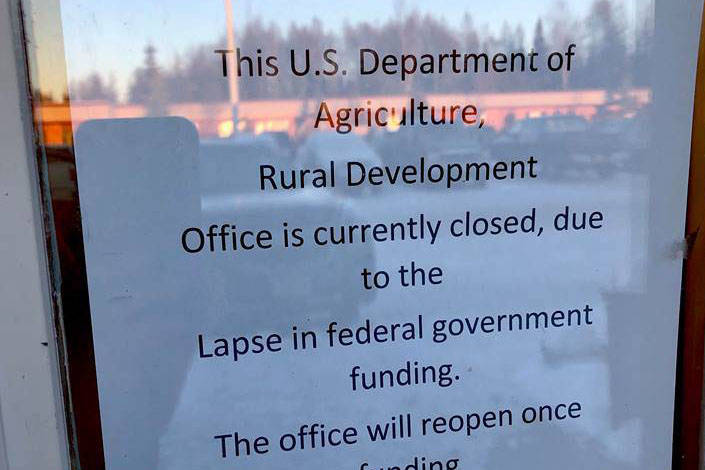
The longest shutdown in U.S. history ended Friday when President Donald Trump signed a bill to reopen the government for three weeks. Nearly 700 emails and 60 voicemails awaited Amy Milburn when she returned to work after being furloughed for 35 days. Milburn is the area director for the United States Department of Agriculture and Rural Development office in Kenai. The office is home to only two employees, including Milburn. She said the impact of the partial federal government shutdown went beyond herself and her coworker.

It was hard knowing how many people were affected,” Milburn said.

Without a regular paycheck, and with the uncertainty of when back pay will come, Milburn said she had to cut costs for her family. She said she cut $600 off her food bill.

“It had an effect on our economy,” Milburn said. “Neither of us were able to go out to eat, which means a server didn’t get a tip and a restaurant didn’t have a customer. I have more heartburn over people who didn’t get their tips.”

She said the effect wasn’t just in food consumption, but with all of her partners in the community.

In Kodiak, which is a part of the office’s service area, 20 percent of the 6,000 person population was not receiving a paycheck. Several Kodiak businesses were offering discounts and IOUs. Milburn said there wasn’t as much awareness about the shutdown on the peninsula.

“It’s not as widely felt in the community when it’s just two people (in our office),” Milburn said. “I didn’t see discounts at grocery stores or in restaurants.”

When Milburn and her coworker were furloughed Dec. 21 last year, the office wasn’t completely shut down. Natural Resources Conservation Services and their employees were funded and able to stay open. Milburn said this was a great thing, as they have more employees.

The USDA-Rural Development office has several programs that help Alaskans become homeowners. According to their website, USDA-Rural Development provides federal assistance resources throughout rural Alaska and has invested $2.16 billion dollars in 236 rural communities in the last eight years. Milburn said all of these programs were brought to a halt during the shutdown. Since furloughed workers can’t discuss work during the shutdown, residents concerned with the status of their loans couldn’t reach out to the USDA office for answers.

“Most of the housing applicants understood it was out of our control,” Milburn said.

Milburn said her office is optimistically hoping there’s not another shutdown.

“We’re glad we’re back,” Milburn said. “It’s hard not being considered essential. It’s kind of degrading.”15320013_web1_shutdown.jpg

Further assessment shows borough faced little damage in Nov. 30 earthquake

Uncategorized

Originally published in the Peninsula Clarion

Further assessments have found little damage to Kenai Peninsula infrastructure after the 7.0 magnitude earthquake rumbled Southcentral Alaska on Nov. 30 last year.

Kenai Peninsula Borough Emergency Manager Dan Nelson said all borough buildings have been deemed safe to occupy. Initially, building managers and supervisors assessed immediate damage following the earthquake. Next, Nelson said seismic specialists conducted detailed screenings of borough buildings and their final report was issued to the borough last week.

“We didn’t have damage compared to Anchorage or the Mat-Su, and the Kenai Peninsula was lucky,” Nelson said.

In their report, three buildings were flagged for further assessment by an engineer, which the borough will contract out.

Skyview Middle School, Kenai Middle School and Nikiski Community Center will all be receiving a further assessment by an engineer in the following months.

Nelson said after the earthquake there were a lot of little things that were fixed right away, such as cracks in borough-maintained roads.

In the city of Kenai, City Manager Paul Ostrander said there was little to report after damage assessments.

The Kenai dock was slightly damaged along with an inactive well house, and the building surrounding the well house, which has now partially subsided, Ostrander said.

The city also experienced a water main break in one of the city’s neighborhoods, which occurred a week or so after the earthquake and was fixed shortly after the problem was identified, Ostrander said. The break created a small disruption to the neighborhood’s water supply.

Ostrander said the dock and the well house were both insured.

Residents who experienced damage to their home have until Jan. 29 to file for federal assistance. Nelson said there were a lot of scattered incidents to homes in the borough, but that the state will handle the federal assistance process for residents.

“If you think you have damage you can report it,” Nelson said. “It’s a fairly simple to process to get started on.”

Nelson said now is a good time for residents to evaluate their own home emergency plans.

“It’s a really good time to look at any plans you have for an emergency,” Nelson said. “Just in case the next big earthquake is a little further south.”15279958_web1_47220456_581615692282053_7979177864413052928_n-1200x800.jpg

Borough works to extend state grant agreement for K-Selo

Alaska, Uncategorized

Originally published in the Peninsula Clarion

Efforts to build an appropriate school in Kachemak-Selo are still going strong.

The Kenai Peninsula Borough Assembly passed an ordinance at Tuesday’s meeting to work on extending the state agreement for their grant share of approximately $10 million for the school.

K-Selo has been in need of a new school for nearly 10 years. In 2011, the village petitioned the school board for a new facility. In 2016, the state appropriated $10,010,000 for construction of the school, but in order to proceed the borough needed to provide a match. Borough residents voted down the match bond package, which was nearly $5.5 million, last October.

The $10 million grant the borough received from the state expires June 30. Tuesday’s ordinance allows borough Mayor Charlie Pierce to work with the state on extending the grant deadline for up to seven years. Given the extension, the ordinance says the borough will have more time to find the 35 percent match funds required by the grant to construct the school.

The current school in Kachemak-Selo is made up of three borough-leased buildings and serves about 46 students. A December memo from the borough community and fiscal projects manager, Brenda Ahlberg, told the assembly that the current school has deteriorated to the point that it is no longer viable as an educational facility.

The proposed new K-12 school will be 15,226 square feet, the memo said. Some residents have expressed concern about the $16 million cost for the school, given its remoteness and small student population. However, a state statute based on the number of students dictates the size of the school, and the borough does not have the flexibility to downsize the building. Shipping in materials is also expected to increase the cost.

At Tuesday’s meeting, Jason Ross of Nikiski provided public comment expressing frustration over school’s price tag.

“We could probably build a road that would go back and forth and make things a lot easier for education and give them more opportunity,” Ross said. “With a brand new building — getting supplies in and out to build the thing — it sounds like it’s going to be kind of an arduous deal there. It might be easier to just build a road and create access for a bunch of people who don’t have it. I realize they move out there and they want to be off the system… How much money do we spend on a group of kids who choose to live a lifestyle like that?”

One of the largest drivers of cost comes from the remote nature of the village. The village sits at the bottom of a steep bluff only accessible by a dirt switchback trail, too narrow and steep for most vehicles to traverse. The borough initially considered upgrading the road to borough standards but found it would be too expensive.15260861_web1_49606043_273456466666625_3883115979974115328_n-1200x800.jpg

Kenai legislators question Board of Fisheries decision

Alaska, Uncategorized

Originally published in the Peninsula Clarion

State lawmakers from the Kenai Peninsula havebanded together to question a recent Board of Fisheries proceeding, according to a press release. 

An unexpected vote by the Alaska Board of Fisheries, which took place with little notice, decided to move the 2020 regulatory meeting from the Kenai Peninsula to Anchorage. The meeting was originally going to be held in Anchorage, but a March 2018 vote moved the meeting to the Kenai-Soldotna area, the Clarion previously reported.

In a Wednesday letter, the peninsula delegation outlined concerns the “Alaska Board of Fisheries may have intentionally circumvented the public input process that is normally required when deliberations on meeting locations are made.”

“Transparency, integrity and process are imperative in the effort to restore public trust,” said Sen. Peter Micciche (R-Soldotna) in the release. “The people of Alaska deserve better. The public process and the Board’s own procedures were circumvented and Kenai Peninsula officials were disrespectfully misled at the January 18th meeting. The request from the entire Kenai Peninsula Legislative delegation is simple and united: Rescind the actions to move the 2020 BoF Upper Cook Inlet Finfish meeting from the Kenai and reschedule a meeting following BoF procedures. Rebuilding trust must include facing and hearing from the Alaskans we serve.”

At the start of the Arctic-Yukon-Kuskokwim finfish meeting on Tuesday, Jan. 15, Board chair Reed Moriskey mentioned that the Upper Cook Inlet meeting location would be discussed. On Friday, the board reversed their March 2018 decision with a 4-3 vote, bringing the 2020 meeting back to Anchorage, the Clarion previously reported.

“There are not enough words to express my disappointment and frustrations with the Board of Fisheries. It is completely disingenuous to tell people who have driven to Anchorage from the Kenai Peninsula to testify that there would be no action taken regarding the 2020 UCI BoF meeting location. Then, to turn around and have the issue addressed after their departure,” said Representative Gary Knopp (R-Kenai/Soldotna).

The letter requests that the board allows the public adequate notice to revisit the issue.