Students get firsthand account of Soldotna’s homesteading history

Alaska, News, Print, Uncategorized

This story originally published in the Peninsula Clarion.

Third graders at Soldotna Elementary are learning all about their community. Marge Mullen, one of the city’s first homesteaders, it invited every year to teach students about what life was like in the early days on the peninsula.

Mullen showed the students around Soldotna’s historic post office, where she used to receive mail. She visited the students in their classroom earlier last week to talk about her own homestead.

“I took some survey tape and made a 14- by 16-foot square on the floor to show them that my homestead could have fit inside their school room,” Mullen said.

Third-grade teacher at Soldotna Elementary, Shaya Straw said having Mullen speak to the students is a great opportunity.

“I think it’s cool they get to have this first-hand account of history here,” Straw said.

Marge Mullen shows a group of third graders around the Howard Lee Homestead, which was used as the city’s first post office when she first homesteaded in Soldotna, on Wednesday, Oct. 17, 2018, in Soldotna, AK. (Photo by Victoria Petersen/Peninsula Clarion)Marge Mullen shows a group of third graders around the Howard Lee Homestead, which was used as the city’s first post office when she first homesteaded in Soldotna, on Wednesday, Oct. 17, 2018, in Soldotna, AK. (Photo by Victoria Petersen/Peninsula Clarion)

Marge Mullen shows a group of third graders around the Howard Lee Homestead, which was used as the city’s first post office when she first homesteaded in Soldotna, on Wednesday, Oct. 17, 2018, in Soldotna, AK. (Photo by Victoria Petersen/Peninsula Clarion)Marge Mullen shows a group of third graders around the Howard Lee Homestead, which was used as the city’s first post office when she first homesteaded in Soldotna, on Wednesday, Oct. 17, 2018, in Soldotna, AK. (Photo by Victoria Petersen/Peninsula Clarion)

Marge Mullen shows a group of third graders around the Howard Lee Homestead, which was used as the city’s first post office when she first homesteaded in Soldotna, on Wednesday, Oct. 17, 2018, in Soldotna, AK. (Photo by Victoria Petersen/Peninsula Clarion)Marge Mullen shows a group of third graders around the Howard Lee Homestead, which was used as the city’s first post office when she first homesteaded in Soldotna, on Wednesday, Oct. 17, 2018, in Soldotna, AK. (Photo by Victoria Petersen/Peninsula Clarion)

Marge Mullen shows a group of third graders around the Howard Lee Homestead, which was used as the city’s first post office when she first homesteaded in Soldotna, on Wednesday, Oct. 17, 2018, in Soldotna, AK. (Photo by Victoria Petersen/Peninsula Clarion)Marge Mullen shows a group of third graders around the Howard Lee Homestead, which was used as the city’s first post office when she first homesteaded in Soldotna, on Wednesday, Oct. 17, 2018, in Soldotna, AK. (Photo by Victoria Petersen/Peninsula Clarion)

Marge Mullen shows a group of third graders around the Howard Lee Homestead, which was used as the city’s first post office when she first homesteaded in Soldotna, on Wednesday, Oct. 17, 2018, in Soldotna, AK. (Photo by Victoria Petersen/Peninsula Clarion)Marge Mullen shows a group of third graders around the Howard Lee Homestead, which was used as the city’s first post office when she first homesteaded in Soldotna, on Wednesday, Oct. 17, 2018, in Soldotna, AK. (Photo by Victoria Petersen/Peninsula Clarion)

Henu’ Community Wellness Court honors first graduates

Alaska, News, Print, Uncategorized

This story originally published in the Peninsula Clarion.

The Kenaitze Indian Tribe Henu’ Community Wellness Court celebrated the program’s first graduates Friday afternoon at the Tyotkas Elder Center.

The Henu’ Community Wellness Court is a joint-jurisdiction therapeutic court, operated by the Kenaitze Indian Tribe and the State of Alaska Court System. The court serves offenders who face legal trouble stemming from substance use.

Kenaitze Tribal Court Chief Judge Susan Wells says the program is about transforming lives.

“When we talk about transforming lives, that’s really what it is,” Wells said. “Most people that come into the program really want to sober up and be clean.”

The program’s first graduates, Dale Vaughn and Eli Darien, were awarded many celebratory tokens, including a piece of Dentalia, which Wells said was historically used as money in the area and shows the participants they have value. Graduates also received Chaga tea, a spruce hen feather and an agate rock, which all hold important cultural significance.

Vaughn said the program has been amazing.

“Eighteen months ago, I had three years hanging over my head,” Vaughn said. “It was either do the three years or get out with no license. I’d probably be in the same boat, in and out of jail, like I was before, but this program came along. I decided to give it a try. Now look at me. It’s all been worth it.”

Darien also said his experience in the program was phenomenal.

“I had some rough spots, but I got over them,” Darien said. “It’s been just a wonderful experience. When I started the program, I pretty much didn’t have anything. Now it seems I have everything at my fingertips.”

Henu’ uses rehabilitation to reduce recidivism rates and improve the lives and the communities of program participants. The program is 18 months long and goes through a series of phases. One phase is the trust phase, where participants and the tribal court learn to trust each other through the process.

“It’s not so much that we learn to trust them to do what they’re supposed to be doing, it’s them trusting us to help them,” Wells said.

To be in the program, people must go through an interview process with tribal probation officers. Wells said they focus on people who are high risk and have high needs. Priority is given to people who have children involved. Members of the program cannot have a distribution charge.

The program is individualized for the needs of each person’s recovery, but it takes at least 18 months to complete, and sometimes even longer if the participant relapses. Wells said the 18 months is necessary to regain complete sobriety.

“They want that clean, sober life, but they can’t because of the chemicals in their brains until they can get them out,” Wells said. “A six-week program just doesn’t work; it’s not enough time. It doesn’t take care of that addictive brain. We realized early on in this program if the person is addicted or just getting out of jail and they’ve been sober for a month or six weeks, their addiction is a lot of work.”

Wells credits part of the program’s success to the Dena’ina Wellness Center and its clinicians, as well as asking the right questions.

“We have to change the questions,” Wells said. “It’s not ‘what’s wrong with you? Why aren’t you stopping? You want to. You say you want to. What’s the matter with you?’ We are asking the wrong question, and what we need to do is look deeper at what happened to you to get you on this path, and what can we do to help you get back. It’s not about us catching them doing something wrong; it’s about catching them do something right and helping them continue on this path of sobriety.”

Wells said she believed the program can help change lives and communities.

“We want to stop the recidivism, and I think we can,” Wells said.

Both Vaughn and Darien said they are excited to see what opportunities the future has in store for them.

“I can get on with my life,” Vaughn said. “I can drive legally without looking over my shoulder, you know.”

“I’m just going to keep on this path on recovery,” Darien said. “So many good things have happened to me already.”

The Kenatize Indian Tribe held their inaugural graduation for the Henu’ Community Wellness Court program on Friday, Oct. 19, 2018, in Kenai, AK. (Photo by Victoria Petersen/Peninsula Clarion)The Kenatize Indian Tribe held their inaugural graduation for the Henu’ Community Wellness Court program on Friday, Oct. 19, 2018, in Kenai, AK. (Photo by Victoria Petersen/Peninsula Clarion)

What’s next for K-Selo?

Alaska, Education, News, Print, Uncategorized

This story originally published in the Peninsula Clarion.

Bonds to build a new school in the Old Believer village of Kachemak Selo, east of Homer, were voted down last week, but the effort to build K-Selo a school is not over.

Brenda Ahlberg is the community and fiscal project manager for the Kenai Peninsula Borough. She said the borough will be working with several entities to make sure the community of K-Selo gets the facility and education they need.

“It’s important to know the voters have spoken, and respect that,” Ahlberg said. “That doesn’t mean we won’t continue to try and provide a quality education and facility for K-Selo.”

Pegge Erkeneff, communications liaison for the Kenai Peninsula Borough School District, said the district is disappointed with the results of the school bond vote.

K-Selo has been in need of a new school for nearly 10 years. In 2011, the village petitioned the school board for a new facility. In 2016, the state appropriated approximately $10 million for construction of the school, but in order to proceed the borough needed to provide a match. Borough residents voted down the match bond package, which was nearly $5.5 million, this last Tuesday.

The current school in Kachemak-Selo is made up of three borough-leased buildings and serves about 46 students. Erkeneff said the school has deteriorated beyond useful capacity. The buildings are converted homes, and students and school district officials have said the buildings are unsafe and leak in the winter, among other issues.

One of the largest cost drivers comes from the remote nature of the village. The village sits at the bottom of a steep bluff only accessible by a dirt switchback trail, too narrow and steep for most vehicles to traverse. The borough initially considered upgrading the road to borough standards but found it would be too expensive.

Some voters and assembly have expressed concern about the $16 million price tag for the school, given its remoteness and small student population. However, a state statute based on the number of students dictates the size of the school, and the borough does not have the flexibility to downsize the building. Shipping in materials is also expected to increase the cost.

With no backup plan, Ahlberg said the borough will reconvene with the school district, the K-Selo community, the state Department of Education and Early Development and the state legislature to discuss what’s next for the project.

“This project is not going to die,” Ahlberg said. “We will work with DEED and the state legislature on the current grant, so we can try to flesh out all options and we can build a school for this community.”

The $10 million grant the borough received from the state expires next year.

The borough is still required to provide a suitable school for the children of K-Selo and may have to fit the bill if the grant expires without any matching funds.

Future of Kenai bowling alley in limbo

Alaska, News, Print, Uncategorized

This story originally published in the Peninsula Clarion.

Members of the public came out Wednesday night to urge Kenai City Council members to support Charlotte Yamada’s effort to reopen Kenai’s bowling alley.

Yamada updated the council on recent actions she’s taken to gather funding for the bowling alley, which would help fund equipment updates. Yamada has been working towards reopening the bowling alley since it closed in late 2015.

“It is taking a long time to get this process done,” Yamada said. “It’s a very specific business we are trying to get back up and on its feet, and that in and of itself is kind of what we are fighting against.”

Because of the specificity of the business, and because there are so few bowling alleys in the state, getting funding to update the building to code and to buy equipment is proving difficult.

The Kenai City Council held an executive session at the end of their Wednesday meeting to discuss a request for renegotiation of terms regarding the sale of the bowling alley property. The council unanimously passed a motion authorizing the city manager to renegotiate the terms of the bowling alley opportunity. The administration came to no decision but said at the meeting they are going to continue negotiating with the owner of the building, Sue Chang, and her business partner Yamada.

Yamada said Thursday that progress with the bowling alley is up in the air. At Wednesday’s meeting, she was optimistic about the bowling alley’s potential.

“It does lend itself to being just what our community needs,” Yamada said. “I’m just crazy enough to jump on board.”

The bowling alley was built in 1984 as Kenai Bowl. It sat on city-owned land in Kenai’s airport reserve, and the owners paid an annual lease, which went to support the Kenai Municipal Airport. Most recently, Ken Liedes, who operated the business as Alaskalanes, owned the bowling alley. The Clarion previously reported his annual lease to the city was $27,000, which he defaulted on before shutting the alley’s doors in late 2015. The city reclaimed the building and sold it for $450,000 in February of last year to Anchorage-based commercial real estate consultant Dean You.

Kenai resident Teea Winger also spoke to the council in support of the bowling business. She said bowling league dues alone would offer a significant profit to the bowling alley. Winger said it would cost her $2,500 in dues for one bowling season. With 12 lanes and four to five people on a team in each lane, she said the bowling alley would have a strong market.

“We’re trying to definitely build up the city of Kenai,” Winger said. “Between this, and the arcade that’s going in, this will really give a lot more activity to the Kenai area than we’ve seen in the past.”

Jeanie Carter, Yamada’s aunt, said the bowling alley would be another place for young people to hang out in the community.

“It’s really nice to know that there’s going to be somewhere else you can go as a couple or as a family besides the movies or out to eat,” Carter said. “That starts adding up dollar wise and weight wise. I have two special needs kids that are very active and I would love to see another place for them to go.”

RaeEllen Kurzendoerfer is a Kenai resident, mother and educator. She also sees the bowling alley as another option for the community’s youth.

“I have six children of my own… My two younger boys are always asking me ‘mom when can we bowling?’ andIhave to tell them that we have to go all the way to Anchorage to go bowling,” Kurzendoefer said. “It’s been a huge part of our community and I think with the Yamadas running the business it will flourish for the youth in our community.”

Voters reject K-Selo bond proposition; oust incumbents in municipal elections

Alaska, News, Print, Uncategorized

This story originally published in the Peninsula Calrion

Peninsula voters shot down a controversial proposition to fund a new school, passed another to move the border between the Central and South Peninsula Hospital Service Areas to the true midway point, and elected some fresh faces to both the borough assembly, school board and city councils.

Tuesday night’s unofficial results, with all 28 precincts reporting, show Proposition 1 failing by nearly 60 percent and Proposition 2 succeeding by 65 percent.

Many candidate races on the central peninsula were uncontested, while some were more competitive. In Kenai, three candidates, Robert Peterkin II, Teea Winger and Bob Molloy were running for two vacant city council seats.

Carol Baumer, a retired Kenai resident, said voting for Teea Winger for the Kenai City Council brought her to the polls Tuesday.

“It’s a chance to sort of do something different,” Baumer said. “We’re all aging. It’d be nice to kind of get newer people in as the rest of us age-out.”

Newcomer Peterkin II was elected to the Kenai City Council, along with incumbent Molloy. Winger fell short by only 49 votes.

“I certainly appreciate the confidence of the voters and congratulate both Robert Peterkin and Teea Winger on a really good race,” Molloy said. “I’m looking forward to working with Peterkin and the other city council members.”

In Soldotna, all three candidates ran unopposed for the three open council seats.

Todd Paxton came out on top in the Nikiski Fire Service Area board member race against Peter Ribbens.

In the contentious southern peninsula Borough Assembly race, incumbent Willy Dunne beat out Troy Jones with 626 votes against 541 votes.

In the central peninsula, both borough assembly candidates ran unopposed. District 1 candidate Hibbert came in with 426 votes for the Kalifornsky area. For District 6, which includes Seward, Hope, Moose Pass and north Sterling, Kenn Carpenter received 669 votes.

Greg Madden leads the four-way District 5 School Board race, with over 163 votes ahead of 15-year incumbent Marty Anderson.

“Congratulations to Madden,” Anderson said. “It was a privilege to serve on the school board for 15 years. It was the longest I’ve ever done anything. I hope Mr. Madden learns quickly because there’s a lot of things coming up for the school district. I wish him well.”

Nine-year incumbent Tim Navarre lost by 43 votes to Matthew Morse, in the District 2 School Board race.

“I’m happy to win and I hope to do some great things for the school district,” Morse said.

At polls from Sterling to Ninilchik, voter turnout seemed somewhat sparse, with intermittent bursts of activity that kept poll workers on their toes.

Preliminary numbers showed 9,113 voters turned out for the elections this year, down from recent years. Unofficial results show 9,113 ballots were cast, out of 47,158 registered voters — approximately 19 percent of the population. In the 2017 Regular Election, 15,177 of the 44,951 registered voters cast ballots — approximately 34 percent of the population. Only about 21 percent of registered voters cast ballots in the 2015 regular elections.

On the central peninsula, voters seemed most concerned with the K-Selo bond proposition, which would provide $5,390,000 to help build a new school in Kachemak-Selo, an Old Believer village east of Homer. The Kenai Peninsula Borough was awarded a $10,010,000 grant through the 2016-2017 state capital budget. Under the grant program, the borough must provide a 35 percent match of $5,390,000. Some voters said the K-Selo bond proposition was the primary reason they showed up at the polls.

In Kenai, Kaye Reed said she came out to vote because it was her civic duty. She said she supported the K-Selo bonds because it means the peninsula is growing.

“If we’re needing to build a new school, that means we’re having growth, and that means we should be building new schools,” Reed said.

In Soldotna, teacher Bristol Demeter said supporting education by approving the K-Selo bonds was the main reason she came out to vote. Chad Sorenson, also in Soldotna, said he came out to vote because it was his civic duty. He said he also supported the K-Selo Bond issue.

“I think the school bond is important,” Sorenson said. “It’s just the right thing to do for the little kiddos.”

In Sterling, Ted Moran said he came out specifically to vote against the K-Selo bond proposition.

“I think it’s just a waste of money for such a small area,” Moran said.

In Ninilchik, Marti Chapman also visited the polls to support the bond.

The bonds failed with 4,431 ‘no’ votes.

Although the K-Selo bond was the focus of many ballots on the central peninsula, many were ambivalent when it came to Proposition 2, which moves the common boundary between Central Peninsula Hospital Service Area and the South Kenai Peninsula Hospital Service Area 15 miles south. The boundary between the two hospitals has always been at the Clam Gulch Tower along the Sterling Highway, which is 14.5 miles closer to the Central Peninsula Hospital than the true midway point. Chapman said she spent more time reading up on other issues.

“I didn’t do enough reading on that,” Chapman said. “I’ve been educating myself mostly on what’s coming up (in the mid-term election), with proposition 1.”

The proposition to move the border to the midway point was successful with over 65 percent of voters supporting it.

Reach Victoria Petersen at vpetersen@peninsulaclarion.com.

Kenai City Council candidate Teea Winger and her husband hold campaign signs for passing motorists along the Kenai Spur Highway on Tuesday, Oct. 2, 2018 in Kenai, Alaska. (Photo by Erin Thompson/Peninsula Clarion)

Kenai City Council candidate Teea Winger and her husband hold campaign signs for passing motorists along the Kenai Spur Highway on Tuesday, Oct. 2, 2018 in Kenai, Alaska. (Photo by Erin Thompson/Peninsula Clarion)

A supporter of Robert Peterkin, who ran for Kenai City Council, campaigns along the Kenai Spur Highway on Tuesday, Oct. 2 in Kenai, Alaska. (Photo by Victoria Petersen/Peninsula Clarion)A supporter of Robert Peterkin, who ran for Kenai City Council, campaigns along the Kenai Spur Highway on Tuesday, Oct. 2 in Kenai, Alaska. (Photo by Victoria Petersen/Peninsula Clarion)

School district sees rise in homeless students

Alaska, Education, News, Print, Uncategorized

This story originally published in the Peninsula Clarion.

The Kenai Peninsula Borough School District has seen a 42-percent increase in their Students in Transition program from this time last year. The 16-year-old program provides services to homeless students and students no longer in the custody of their parent or legal guardian.

As of Sept. 12, there have been 98 students referred to the program. There were 69 students identified at this time last year.

“These are only the students we know of, not necessarily all the homeless students present within our District,” Kelly King, the district’s Students in Transition coordinator, said. “We work very hard to identify and support as many as we can, but we know there are more that we aren’t aware of, for a variety of reasons.”

King has been the coordinator for nearly 11 years, and works with Jane Dunn, a liaison in Homer who serves the southern peninsula.

“Our job is to identify homeless students within the school district,” King said.

Referrals come from a variety of places, including students, parents and school staff. When a student is referred, King does a needs assessment to make sure the child qualifies for the federal definition of homelessness. After a student is enrolled, they are enrolled for the entire school year. Youth enrolled in the program must be attending school. Needs relating to school attendance are addressed by the program, including school supplies, hygiene products, free meals, transportation to and from school and all of those things that can be a big stressor for a family when they’re housing situation is vulnerable, King said.

“Our whole goal is to make sure students have access to education and that they can have everything they need to succeed while they are there,” King said.

Enrollment in the program is always high at the beginning of the year. However, King said she couldn’t attribute any one thing to the rise in enrollment this year, compared to last year. There is no carrying over from one year to the next — each student must re-enter the program every year.

“Are staff and teachers getting better at identifying students?” Pegge Erkeneff, the district’s communications liaison, said. “Kelly said ‘no,’ it’s nothing specific.”

Erkeneff said the spike in enrollment is interesting because of the nicer fall weather the area has been experiencing.

“We always see a spike when the weather gets cold,” Erkeneff said. “So, in the fall when it gets colder, numbers jump. Or as soon as we have our first big cold spells in October and November, we’ll see a spike. But now, it’s warm. The weather is nice. For people who are tent camping, the weather isn’t affecting them that much, yet.”

King said families will often do the best they can until the cold hits, after which those families tend to reach out to available resources.

Enrollment will continue to grow all the way until the last day of school. On average, the program serves around 250 students per year.

“Even if a student becomes permanently housed, the chances of them becoming homeless again are very high, “ King said. “We really try to follow with the support and services for the entire year.”

King said the central peninsula is one of the only communities of its size that does not have a family or youth shelter in place.

“We’re not driving by those facilities on the Kenai, because they don’t exist,” King said. “It takes our attention away from an issue that is actually happening. Bringing awareness that homelessness is even a problem in our community is huge because it’s rather invisible.”

Homelessness within the district is spread out. In areas with a larger population like Homer and Soldotna, more students are enrolled in the program.

In Nikiski, there are six students enrolled in the Students in Transition program. In Kenai, that number is more than double, with 15 enrolled. Seven Kasilof students are enrolled in the program. In Soldotna and Sterling, there are 22 students enrolled. Six Seward students are enrolled in the program. Homer has 27 students enrolled, and the combined area of Anchor Point, Ninilchik, Nanwalek, Port Graham and Seldovia has 15 students enrolled in the program.

The district used to hold a vigil for homelessness to bring awareness to the issue. One year, an anonymous donor donated $10,000 to the program, Erkeneff said.

People who are interested in donating to the program can help in two ways. There is a donations account set up for the program that becomes useful after grants run out, which King said is usually around Christmas. Another way is to support the agencies that support the children outside of the district like the Kenai Peninsula Food Bank, Love INC, and the LeeShore Center.

King said students and families become homeless for a variety of reasons, including domestic violence, natural disaster, illness or disease and little-to-no health insurance, lack of affordable housing within a community, divorce or death in a family, substance abuse or mental health disorders, loss of a job or lack of employment or abandonment.

“There is no single reason why people experience homelessness, despite certain stereotypes that are often presented,” King said.

Farm to food bank: Equipment rental leads to community benefit

Alaska, food, News, Print, Uncategorized

This story published in the Peninsula Clarion and picked up by the Associated Press.

Kenai Soil and Water Conservation District are expanding their catalog of affordable agricultural rental equipment through a charitable project that benefits both farmers and the community.

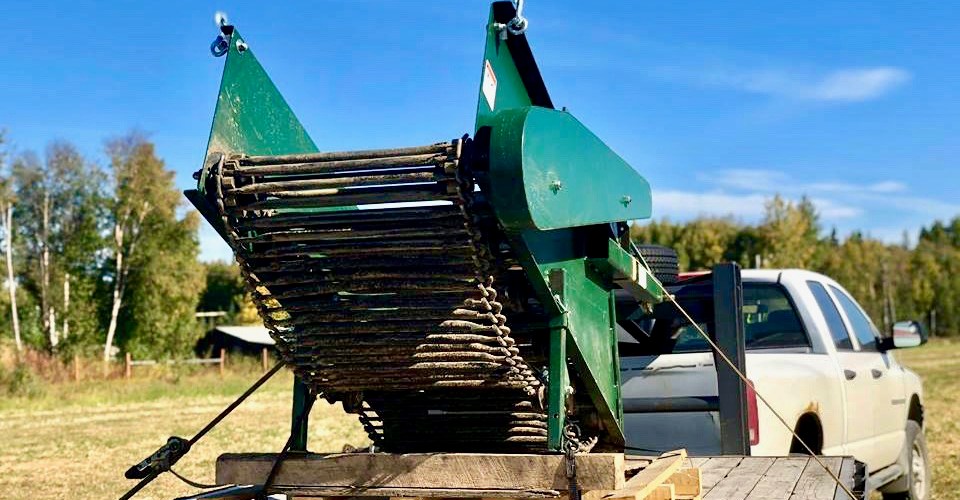
Three pieces of equipment, which includes a potato digger, a potato washer and a potato planter, were purchased with the assistance of grants from the Kenai Peninsula Foundation, the Rasmuson Foundation and Western SARE. The equipment can be rented to small-scale farmers for $25 day, plus a donation of 25 pounds of potatoes to the Kenai Peninsula Food Bank. It’s a small price to pay for equipment that could cost a single farmer thousands.

“I couldn’t afford to buy a new potato digger,” Abby Ala, owner of Ridgeway Farms, said.

The equipment works on a single row of potatoes, or another root crop, and is “infinitely faster” than the old fashioned way, Ala said.

“I would harvest on my hands and knees,” Ala said. “I’m 71 years old. It would take me an hour to go halfway down one row.”

Many small-scale farmers don’t have the funds to invest in such expensive equipment. Kenai Soil and Water Conservation District is trying to make small-scale agriculture easier and more accessible.

It took three years to get the potato digger, washer and planter equipment.

“We’ve been hearing from small-scale potato farmers for years that a single row potato digger would make life so much easier,” Chay said. “I first spotted the equipment at an expo in Michigan and said ‘we could really use those.’”

Kenai Soil and Water Conservation District rent out farm equipment of all kinds.

“They have more than just the potato digger,” Ala said. “They have everything a farmer might need. It is too expensive for every farmer in the area to buy this and buy that. I’m really impressed with soil and water for doing that.”

Chay said five farms have shown initial interest. Ala at Ridgeway Farms was among the first to try out the potato digger. The potato planter will be used in the spring.

Chay said Kenai Soil and Water Conservation District and the farms are excited about the new equipment.

“One farmer told me that he’s never digging a row of potatoes by hand again,” Chay said.

Food on the go: Trucks help local chefs make restaurants a reality

Alaska, food, Print, Uncategorized

This story originally published in the Peninsula Clarion.

The peninsula food scene Joe Spady grew up with is much different than the food scene in the area now. The 30-year-old, who opened Joe’s Meatball Shoppe in Soldotna earlier this summer, said he’s seeing more local food, different kinds of food and an increase in the number of food trucks in his hometown.

“The food scene is growing amazingly,” Spady said. “It was a different food scene than I grew up in, which was just the same four identical restaurants.”

Spady recalls area restaurants selling ubiquitous fare, like burgers, fries, tacos and pizza, but not much else. It didn’t seem people were craving much else, Spady said.

“It’s neat to see the shift in people really wanting more,” Spady said. “It’s not that we simply didn’t have it, it’s that people weren’t asking for it.”

These days, peninsula palates are hungry for something new. Wanna Kane lives in Nikiski. Last June, she opened up her food truck, Tuk Tuk Express where she sells Thai-style street food. There are only a handful of restaurants in Nikiski, and Tuk Tuk Express offers something less typical than what’s found in the area. Kane was able to find a spot to park near her home, where she is open Monday through Friday, and has partnered with local brewery, Kassik’s, to provide sustenance for beer-drinkers on Friday nights. Kane said even in the short time she’s been in business, she’s seen her business grow and the community welcome her.

“When I first opened it was slow, but very steady,” Kane said. “People are used to us being here now. It is just a different variety for Nikiski. People seem to like the quick, pick-up-and-go (style) of a food truck. We don’t see many food trucks out in Nikiski. Most are in Kenai and Soldotna, but I’ve seen growth, even in the short time I have been in business.”

When trying to come up with the concept of his food truck, Spady brainstormed food not readily available in the area.

“We don’t have a meatball shop,” Spady said. “In New York, there’s a pretty popular shop called ‘The Meatball Shop.’ I loved that place when I lived in New York. So I was thinking, what if I do that and kind of just transition all my sandwiches into meatball form… it’s fun to be a specific niche, while still doing what I’m passionate about.”

Once he created his menu and brand, Spady was ready for business. For many, the cost of a food truck is often what holds aspiring cooks back from their mobile eatery dreams. The Kenai Soil and Water Conservation District offers an affordable way for new business ventures to feel the industry out through the rental of a small trailer equipped with a kitchen: the ideal starter food truck.

“I was originally going to get a booth and rent a kitchen, but the opportunity to have it all in one was so nice,” Spady said. “It’s crazy affordable. So many people are like ‘oh you’re starting a food truck. How fun. I’ve always dreamt of starting a food truck.’ That’s when I’m like, ‘our state is so good for small business and with this opportunity, literally $100 and you can start your food truck this week.’”

Heidi Chay, district manager of Kenai Soil and Water Conservation District, said the trailer, which was acquired in 2007, was originally set up as a test kitchen and a small business incubator. The Kenai Soil and Water Conservation District rents out other equipment that can help small businesses, especially farmers. The trailer is used at the Kenai Peninsula Fair for the 4-H barbecue, fundraisers and small businesses who want to test new products. Since Spady started Joe’s Meatball Shop, Chay said she’s received several inquiries for the trailer from people interested in developing their small business ideas.

“Turns out a lot of people have this food truck dream,” Chay said. “This has been the turnaround year because Joe is so generous about telling people about us.”

Andy Heuiser is the events and program director at the Soldotna Chamber of Commerce. He’s been working closely with food vendors through events put on by the chamber, including the Wednesday market, which sees perhaps the largest concentration of food trucks in the area. He said the food vendor scene really took off around 2014, just around the time Music in the Park was starting.

“When Music in the Park started, I think it really helped those food vendors quite a bit,” Heuiser said. ”They have a good customer base with the lunch rush and then with the evening rush.”

Originally, Spady was hoping to set up Joe’s Meatball Shop at the Wednesday Market, only to find there was a waitlist for food trucks.

“Professionally, I’m (upset), but personally, I’m so excited for our community,” Spady said. “What a wonderful problem to have. There’s so much variety. The variety of food trucks we have is way bigger than the variety of restaurants we have in town, which is so cool.”

To accommodate this new type of eatery, the city of Soldotna had to modify its regulations in 2015 to make it simpler for mobile food vendors to do business. Director of Economic Development and Planning for the City of Soldotna, John Czarnezki said he thinks the updated codes have been well-received by businesses.

“I can’t say whether the code changes have promoted small business — we have no way to measure,” Czarnezki said. “But, anecdotally we have noticed a large number and variety of food trucks in the area.”

Czarnezki said there are many factors that can influence food truck growth, like the number and type of events and venues where they can operate, the status of brick and mortar restaurants, and the health of the local economy.

In Kenai, where Tammy Olson runs Double O food truck, there are far fewer food trucks operating. Olson said this is because of ordinances maintained by the city that make it difficult to run a food truck.

“Kenai needs to change its ordinances,” Olson said. “They are not food truck friendly.”

Double O started in April of 2015. The food truck moved its business into the airport in 2016. The business left the airport restaurant location this year, and continues to operate out of the Double O trailer, where Olson said they make triple the business compared to the airport.

“It seems people enjoy food trucks more than a restaurant,” Olson said.

Elsewhere on the peninsula, food trucks have appeared in even the smallest of communities. In Cooper Landing, David Bond opened up Blue Yeti in 2015 in front of the grocery store. When Bond first opened, two other trucks also opened in the area. One truck went out of business, and the other is Libby’s Bites on the Fly, which sits near Wildman’s.

“I thought that I had a great idea, only to find out two more trucks were opening at the same time,” Bond said.

He said he had his fair share of challenges starting his truck in Cooper Landing. Finding a spot to park that had visibility, a power source, a restroom nearby and parking with the ability to turn around was difficult for Bond. Blue Yeti is also a solo project for him.

“My biggest challenge is working alone,” Bond said. “I do the planning, purchasing, preparation, order taking, cooking and all the washing by myself. It’s a one-man show, but that may be some of the appeal.”

Despite these challenges Bond says the experience is a blast.

“I get to sit in the center of town and visit with many of my customers, who are good friends as well,” Bond said. “The opportunity to do quality, small-batch cooking is also fun for me. I like to pass the goodness onto others.”

Spady said he’s learned a lot since starting Joe’s Meatball Shop, and that it’s been challenging due to space. He said he plans to be open through the end of summer and then will most likely move Joe’s Meatball Shop into its own brick and mortar this winter.

Reach Victoria Petersen at vpetersen@peninsulaclarion.com.


Solar power growing on peninsula

Alaska, News, Print, Uncategorized

This story published in the Peninsula Clarion.

Stephen Trimble wants everyone to know that the business of solar power is growing. His company, Arctic Solar Ventures Corporation, has been installing more and more solar panels on the central peninsula.

In 2016, when Trimble’s company first started, it put up around 120 panels. In 2017 that number ticked up to set more than 1,000, and so far this year they have already surpassed a thousand.

‘We’ve seen a huge uptick in volume,” Trimble said. “There’s a lot of different tangible outcomes that come from solar.”

One of Arctic Solar Ventures’ recent customers is Dale Bagley, one of the owners of Redoubt Realty. On July 14, he installed 48 panels on the Redoubt Realty building on Kalifornsky Beach Road. He said he was interested in solar power because of the cost savings. The panels cost him a total of $50,000, but he’s expecting to save over $3,000 a year.

Bagley was awarded a $13,800 grant to help pay for the cost of the panels on his commercial property. He says there’s a lot of tax benefits and government rebates for those interested in getting into solar.

“I can’t say I ever thought two hoots about doing solar,” Bagley said. “I was never part of that group, but now I’m in it for the savings perspective.”

On an average day, Bagley’s building uses roughly 50-kilowatt hours, which is the total amount of energy used in an hour of time. So far, his best day for solar energy production has been 100-kilowatt hours, which is twice as much energy as he needs. The excess energy can’t be stored, and it goes back into the grid to help power neighboring buildings. Bagley then receives credit on his electricity bill for the energy he put back on to the grid.

When Bagley was first looking into solar, one of his biggest worries was how clunky chrome and flashy equipment on the roof of his building would look, he said. However, Arctic Solar Ventures uses a matte black set up to attract the sun and the heat. This is most useful in the wintertime when snowfall might cover the panels.

“All the panels are black with black hardware,” Trimble said. “(The panel) absorbs more heat to help melt the snow off of them. Also, building the panels vertically gets rid of the snow problem.”

Trimble said one of the biggest myths about solar power in Alaska is panels don’t work well in the cold.

“Our seasons have changed quite a bit and there’s less snow on the ground, which has improved viability for solar,” Trimble said. “Solar panels produce more electricity the colder it gets. In places like Arizona, where people think solar can crank for days, they get damaged by the heat. Colder air is a secret advantage we have.”

Voltage levels and the value of solar power is diminished in the darker months of December and January, Trimble said.

Though interest in solar energy has been gaining traction recently, it’s not brand new. Anchorage-based renewable energy company Lime Solar, which was founded in 2013, maintains an office in Homer. Soldotna-area contractor Gary Dawkins has been installing wind turbines and solar panels for 28 years for a variety of homes and businesses, including some on the remote west side of Cook Inlet. For the last four years, the city of Seward and the Seward Sustainable Energy Group have hosted a Seward Energy Forum and Fair focusing on renewable energy sources — including solar —in Alaska.

The Kenai National Wildlife Refuge’s new visitor center has been investing in solar power since it first opened its doors in May 2015. The center uses a pair of 60 square meter solar arrays, which are expected to provide between 3 and 10 percent of the headquarters building’s power with more during summer months.

On a community level, there’s new potential for solar power. Homer Electric Association has been seriously looking into solar power over the last year. Bruce Shelley, director of member relations at HEA, said awarding the contract for the community solar project, which would be Alaska’s highest-capacity solar farm, was brought to a standstill with a tie vote at HEA’s March 12 board meeting. The proposed solar farm would be positioned at HEA’s Anchor Point substation and would take place through a purchase tower agreement, which means a contractor provides a bid to build an 800,000-watt system, and HEA purchases the power from it.

However, Shelley said HEA isn’t done yet. After HEA’s annual meeting on May 3, a member survey, which asks for a $10 pledge of support, has been distributed as a way to gauge interest in introducing solar power.

“We’ve been encouraging members to make pledges, and so far almost 50 people have signed up and have pledged,” Shelley said. “We are pushing it hard.”

In the fall, the board members will vote again if they want to award a contract for the solar project.

Also on July 14, borough assembly member and owner of Alaska Cab Brent Hibbert had Arctic Solar Ventures place 30 panels on his home. He said solar power could help him become more self-sufficient and that he’s already noticed a difference.

“I hope (solar power) is growing,” he said. “It’s a little expensive to get into, but it pays for itself.”

State mistake triggers Medicaid repayments from providers

Alaska, News, Print, Uncategorized

Originally published in the Peninsula Clarion.

Speech pathologist Carma Shay will have to find a way to reimburse the Alaska Department of Health and Social Services an estimated $8,000 in Medicaid payments the state said it paid in error.

The state is seeking about $15 million in Medicaid funds that were paid in error to over 1,000 healthcare providers in the state.

“This is just horrible,” Shay said. “How are we supposed to continue to serve our clients when all of the sudden we’re being told, ‘You know what? We need to go back and make you pay back 10 percent?’”

Shay is the owner and sole provider of Take Home Speech, a Kenai speech pathology clinic focusing on speech and swallowing health in children. Shay said 90 percent of her clients use Medicaid and that she’s the only Medicaid speech therapy provider on the central peninsula that offers in-home care for her patients.

“It’s important for a child to feel comfortable, especially when I’m demanding they do something really hard, like talk when they can’t, so I like working where they are comfortable,” Shay said. “The clients really need these services, but they are unable to pay (without Medicaid).”

Medicaid is a public insurance available to children and adults who meet the income or health condition requirements. The funds for the program are appropriated by the Legislature each year. About 28 percent of Alaska’s population were on Medicaid as of May 2018, according to the Center for Medicare and Medicaid Services.

The state is still calculating the exact figures each provider owes, but Shay said she’s expecting to pay back around $8,000. The recoupments are based on services billed to Medicaid between October 2017 and the end of June when the Department of Health and Social Services realized it was paying too much.

In preparation for the fiscal year 2018 budget, the state reduced Medicaid rates by 10.3 percent as a cost-saving measure, said Jon Sherwood, deputy commissioner for Medicaid and health care policy for the department. However, the reduction, which was supposed to be implemented Oct. 1, 2017, wasn’t applied until June 11 of this year because of an administrative oversight, he said.

“We did not submit the work order required to implement it,” Sherwood said.

Since the oversight, Sherwood said the department has updated its policies and procedures to reiterate staff responsibilities. Sherwood also said that nothing like this, that he knows of, has happened before.

Now, the state is asking for the money back.

“We recognize this is going to potentially put a financial burden on our providers, and we deeply regret the oversight,” Sherwood said.

Providers were notified on June 29 about the recoupment, and Sherwood said the department will very soon be reaching out to providers by letter and phone call to update the amount owed and to discuss a plan for payment. There will be several ways providers can pay: either as a lump sum or through installments. Hardship waivers are also available upon request and approval.

Shay said she doesn’t have $8,000 saved up for this.

“If I knew this was coming I would have stashed some money away,” Shay said.

Central Peninsula Hospital in Soldotna is expecting to pay more, somewhere between $200,000 and $300,000, according to the hospital’s government and external affairs director, Bruce Richards.

“It was a surprise,” Richards said. “But I certainly understand how this happens. It’s not a make or break issue for the hospital.”

Both Shay and Richards said the recoupment or the rate adjustments won’t affect the number of Medicaid clients they take on in the future.

“For me personally, it’s definitely not going to stop me from providing services to the clients, because they need it,” Shay said. “These are usually clients that don’t have the financial ability to pay for it.”

However, the recoupment and the 10.3 percent readjustment that was implemented this summer is creating, what Shay calls, “a scary time” in her practice.

“It’s cut back on my time with the families,” Shay said. “I used to offer one-hour sessions, and now I just can’t do that anymore. I offer half-hour sessions. It’s kind of disappointing because I’m cutting back on the time I’m spending with clients, but all of my families have been really understanding.”

Funny River Festival supports community’s ‘great big living room’

Alaska, Print, Uncategorized

Originally published in the Peninsula Clarion.

Mary Youngman describes the Funny River Community Center as the area’s big great living room.

She’s the advertising chairwoman for the Funny River Community Association, which is hosting the Funny River Festival this weekend.

The festival is the only big event the community association organizes, with the proceeds going towards keeping the community center running.

“It’s kind of our only real big money maker,” Linda Vizenor, who is helping plan the festival, said. “It’s what supports us.”

The small building on Pioneer Access Road, about 13 miles down Funny River Road, sits near the community’s new playground, paved walking trail, basketball court, pickleball court and sledding hill. During the 2014 Funny River fire the community center quickly expanded into a disaster relief center for area residents affected.

The community center offers events for the public nearly every day of the week, including a cards night, a quilters meeting, craft groups, an exercise group and on the first and third Friday of every month a volunteer cooks soup for the center.

Youngman moved to Funny River from North Pole about seven years ago. She’s been attending the quilting club at the community center almost as long.

“(The community center) really serves as the gathering spot for the residents here and the community,” Youngman said. “The community center is really special for me.”

Youngman said she’s hoping the festival generates enough funds to keep the community center’s lights on and doors open.

“We’re working towards just keeping a place for the community, you know as we age we don’t just sit home and rock and read, or watch TV,” Youngman said. “We get involved with people.”

The Funny River community has been traditionally home to retirees and seasonal residents. The 2010 census shows that 50.2 percent of the population is 45 or older, with a median age of 45. However, both Youngman and Vizenor are seeing younger families move in.

“There’s a lot of young families building out here or have moved in here,” Vizenor said. “We can only tell by seeing how many kids use the playground we built.”

Vizenor moved from Eagle River to retire in Funny River 11 years ago. She worked on getting the playground installed near the community center, which some residents didn’t necessarily see a need for.

“I know when we first started looking to try to put the playground in there were a lot of people that said, ‘Well, there just isn’t anybody to use it,’” Vizenor said. “I had come from a parks background and I said, ‘If you build it, they’ll come.’ It’s been amazing to see. When we were playing bingo the other night, a group of teens came and played basketball all evening. I was so thrilled to see them.”

Vizenor and Youngman both said that the winter population is growing as well.

“The population drops in half in winter, but now there’s a lot of people moving in, and those of us that are used to having our roads to ourselves are going to have to learn to share,” Vizenor said.

To celebrate their growing community, Youngman said the Funny River Festival is a place where neighbors can catch up with each other while participating in games, tournaments, an auction and other events.

“It’s more of an old-fashioned get-together,” Vizenor said

The events begin Friday with a golf tournament at 10 a.m. and playing card tournaments for cribbage, nickels and pinochle at 6 p.m., with a split the pot raffle to end the night.

Saturday starts at noon with an opening ceremony, more games, arts and craft vendors and a cake walk. There will be a kid run for children 8 and under at 1 p.m. and a brisket dinner at 5:30 p.m., followed by bingo at 7:30 p.m.

Sunday starts at 9 a.m. with a pancake breakfast, a live auction at noon, with the festival’s main raffle to follow.

Main raffle prizes include a chest freezer filled with 175 pounds of meat, a Traeger grill, a chainsaw and more. There will daily snack bars and door prizes. Live music will be played throughout the weekend, as well.

The festival is Aug. 3, 4 and 5 at the Funny River Community Center, 35850 Pioneer Access Road.

A hub for industry becomes a community with opening of Nikiski youth center

Alaska, News, Print, Uncategorized

This story originally published in the Peninsula Clarion.

Nikiski, an industrial base for oil, gas, mining and fishing for decades, was once rich with industry money and a number of bars, restaurants, cafes, and independent video store and even an arcade. As oil prices plummeted and a fabrication plant and fertilizer producer closed, so did many of the area’s businesses. Now, community members are working to revitalize the area.

Todd Brigham grew up in Nikiski. He left for college and returned more than nine years ago with his wife to start his family. Last month, Brigham quit his job as an engineer for ConocoPhillips to give back to his hometown. Now, he said he’s working harder than he ever did as an engineer.

“We want to help our youth navigate life,” Brigham said. “The Compass is really about building relationships, and teaching practical life skills, and really getting the youth pointed in a healthy direction.”

Brigham and his wife Emily are starting the Compass, a youth center, they hope to open just in time for school to start. Currently under construction, the center will feature a lounge area, games, pool table, air hockey, foosball, computers for children to work on homework, a conference room where Brigham hopes to offer work sessions on personal finance, first aid and other practical knowledge, a shop area where kids can learn to make ceramics with the center’s donated wheels and kiln and a coffee house that community youth will help run in the morning. Brigham said the revenue made from the cafe will support the center and will be open to the public every morning.

A 1953 Willys pickup truck donated by Brigham will also offer youth an opportunity to learn about automotive restoration.

“We can paint it Compass colors and drive it in the Fourth of July parade next summer,” Brigham said.

The youth center is located next door to M &M Market, near Nikiski Middle/High School, and is geared towards children in that age range. Drop-in service will run from 2:15–3:30 p.m. on weekdays.

In the summer, Brigham hopes to offer outdoor programs where youth can go canoeing and hiking in the area.

“It’s actually surprising, a number of the youth around, even though we have it all around us, they’ve never been out,” Brigham said. “We want to get them out in creation and enjoy the rivers and the hills.”

Brigham has worked with many of the youth in Nikiski through his church, Lighthouse Community Church. He’s setting the Compass up as a faith-based organization, but the center is open to any youth in the area.

“I’ve met a lot of good kids, with a lot of ideas a lot of talent, but not a whole lot of direction,” Brigham said. “There’s a number of youth that I’ve run into or stopped by that aren’t really involved in anything and, or dropped out of school. I think we can really fill a gap where they can really have a place to belong and help some of them through the tough years of being a teenager. (Nikiski) is a place where there’s not a whole lot to do around here, (the Compass) is a place where they can come and hang out.”

Residents of Nikiski say they see a need for the Compass and more community centers, as well. Stacy Oliva, a co-vice chair of Citizens for Nikiski, Inc., a group petitioning the state to incorporate Nikiski as a city, and a member of the North Peninsula Recreation Service Area Board, said she loves the concept of the Compass.

“It’s definitely needed,” Oliva said. “It’s so needed in every community, and it’s neat they chose here.”

There were no community centers like there are now when Oliva was growing up in Nikiski in the 70s.

Both Oliva’s maternal and paternal grandparents homesteaded in Nikiski in the 1950s. She said she’s seen Nikiski change from a homestead area to a growing community.

“[Nikiski] lost its homestead feel,” Oliva said. “We always had really small family get-togethers and we relied on each other, shared things. It’s more commercialized now, and we don’t have neighborly gatherings like we used to, but now there are so many events where people are getting together here.”

She said she’s seen more families come to Nikiski in pursuit of a rural lifestyle, and a growth in agricultural enterprises, including marijuana.

“It’s still very industrial as an area, but it’s definitely very family-oriented,” Oliva said. “Nikiski is very unique and it has great families.”

While there is a growth in families, Oliva said Nikiski has also seen a growth in criminal activity, which she said is the community’s biggest drawback.

“Unfortunately, remoteness has left the door open for criminal activity, more so now than in the (Trans-Alaska Pipeline System) days,” Oliva said. “It’s just now it’s more unpredictable… You can stay under the radar here.”

Brigham is hoping to keep Nikiski’s youth out of trouble.

“We found that the youth that doesn’t have something to be part of or something to do, is getting in trouble, or are headed in a bad direction, so we really want to come alongside them and help them be set up for success,” Brigham said.

This is the first center dedicated to youth in Nikiski. The Nikiski Community Recreation Center, which was created after the Nikiski Elementary — housed in the same building — was shut down in 2004, also offers youth programs, a playground, a teen center that hosts monthly teen nights, youth sports programs and space for area-wide events.

Rachel Parra, the recreation director of the North Peninsula Recreation Service Area, said the Nikiski Community Recreation Center has been a work in progress, but that it’s central to community events. The list of programs and events is growing every year. Residents this summer can now enjoy Yoga in the Park for free at 10 a.m. on Wednesdays and next month, the Nikiski Pool is hosting its first ever cardboard and duct tape boat race.

“The primary industry out here is oil and gas and fishing, but it seems like we have a really growing desire to have a community out here and offer different things for teens to do,” Brigham said. “I know the rec center has been really trying to help get stuff like that going as well as (Challenge Martial Arts).”

Brigham said he sees a desire for community growth in Nikiski, and it’s because of a collaborative effort between the area’s organizations and businesses.

“We love Nikiski, we love being out here and we have the woods, and the ocean and a lot of things to enjoy, but we want to come together as a community of people as well,” Brigham said. “I see that happening out here as well. With oil and gas and fishing, it’s very seasonal. It ebbs and flows with oil prices, so we get little booms and slow periods. It seems right now we are headed in a new direction and I’m excited.”

The strip mall where M &M Market and the Compass are housed, has gradually added businesses in the past few years — what was once a nearly empty strip mall is now home to two restaurants, a martial arts studio, a ceramics shop and now the Compass youth center. Felix Martinez, owner of M &M Market, feels the ebbs and flows of Nikiski economy strongly. Last year, the hardware store closed and a community gas station stopped offering repairs, after which Martinez said his sales dropped between 12–14 percent.

“Our little community economy imploded last year,” Martinez said. “Though, Nikiski has been up and down since the beginning.”

Martinez has been an owner at M &M Market since 2003, but the store has been around since the 60s. He said in order for business to grow in Nikiski, people need to be willing to take risks.

“I don’t think I’ve seen someone take as big a chance as (Brigham),” Martinez said. “It almost brings a tear to my eye. When you see someone take a chance it makes you smile and you remember there are good people in the world. Our youth is our future, and if Todd next door is putting this much into our youth, it’s the least we could do to support him.”

The Compass is preparing to have an open house on Aug. 11 where the community can come and learn about the center’s goals.

From surplus to soap: Peninsula goat farmers get crafty with products

Alaska, News, Print, Uncategorized

This story was originally published in the Peninsula Clarion.

Goat hobby herds are becoming more and more popular on the Kenai Peninsula.

While some farmers sell their excess milk through herdshare programs — in which a shareholder invests in an animal and retains a proportionate amount of the animal’s production — others are using their surplus to craft specialty soaps.

When Deanna O’Connor isn’t milking her 11 goats — which she does twice a day on her lakeside property in Nikiski — she’s making goat milk cheese, ice cream and soap.

She shares her recipes and writes about her eight years of experience as a goat owner on her blog If you give a girl a goat…. Taking care of the goats started out as a hobby, but has recently grown into something more, she said.

“I think people are more aware of the products that they are putting on their skin and what they’re consuming,” O’Connor said. “I think particularly people in Alaska are hyper-aware because we are more connected to our environment.”

O’Connor sells her soap through her blog and at Alaska Herbal Solution’s Soldotna Wednesday Market booth. She plays with fragrances, exfoliants and oils to meet the needs of a broad range of people. She said, in general, goat milk soap is great for anyone who has issues with their skin. For acne, O’Connor would recommend her Tipsy Goat soap. It’s made with the amber beer from Alaska Brewing Company. Her favorite though is a new one she’s calling Farm Morning, which contains beef tallow, pork lard, black coffee, honey, oatmeal and more.

“It’s a good creamy bar,” she said.

Meg Wright of Wise and Right Farms also makes goat milk soap in Nikiski. She started three years ago as a way of making unique Christmas gifts for her family.

“My friend, who had made soap lots of times before, came over to my house and taught me how to make hot process goat milk soap,” Wright said. “From that day on I have been hooked on making and using it.”

Wright said she likes to be creative with her soap making, whether it would be adding basic colors, layering and swirling them or adding exfoliants such as pumice, clays or seeds. When it comes to fragrance, she goes by what her family likes. Like O’Connor, she also has unscented soaps for people who may be allergic.

O’Connor and Wright are not alone. At the Soldotna Wednesday Market, Wright sells her soap alongside five other soapmakers and two people selling goat milk soap. Despite the saturation in the market, Wright said she doesn’t try to compete.

“Everyone’s soaps are going to be different, so while everyone might use goat milk, the oils and other ingredients will and could be different,” Wright said. “It’s a pretty friendly market. We all have different spins on our soap, so there’s something for everyone. There seems to be enough variety for all the visitors.”

Wright also makes body butter and beard oil, with plans to expand to goat milk lotion and lip balm.

Out of class, but not off-duty: Local teachers come together to make music

Alaska, Print, Uncategorized

This story was originally published in the Peninsula Clarion.

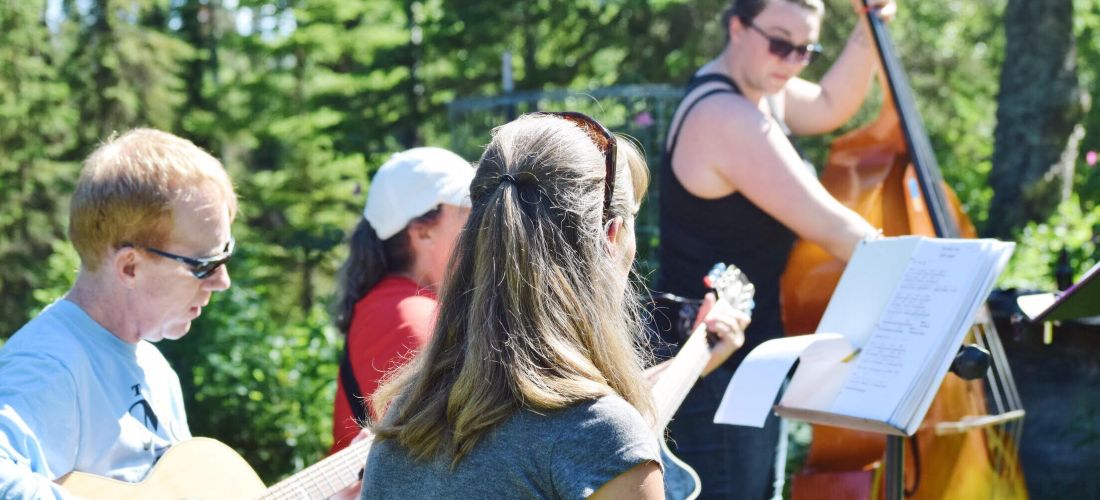
For the members of the band Recess Duty, teaching music all day just wasn’t enough.

“We decided we should do something for ourselves,” Kent Peterson, the band’s guitar and harmonica player, said. “We decided like ‘oh let’s get together and play some music.’”

The band began after many of the members joined together to put on a summer music camp.

“We were giving up our summer and hardly making anything,” Peterson said. “It was another volunteer thing.”

Four years ago, the band booked their first gig at the Kenai River Festival.

All of the members of Recess Duty are or were music teachers locally. Peterson teaches at Soldotna High School.

Tammy Vollom-Matturro plays the cajón and other percussion instruments. She conducts the Kenai Peninsula Orchestra and used to teach music at Kenai Central High School, Kenai Middle School and Tustumena Elementary.

Jeanne Duhan plays the guitar and sings. In the orchestra, she plays the french horn and is a retired music teacher from K-Beach Elementary. After retiring last year, she opened up Log Cabin Music, a band instrument repair shop.

Kristen Dillon plays bass and micro bass and works at Nikiski Middle and High School. Her husband, Jonathan Dillon plays the violin and is a music teacher at Mountain View Elementary.

Simon Nissen plays percussion, keyboard and sometimes mandolin. He is a choir teacher at Kenai Central High School.

Band members said they enjoy spending time together since most of the time they are busy teaching.

“It’s a lot of fun to get together and make music together,” Peterson said. “It was more about getting together to socialize and play. We all work alone so we never get to interact with each other.”

unnamed-2 copy

Duhan said that Peterson is a model musician for the children he teaches in his guitar class. As teachers, the members of Recess Duty have the opportunity to be examples for their students.

“Kent is a great model for how music is something to share,” Duhan said. “He loves to play music and he’s always up for rehearsing. He’s just a really good model for what being a musician is. It’s cool that the kids get to see him out and about.”

Peterson said that it can be difficult for music teachers to find the right venue to perform outside of school. He said he’s fortunate that the members of Recess Duty can also perform in the Kenai Peninsula Orchestra as well as in community and high school musicals.

“We talk about how music is this lifelong activity and kind of preach that to a lot of people,” Peterson said. “But there are a lot of music teachers who aren’t making music, mostly because there’s a challenge to find a venue to do it. This was a way for us to get out and show that there are ways to play music.”

The band describes their genre of music as folk, oldies and “definitely the classics.” They mostly perform covers, but will sometimes play some of Peterson’s original music. Duhan said as a band they focus on their strengths, which is harmonizing.

Finding times to perform has been a challenge for the band. During the school year, most of the band members are busy with their students and classes, and during the summer many of them will leave for vacation.

“We played a lot two years ago during the school year and it was really tiring,” Kristen Dillon said. “After a whole day of school, singing and conducting and doing all that, and then going to play.”

For the members of Recess Duty, playing together outside of school is just another way to stretch their music muscles. Vollom-Matturro said that it sometimes puts her out of her comfort zone.

For the teachers, who spend much of their work life teaching students the right way to play music, the band allows them to be creative and experiment on their own, Duhan said.

“All day long we’re teaching how to read music and theory, and (telling students) ‘this is the proper way,’” Duhan said. “It’s nice to be on the other side of that, where we’re finding harmonies and making it up. It’s nice to approach it from a different angle.”

Recess Duty is performing from 1 to 3 p.m. Friday, July 13 at the Swank Street Market in Soldotna, and again at Noon Tuesday, July 17 at the Soldotna Public Library.

Ionia: Born and bound by food

Alaska, food, Print, Uncategorized

Originally published in the Peninsula Clarion.

On Tuesday at noon, the lunch bell rings in Ionia, a health-conscious community near Kasilof.

Over 50 servings of brown rice with pumpkin seeds and sesame salt, baby daikon radish, sauerkraut and split-pea soup make their way out of the large kitchen in the Community Center and into the bellies of the residents of the community. After lunch, a group will plant 50 crabapple trees near their berry patch. Food and the process of creating food are sacred in Ionia.

In 1986, five families who share an appreciation for the macrobiotic tradition gathered together to create a community where they could practice a culture rooted in whole food and its effects on mental health.

Eliza Eller, an Ionia resident who has been there since the beginning, said that they were seeking balance.

The macrobiotic diet consists of whole grains and plant-based foods, like whole grain bread and pasta, millet, couscous, beans, seeds, root vegetables, leafy vegetables, sea vegetables and more. A grain and a vegetable are the minimum for a meal, but then several vegetable dishes like beans or pickles may become added side dishes.

“Food is a big part for us,” Eller said. “It’s personal — what you eat every day is like your personal relationship with nature, you know?”

Ionia is now in its third generation of families, many coming from the original founders. Roughly 50 people call it home, Eller said, with an influx of volunteers in the summer.

“Sometimes in the summer we’re feeding 80 or 90 people,” Eller said.

The first five acres were purchased for $300 down and then $300 per month. The group lived in teepees for the first winter before the families pooled together their Permanent Fund Dividend checks to create a building fund that they used to create open-concept cabins for each family. Every year, the community tries to expand its land. Ionia Inc. is a nonprofit that can receive grants and fundraise for new projects, like the ongoing current barn project, which will provide a small folk school and different shops that will make it easier for families to build housing, which Ionia is currently short on.

Majority of the cooking is done in the home, where kitchens are built with extra space. The community will have group feeds for many lunches and holidays, which are every full moon, Thanksgiving, solstice or Christmas depending on the year and the Fourth of July. On Sept. 15, Ionia will celebrate the harvest moon with a local food festival that features healthy food vendors and a farmers market at Soldotna Creek Park.

The food in Ionia is sourced locally as much as possible through foraging, gardening and partnerships with local farmers. Brown rice and other grains are imported in bulk.

Eller said the garden is her happy place and it produces thousands of pounds of food like kale, radishes, lettuce, garlic and more.

Because of the short growing season in Alaska, pickling and fermenting produce is a way to enjoy plant-based products all year long. Miso, a Japanese soybean ferment that is used as a seasoning, and tempeh, an Indonesian fermented soybean product used as a meat alternative, are Ionia favorites.

“Because food is so important to us, we spend a lot of our time preparing food, fermenting food, pickling food,” Eller said. “We’re all about the food here. It’s very time-consuming.”

Animal products of any sort, including honey, and concentrated sugar will never be found in an Ionia kitchen.

“Everyone thinks we’re crazy because we don’t eat fish here,” Eller said. “We’re not restrictive about what people eat, we’re like, ‘Eat whatever you need to eat, just not on the property’, and that seems to work well. Slowly the environment wins and you adjust.”

Despite no honey or concentrated sugar, Ionia is not without sweet treats. Eller said they eat desserts like berry and fruit pies, crisps and cookies, about three times a week. Desserts are made using a gentle sweetener like like brown rice syrup, and occasionally maple syrup.

Eller said the benefits from eating this way go beyond physical health.

“There’s just a tremendous appreciation with how food can affect our emotions and help us think clearly,” Eller said. “Everyone knows it’s good for your heart and it’s good for your weight and diabetes and all these things that are physically based, but there isn’t quite as much awareness in the medical field around food and mental health.”

Everyone cooks and rotates on a schedule, and Eller said almost everyone wants to be in the kitchen. Food is more than just fuel — it’s an art and a way for community members to express themselves, she added.

“Embedded in macrobiotics is a real love of cooking,” Eller said. “Cooking became an art and a skill that is very revered, and there’s a lot of respect for the cook in the household. Everybody grows up cooking and everyone knows it’s one of the things everyone needs to do and share and it’s not looked at as a burden, but as an opportunity to be creative.”

Menu planning is intuitive and season-based, with warming soups and stews for the winter months and salads and blanched vegetables for the summer.

The gastronomically inclined can get a taste of Ionia cuisine at the at 11 a.m. on Saturday, July 14, at the Soldotna Saturday Farmers Market as part of the Chef at the Market series. Ionia residents Ally Bril and Emma Becherer will be making samples for the public.

“We’re going to do vegan bruschetta, and keep passing them through there so people can have tasters and see what we’re doing and all about,” Bril said.

Reach Victoria Petersen at vpetersen@peninsulaclarion.com.

Memories for sale: Nostalgic game shop opens in Soldotna

Alaska, News, Print, Uncategorized

Originally published in the Peninsula Clarion.

Remember the large Blockbuster banner sign outside of the now-closed shop? The 14-foot by 7-foot sign is now inside of Beetle Boss — a nostalgic media shop in Soldotna that opened Sunday.

A Blockbuster rug, candy cigarettes, laserdisc players, a Toys “R” Us checkout sign, game cubes and Mario T-shirts are just a few recognizable signs of childhood inside of Beetle Boss.

Beetle Boss owner Jami Sperry, a custodian with the Kenai Peninsula School District, had so many games in his house that he decided to open the store. The majority of Sperry’s games and memorabilia have been collected over the last six months.

“I wasn’t really into games, it was mostly my brother,” Sperry said. “I enjoyed watching him play. I wasn’t very close to him, but when he was playing games he allowed me to be in his room and just watch him. He would let me play once in awhile.”

Sperry said he created the shop to be a safe space.

“It gives a place around here where kids can come in and play games,” Sperry said. “It’s a safe place where if kids are on the street and they don’t know where to go, they can come here, play some games, be safe and stay out of trouble.”

The buy-sell-trade business will also have a back room where TVs will be set up and people can play games onsite.

The shop sells a hodgepodge of items including DVDs, video games, T-shirts, consoles, Magic cards and more. Sperry said he wants to bring the community together over retro products like laserdiscs. Similar in appearance to DVDs and about the size of vinyl records, the discs came out in the 70s and were manufactured until 2009.

For hobbyists interested in watching their laserdisc, Sperry has a couple of laserdisc players for sale as well.

Sperry said he’ll also carry international products, including the Chinese version of the Nintendo 64 console, called the IQue, and retro consoles like Sega and Nintendo.

Sperry wants to support local crafters that fit into his theme. Currently, he’s selling locally knitted stuffed toys shaped like popular cartoon characters.

Sperry said he will start a public Super Mario Kart tournament in September. The public will be able to enter into the six-month tournament, and every month the top three winners will advance. In March, the top 15 will battle it out for a grand prize. People who enter into the tournament will pay a nominal fee, which will, in turn, go into Sperry’s 1974 Miracle Whip jar. The jar is the repository for donations that go to Bridges Community Resource Network, an organization in Soldotna that focuses on social and welfare services for individuals and families.

“I just want to raise money to help people in need, and grow this community,” Sperry said.

Sperry said he hopes to have the shop open every day in the summer from Noon to 5 p.m., inside the Peninsula Center Mall.

Goat yoga comes to the Peninsula

Alaska, Print

This story was originally published in the Peninsula Clarion.

Amber Harrison had few expectations when she laid down her yoga mat at the Palmer Fairgrounds last year. She came all the way to the Matsu Valley to try something she had seen only seen on the internet: goat yoga.

“I kind of thought, ‘oh that’s silly, is that even really yoga?’” Harrison said. “I pretty much only went to the fair to see that and what it was all about.”

Harrison, the owner of the Yoga Yurt, introduced goat yoga to the peninsula. Her first goat yoga session was this weekend.

After her goat yoga experience at the fair, Harrison posted a photo to the Yoga Yurt’s Facebook page asking if anyone would be willing to rent their goats for a session. Liberty Alaskan Goat Farms, a hobby farm off of K-Beach Road, offered to supply Harrison’s class with some baby dwarf goats and a place to practice.

The sessions took place outside, in the backyard of Liberty Alaskan Goat Farm. Jennifer Enersen of Liberty Alaskan Goat Farm had a few of her Nigerian dwarf goats, and Barbra Wills of White Gold Farm provided a group of her Alpine/Nubian breed goats to entertain the yoga class.

“I had heard about [goat yoga] a few years ago,” Enersen said. “I always thought it would be so fun to do. I kind of joked with my husband about it. Eventually, I would love to get into therapy with goats. I’m a nurse by trade and a farmer on the weekend.”

Harrison said the main goal with goat yoga is just to have fun.

“The unpredictability of the animals is just entertaining,” Harrison said. “They have minds of their own. Sometimes they’ll just be nibbling on your hair, or sit by you or stare at you. Or they’ll be in a corner doing their own thing. There are even people who came that just sat and pet the goats. So it’s kind of also a petting zoo. … They’re adorable. Who doesn’t want to be around tiny adorable farm animals?”

LaRae Paxton attended the first session at noon. She said she watched numerous Youtube videos to prepare herself. It was her first time, and she said “it was great fun,” despite being the only person in the class who had her mat urinated on.

Katrina Cannava brought her two children, Parker and Anna, to try goat yoga for the first time.

“We loved it,” Cannava said. “We have an uncle who had done it before, so we were super excited to try it. It was great for the kids.”

The Yoga Yurt, which celebrates their second anniversary this week, offers a wide range of yoga classes and workshops. In the summer, Harrison does free yoga in the Soldotna Creek Park at 6 p.m. on Fridays and paddleboard yoga on local lakes in the summer and pools in the winter.

“I try to do more traditional structured yoga, of course,” Harrison said. “That’s the foundation of our studio. I think sometimes we get in our heads about what yoga is supposed to be.”

Harrison said their aerial fitness class, which uses hanging silks, is among her most popular courses.

“It’s really fun and people get intimidated because they think like, Cirque du Soleil. We do stuff like that, but most of it is more yogic,” Harrison said.

The yurt can fit around 27 people and features a ceiling window that allows natural light to pour into the space. Harrison said she plans on more goat yoga classes in the future.

The Yoga Yurt is located on East Poppy Lane, off K-Beach Road.


100 years ago, Spanish flu devastated Alaska Native villages

Alaska, Print, Uncategorized

Originally published in the Peninsula Clarion.

At the dawn of the 20th century, 15 people lived in the village of Point Possession on the northern tip of the Kenai Peninsula, according to census data. After the 1918 Spanish flu epidemic reached the small settlement and killed 10 people, a single family were all that was left of the Point Possession population.

A century later, the exact death toll from Spanish flu is unknown. Estimates place it between 20 million and 50 million people worldwide.

The Alaska Office of Vital Statistics reports nearly 3,000 deaths between 1918 and 1919 in the territory. Per capita, more people died in Alaska of the Spanish flu than anywhere else in the world other than Samoa.

Katie Ringsmuth, a history professor at the University of Alaska Anchorage and owner of public history consulting business Tundra Vision, said the epidemic represented total annihilation.

“This truly was as close to extinction as people experienced,” Ringsmuth said. “What’s shocking to me is that very few people are talking about this as the anniversary arrives … This was a demographic game-changer. Before, there were more native people than neo-Americans.”

Ringsmuth is working on restoring the Naknek cannery in the Bristol Bay region. She’s been compiling documents and records to tell the history of how the flu affected Alaska and the small fishing community of Naknek. Ringsmuth said it was the community’s most able-bodied that were affected by the flu.

“You tend to think it was the old people, the young, the weak, but it [wasn’t],”Ringsmuth said. “It killed the 30-year-olds, the strongest part of the community.”

Though the epidemic began in January 1918 in the rest of the world, the virus took a long time to reach Alaska. Historians believe it was likely carried by steamships and barges from Seattle and other ports. The first cases appeared in October in Juneau, and as ships and barges made their way around the state in the fall of 1918. The pandemic seeped into the state from the coasts. In October 1918, the S.S. Victoria docked in Nome, and the men on board unknowingly delivered mail carrying the virus, according to a 2015 Senior Voice article by Alaska historian Laurel Downing Bill. A month later, 31 of the men aboard the S.S. Victoria died heading south from Nome. Dog sled teams, explorers, missionaries and people in search of their family members brought influenza into Alaska’s more isolated areas.

In historian Alfred Crosby’s “The Forgotten Pandemic,” he writes about how Spanish flu affected the U.S., how the disease made its way from one side of the country to the other and why he believes the events of 1918 and 1919 are “largely forgotten.” In reference to how quickly and virulently influenza impacted the small villages of Alaska’s northwest corner, Crosby states in his book that “the Spanish flu did to Nome and the Seward Peninsula what the Black Death did to 14-century Europe.” Crosby estimated that 8 percent of the Alaska Native population died from the flu.

Tim Troll, a former Dillingham resident, used to the run the museum there. He’s also compiling a history of how the Spanish flu affected Alaska and the Bristol Bay area.

“This was a worldwide epidemic, and Alaska is always thought of being isolated and out of the way, but not enough to keep this sort of thing out,” Troll said.

At the time, the territorial government of Alaska was overwhelmed with the demand in medical care, and the federal government had exhausted services fighting the pandemic in the Lower 48 and providing for the war effort in World War I. Territorial Governor Thomas Riggs requested $200,000 in relief aid for the state. The request was reduced by half by the U.S. Senate and then voted down in the House of Representatives.

Other diseases not previously endemic to Alaska were also making their way into the state. Cases of smallpox, influenza, measles, tuberculosis, whooping cough and other communicable diseases cropped up in villages in Alaska from the 1830s–1920. The disease was carried to some of the state’s most remote locales, often by ship and dog sled. As villages became aware of the deadly infiltration, word of mouth was often times the only way to warn other communities. In a 2012 Anchorage Daily News article, author Tony Hopfinger describes how village leaders and doctors across Alaska ordered the closure of public spaces. Travel was prohibited between villages and armed guards positioned themselves outside some communities and were ordered to shoot anybody who tried to enter. One village, Shishmaref, was able to evade the flu completely.

“(The Spanish flu) epidemic, horrible as it was, occurred in the context of wave after wave of lethal diseases that decimated Alaska Natives,” Shana Loshbaugh, an independent scholar from Kenai who now lives in Fairbanks, said. “The only thing special about it was that, apparently, it was the last major scourge.”

The story was similar on the Kenai Peninsula. Record-keeping at the time was limited, but Alan Boraas, an anthropology professor at Kenai Peninsula College, said about half of the Dena’ina Alaska Native population in the Cook Inlet region died from the epidemic. From 1880–1920, at least eight Dena’ina villages were abandoned after too many people died for the villages to survive.

Places like Kalifornsky, Point Possession, Nikiski, Anchor Point and other villages across the inlet became too small after the epidemic. Boraas said the survivors came to Kenai, Tyonek or relocated further north to Eklutna.

Boraas said the nearest medical facility was in Seward, and that there may have only been one medical professional in Kenai at the time.

“People just suffered and it was terrible,” Boraas said.

By the summer of 1919, the disease was gone from the peninsula.

Today, there are few reminders of influenza’s effect on the peninsula. South of Kenai near Kasilof lies the old village site of Kalifornsky. Abandoned after the outbreak, a small graveyard inside a delicate white fence holds 16 unmarked graves, and one outside the fence, Dena’ina elder and writer Peter Kalifornsky’s resting place. The graves inside the fence belong to village members who perished from disease. The village’s survivors moved to Kenai, or across Cook Inlet to Tyonek.

In Alaska, more than just lives succumbed to what is widely considered one of the world’s worst influenza epidemics. Entire communities and cultures vanished in its wake.

“There was a loss of language, culture, formal schooling and more,” Boraas said.


French-with-orphans902177

Photo courtesy of Tim Troll


Movi found in Alaska caribou, moose

Alaska, News, Print, Uncategorized

Originally published in collaboration with Elizabeth Earl, and in the Peninsula Clarion

A harmful pathogen previously known only in goats and sheep has been found in healthy Alaskan moose and caribou.

Mycoplasma ovipneumoniae, commonly known as Movi, is a harmful bacterium known to cause pneumonia-like disease in both domestic goats and sheep and has caused die-offs in the Lower 48 wildlife populations. This is the first time it’s been detected in animals other than goats and sheep in Alaska, according to a Friday press release from the Alaska Department of Fish and Game. Outside the state, Movi was also found in a healthy bison in Montana, a mule deer in New Mexico and a sick white-tail deer in the upper Midwest.

Movi may have contributed to the death of a caribou in the Fortymile herd east of Fairbanks, according to Fish and Game. Lab tests confirmed the presence of Movi in the dead caribou’s lungs, the first time the bacterium had been connected to an actual case of respiratory disease in wildlife in the state, according to Fish and Game.

Bruce Dale, the director of the Division of Wildlife Conservation, said the dead caribou was also emaciated, which is not a known effect of Movi. Four herds in the state — from near Dillingham to the North Slope — have tested positive for the bacterium, but no sick individuals have been spotted. Archived samples from the Fortymile caribou herd from 2013–2014 have also tested positive for the bacterium, Dale said.

“It’s been around for awhile — it’s not like we’re expecting this to be rampantly present,” he said. “There’s been lots of cases of pneumonia in our caribou studies — never associated with Movi before, but always associated with being in poor condition.”

Movi is one of over 100 known mycoplasma species, which have varying degrees of virulence. The ability for Movi to cause respiratory illness is affected by other pathogens and other factors, as was the case with the caribou, according to the press release.

Individuals can carry Movi for some time without becoming sick, or may never become sick themselves. Environmental stressors, such as hunger, hard winters or other sickness, can open up the opportunity for Movi to manifest itself. Fish and Game does extensive tracking on the Fortymile herd and only one individual turned up susceptible to the disease, Dale said.

Movi was originally thought to have been only present in goats and sheep. State veterinarian Dr. Robert Gerlach said that it is unknown how the transfer between species occurred.

“The pathogen might be present in the wild and natural environment,” Gerlach said.

Nearly 400 of the estimated 1,500 domestic goats and sheep in the state have been tested for Movi, with around 4 percent testing positive, according to Fish and Game.

Statewide awareness of Movi began in early 2016 when the Board of Game considered a proposal to remove domestic goats and sheep from the “clean list,” an approved list that includes animals like domestic dogs and cats and allows them to be moved in and out of the state without a permit. The proposal would have required the goats and sheep to be individually tested, require permits and have double-fencing to prevent any nose-to-nose contact with any wild animals, in part because of the risk of Movi infection.

After public outcry about the burden of the permits, testing and fencing, the Board of Game agreed to delay the proposal for two years, giving goat and sheep owners time to work the issue out on their own with those concerned about the pathogen. In November 2017, the Board of Game was satisfied and turned down the proposalLess than three months later, Fish and Game found wild sheep and goats that tested positive for Movi, including some on the Kenai Peninsula.

Deanna O’Connor uses her blog, “If you Give a Girl a Goat,” to share stories and tips about raising goats that she’s learned running her hobby farm in Nikiski. She first got her goats tested for Movi in 2016, and then with the state veterinarian’s office in 2017. Her goats tested negative for Movi.

“Domestic owners are deeply invested in the health of their herds and flocks and are willingly the first line of defense when it comes to the spread of any illness to and from our animals,” O’Connor said. “We are more than happy to voluntarily participate in programs that keep animals — domestics and wilds alike — healthy, but we do not want to be regulated or permitted.”

With the news of moose and caribou carrying the pathogen, Wasilla resident Tina Judd is only a little concerned. She keeps a herd of 45 goats in Wasilla.

“We have a lot of moose near our property, but we have guardian dogs that keep them at bay,” Judd said.

Judd said she aims to keep up with the most recent science and keep wild and domestic animals separated. She and her husband are creating a support group called the Alaska Goat and Sheep Alliance, which she hopes can be a source for people to learn about and promote healthy herds and flocks.

For now, Judd said that future decisions regarding Movi should be based on science, not fear.

“Until the science is more developed, we shouldn’t look at the discovery of Movi in the wild population as the sky falling, but rather continue the testing of both domestic and wild animals and gathering facts,” Judd said.

Fish and Game plans to do more radio collaring on two wild sheep populations in the Brooks Range and in the Talkeetna Mountains, where animals tested positive for Movi before. Later, they’ll recapture some of those individuals and nearby animals to determine if the collared animal is still infected and if the others became infected, Dale said.

Upcoming Soldotna restaurant chooses ‘Alaska from Scratch’ author as new chef

Alaska, food, News, Print, Uncategorized

This story was originally published in the Peninsula Clarion.

For Maya Wilson, anything worth doing has been terrifying at first. Her newest endeavor on Whistle Hill is no exception.

Wilson, who launched her first cookbook “Alaska from Scratch” earlier this year, announced this week that she will be the head chef at the upcoming Soldotna restaurant Addie Camp Dining Car eatery and wine bar.

Wilson’s popular blog, Alaska From Scratch, began in 2011. She previously worked at The Flats Bistro in Kenai. Wilson said she thinks the new eatery is a great addition to the Soldotna food community.

“The vision for the restaurant was to do it as locally sourced as possible. To support local farmers, support our local vendors. I’m really pumped about that because that’s exactly what the food community needs and what Alaska needs,” Wilson said. “What I want, what I’ve always wanted, is for people to be well-fed and nourished, and this is just an extension of that.”

Peninsula residents may have seen the former train car jutting out from a building under construction atop a hill along the Sterling Highway on the way out of Soldotna toward Sterling. The train car and the building will be opening up as the new restaurant later this year.

The restaurant, owned by the Mary and Henry Krull, who opened Brew@602 in a neighboring former train car last year, will be offering dinner service and Sunday brunch.

The two-story building features large picture windows with views of Soldotna and the Kenai Mountains, two outdoor decks, a bar and plenty of inspiration from the railroad industry, including rail tie siding from the Alaska Railroad, and of course, the train car that will accommodate a more intimate dining experience.

The 1913 rail car, named Addie Camp, came from Addie Mine in Hill City, South Dakota. Wilson said the owners plan to preserve as much of the car’s original detail as possible. The Krulls rode in the car many times over the years before it was taken out of service in 2008. It was part of a tourist excursion in South Dakota. For Mary Krull, creating a restaurant came down to her and her husband’s love of good food.

“We like all things fresh and local,” she said. “We wanted to give Soldotna another option.”

The restaurant will also have its own hydroponic grow operation that will provide greens year-round, adding freshness to their dishes, even in the dead of winter.

Wilson has already started to meet with local farmers and vendors to partner with. She has begun to conceptualize the menu and said it will change with the seasons. Vegan and gluten-free options will also be available.

“It’s not fussy, it’s approachable. I really do try to focus on Alaska’s ingredients. I feel like that will be received well by the locals and the tourists, and I’m hopeful I will bridge that gap a little bit,” Wilson said.

Currently, the owners are working on acquiring a beer and wine license. The application process requires signatures from residents, 21 and older, in a one-mile radius of Addie Camp Dining Car eatery and wine bar. When open, the restaurant hopes to serve local beers on tap and fine wine.

“We need the community’s help to be the eatery and wine bar that we hope to be,” Wilson said.

Krull said they hope to open the restaurant this October.

“It’s a huge undertaking. It’s so exciting, and terrifying too. I’m most excited about for when we finally open and we get that food on the table,” Wilson said.