‘Poor man’s polo’ finds its way to the Kenai

Alaska, News, Online, Print

This story originally published in the Peninsula Clarion.

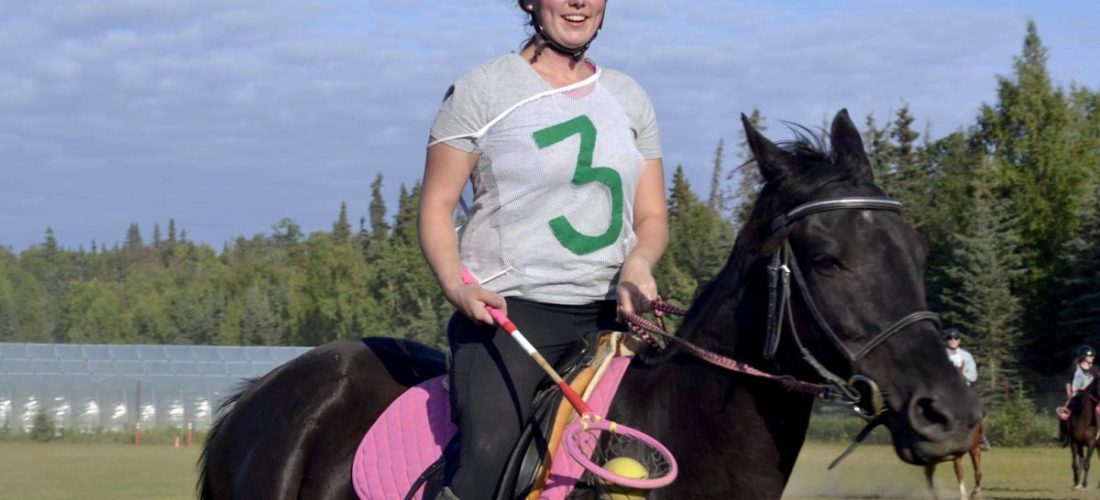
On Thursday nights, Maya Johnson can be found getting her horse geared up for a game of polocrosse. Johnson first heard of the team sport — a combination of polo and lacrosse — when she was riding on the equestrian team at Dartmouth College.

Johnson returned to Alaska several years ago, bringing the sport with her.

Her former riding instructor and director of riding at Dartmouth, Sally Batton, quite literally wrote the book on polocrosse. She visits Alaska once a year, offering polocrosse clinics for people like Johnson, who are passionate about the sport.

“She started teaching our group up here and everyone got pretty into it,” Johnson said.

Johnson said there are also polocrosse groups in Homer and Anchorage.

“We haven’t actually played them, but that’s our goal,” Johnson said.

In polocrosse, there are three people and horses on a team. Similar to soccer, one teammate takes offense, the other defense and another plays the midfield. Instead of lacrosse rackets, the sport has specially made rackets with a small netted basket, used for scooping up the ball from the ground.

The horse community is pretty small on the central peninsula, Johnson said.

“We pretty much all know each other,” Johnson.

On Thursday night, several people came out to play. Johnson said the group who comes to play is getting bigger.

“It gets really competitive,” Johnson said. “I like seeing everyone laughing and trying to push everyone out of the way.”

Johnson coordinates her Thursday games at Ridgeway Farms, where the riding arena almost meets exact regulation size.

Abby Ala, owner of Ridgeway Farms and Johnson’s grandma, said polocrosse is an accessible sport for anyone who enjoys riding.

“This is a poor man’s polo,” Ala said. “It’s fun. You don’t have to have a ton of money. You don’t have to have a lot of experience. You can be really young and do it and you can be older and do it.”

Johnson said residents interested in learning more about the sport can contact her via the Kenai Polocrosse Facebook Group.

17869234_web1_67541422_1324411557735882_1593418087833534464_n-1200x800.jpg


EdWeek:On the Snowy Tundra, Alaska Students Bridge Differences and Eat Moose Snout

Alaska, Education, food, News, Online, Print, Uncategorized

This story was originally published in Education Week, as part of the 2019 Gregory M. Chronister Journalism Fellowship.

Outside of Alaska’s few urban pockets, a constellation of tiny communities, scattered across a rugged landscape, is home to more than half of the state’s residents. Alaska is among the nation’s most rural states—99 percent of its land mass is considered so. Resource extraction, transportation, food insecurity, and climate change have strained and complicated relationships between the state’s first inhabitants—members of 229 Alaska Native Villages—and non-Natives who, for the last three centuries, have come from all over the world to seek opportunity on one of the continent’s last frontiers.

Many familiar with that history see education as a powerful means for defusing tensions among the geographic and cultural groups. That’s what programs like Alaska’s Sister School Exchange aim to do, enlisting middle and high school students to build bridges, by offering them the chance to visit one another’s communities. Founded in 2001 by the Alaska Humanities Forum, the program was initially funded through Congress and a private foundation. Since 2007, the U.S. Department of Education Alaska Native Education program has fully funded the exchange. As of this year, more than 2,000 students have traveled to 88 communities across the state to participate in the free, weeklong exchanges.

Seven years ago, I was one of those students who left her comfortable, urban home in Anchorage to fly 300 miles to New Stuyahok to participate in the exchange. I was a shy high school junior and fourth-generation Alaskan with my own set of misconceptions about my rural neighbors.

The exchange gave me the chance to understand the challenges of life in rural Alaska—like the feeling of being completely isolated and the pressures of subsistence living in an ever-changing natural environment—while also showing me what it’s like to be part of a tight-knit, culturally rich community where I made friends for life.

This April, I made the trip again, this time with an Education Week photographer and four Anchorage students and their teacher to get a sense of the kinds of academic and cultural lessons the program might offer to communities across the country with different needs and lifestyles.

Prepping for the Adventure

The program begins each year long before the travel takes place. To participate, teachers must apply and then spend several months with their students, preparing for the visit. The exchange program provides a cross-cultural learning curriculum designed by educators, both Native and non-Native, where students study their own community and family histories as a step toward understanding their exchange-program peers. The curriculum becomes primarily experiential once the students and their teacher arrive at their sister schools in early spring when students shadow their peers from class to class.

Our two-hour trip this year covered more than 500 miles. Two planes and several snowmobiles were required to reach the destination: Scammon Bay—an isolated Native Village of 500 people, nestled on a mountain a mile or so from the Bering Sea Coast in the southwestern part of the state.

The East Anchorage High School students—Genavieve Beans, Starlyn Phillips, Jonathan Gates, and Nuulau Alaelua—and their math teacher, Ellen Piekarski, each had their own reasons for wanting to make the trip. Genavieve and Starlyn, who are both sophomores, are Alaska Native and wanted to see what life would’ve been like if they had grown up in a Native Village.

Jonathan, also a sophomore, was looking to escape the bustle of Anchorage and connect with his foster and adoptive brothers at home who are of Native heritage. Twelfth grader Nuulau, whose parents are from a rural part of the Independent State of Samoa, sought a way to connect to her own background.

“My parents, they came [to Alaska] and kind of really did struggle, and it’s like they had to fit into society. So I really didn’t learn much about my own culture,” she said. “This program gives me an opportunity to learn about my roots and other people’s roots, too.”

Their teacher, Piekarski, grew up in a military family before settling in Texas and eventually moving to Alaska. She wanted the opportunity not only to visit rural Alaska, but to see what teaching in a rural classroom would be like.

World of White

On the gravel strip that is Scammon Bay Airport, we climbed out of the nine-passenger airplane. Outside, everything was white, except a handful of colorful buildings and the navy-blue squiggle of the nearby Kun River. A thick, white fog hovered overhead, making it nearly impossible to tell where the snowy tundra dissolved into bleached sky. The whoosh of the wind and the buzz of the snowmobiles—the local mode of transportation—replaced the familiar sounds of Anchorage’s busy streets.

We were greeted by a handful of students from Scammon Bay School. The only school in the village, it serves about 200 K-12 students, all of whom are Alaska Natives. The temperature was about 20 degrees, and our student hosts wore their school sweatshirts, sweatpants, and sneakers—puffy weather gear and heavy boots covered us.

Jeremy Brink, a charismatic high school senior who plans to pursue a career in teaching, led the tour through his village. Despite his ease and connection with the community, Jeremy hasn’t lived in Scammon Bay long. He left his hometown of Bethel, a nearby hub, last year to seek a change of scenery and a deeper connection to his Yup’ik culture.

As we trudged through the snow, Jeremy took us inside the health clinic where he explained, to the surprise of the Anchorage students, how the village doesn’t have doctors or nurses. Health aides, whose only medical training is a 12-to-16-week program, are the community’s only source of health care. He explained how a storm last winter prevented planes from landing for a week, endangering patients in need of advanced medical attention—a stark contrast to Anchorage, where the big hospitals serve patients from across the state. Scammon Bay also has no police force. The community’s sole crime deterrents are village public safety officers—who receive 18 weeks of training and are hired by a consortium of tribal leaders from 56 Native Villages with oversight from Alaska State Troopers.

At the only general store, the students were shocked by high prices. They oohed and aahed at a small bottle of ranch dressing, no more than 12 ounces, which cost nearly $6. This, despite having learned about the high cost of rural living in their pre-visit prep—perhaps further proof that there is no substitute for first-hand experience. (In 2012, I felt the same shock when we spent $80 on ingredients for chocolate chip cookies on my exchange trip to New Stuyahok.)

Jeremy’s 45-minute tour ended in the center of the village, at the local stream or carvaq, as it is called in the locals’ native Yup’ik. He invited us to pack our water there, just as the community does. (For residents of the Lower 48, that means to haul water for home use.) That’s something none of us would dare try at Ship Creek, the stream that cuts through downtown Anchorage.

Jonathan stayed with Scammon Bay Principal Melissa Rivers and her family in district-owned housing adjacent to the school. The rest of us, including Genavieve and Starlyn, Nuulau, and Piekarski, occupied a district-owned apartment.

Hands-On Learning

In science teacher Mary Cox’s class, the students got a hands-on lesson from two visiting scientists—Lauren Bien and Chris Iannazzone from the Prince William Sound Science Center in Cordova, about 650 miles southeast of Scammon Bay. The scientists used an inflatable pool, several mystery liquids, some animal furs and feathers, and a handful of cleaning supplies to show the students how oil leaks from tankers and pipelines affect marine ecosystems. Then they let students experiment with potential clean up methods.

“Things that educate that aren’t really book or paper—we try to do as much hands-on as we have available or invite people in,” said Cox, an Arkansas transplant who’s been teaching at Scammon Bay for five years. She said she incorporates hands-on lessons herself by incubating salmon eggs in the classroom to teach about the life cycles of salmon.

Over the next few days, the Anchorage students engaged in other activities reflective of life in the bush. They learned to comb a musk ox pelt for wool or qiviut, skin an otter, and clean, inflate, dry, and cut seal intestines into sheets to sew together into a traditional Yup’ik raincoat. For the final task, students held opposite ends of a pale, slimy strip of seal gut, while blowing into it to inflate the pink, rubbery tube for drying.

At a potluck organized by principal Rivers and members of the community, the students sampled local foods like beluga, seal, herring eggs, smelt fish, and smoked salmon. Moose snout, a local delicacy, was prepared by the school’s chemistry teacher, Kristian Nattinger, who was in his last semester with the school after two years. Together, the students held up their oily, cream-colored, pieces of moose snout cartilage. In unison, they each bit a piece of the meat off the thin layer of hairy snout skin.

“It tasted like chicken,” Starlyn reported.

The locals’ deep knowledge of subsistence food-gathering practices impressed the Anchorage students.

“When you think about people in the bush you think, ‘Oh, they just hunt, they might not know much,’ but in reality, they know a lot more than we do, and they can do a lot more than we can,” Nuulau said. “It made me realize how I need to value things more.”

Macy Rivers, a softspoken 11th grader from Scammon Bay, appreciated the chance to share her life with her urban peers.

“It is important for them to see how we live out here because they could know who we are and how we live and just to see how we grow up and see how different it is living in a village than a city,” she said. “There are no cars, no highways. You know everyone.”

One-Way Exchange

The Anchorage and Scammon Bay students were already sharing Snapchat usernames and bonding over similar music tastes when they learned the rural students wouldn’t be visiting their homes in Anchorage this year. The reason: Conflicting activities prevented the Scammon Bay students from completing the required preparatory curriculum.

The news disappointed students from both communities. “They are frustrated now that they’ve met the students in the community. They’re like, ‘Can’t they just come?’” Piekarski said of her Anchorage students.

But she and other participating educators later said the curriculum is essential to a smooth experience for students, with its emphasis on first understanding one’s own culture, learning different communication styles and how to share cultural differences without offending, and developing an openness to new foods and experiences.

“I wasn’t worried about my students feeling comfortable in the community,” Piekarski said. “Now I see it helped them be prepared.”

“I would absolutely love it if every high school student could do these activities,” she said. “I think it would be an amazing way to improve relations with people from different communities.”

On her last day in the village, Genavieve said four days wasn’t enough. The Good Friday holiday cut their weeklong visit to four days. “I feel like I got cheated out of the experience.”

Nuulau said her time in Scammon Bay has motivated her to visit villages in her parents’ Samoan homeland.

“I learned to not judge and assume a lot of things because even I thought I knew everything before coming [to Scammon Bay],” she said. “When I heard about the trip, I thought, ‘Is it really worth coming here?’ Now, I wish we had more time because it’s just so great. I know why people are here and stay here.”

When I returned to my Anchorage high school in 2012 from my visit to New Stuyahok, I felt both more connected and knowledgeable about my home and neighbors, while also more aware that I had barely scratched the surface of what Alaska has to offer—which only propelled me to discover more of my state.

Leaving Old Perceptions Behind

And I shed some misconceptions about life in Alaska’s rural Native Villages. Like many of my peers, I had believed people in rural Alaska were to blame for the state’s high rate of drug and alcohol abuse and violent crimes. Alcohol-induced mortality rates are more than double in Alaska than for the United States as a whole, with 23 people per 100,000 citizens in Alaska compared to a nationwide average of 9.5, according to 2016 data from the Centers for Disease Control. For Alaska Natives, that rate is more than seven times the national average, with 81.7 people dying per 100,000 residents. What I didn’t understand then was that resources for health care, mental-health services, and addiction treatment are scarce beyond Alaska’s urban areas.

These mindset changes are not uncommon. Program statistics show that 90 percent of participants showed a change in perception following their travels, said Kari Lovett, the SSE coordinator.

For Piekarski, the added benefit was that she got to try her hand at substitute teaching in a math class at Scammon Bay. She found that while the technology and instructional resources there were more limited than in Anchorage, “you can still teach and impart wisdom.”

East High, which draws students from a wide range of racial and ethnic groups, is already one of the nation’s most culturally diverse high schools. But Piekarski said her experience in Scammon Bay further honed her sensitivity to students’ different cultural backgrounds back in Anchorage.

“This experience is definitely going to change how I teach, particularly with my students that are Native Alaskan, and I’ll have some of them that, you know, grew up in a village and then came to Anchorage,” she said. “A lot of the things that students do that used to bug me, I realize, hey, that’s part of their culture.”

Vol. 38, Issue 37, Pages 1, 14-16
Cooper Landing Businesses feel impact from fire, smoke

Alaska, News, Print, Uncategorized

This story originally published in the Peninsula Clarion.

Smoke from the Swan Lake Fire — which was ignited by lightning June 5 and has grown to over 100,000 acres — has had an effect on several communities in the Southcentral area, from Anchorage to Homer.

In the small town of Cooper Landing, winds have blown the fire’s smoke into its valley, affecting the community’s local tourism industry.

Yvette Galbraith, an administrator with the Cooper Landing Chamber of Commerce, said there has been a quite an impact on Cooper Landing because of the smoke. She said many businesses had cancellations and many patrons tried to reschedule for later dates. No businesses closed down, and everyone stayed open, she noted.

“From my understanding unless you had respiratory issues, many were able to still go out and do their activities, just at an adjusted level or time of day,” she said.

She said it was tough having the area be portrayed as constantly smoky.

“So when the weather broke or mornings or afternoons were clearer, folks missed out enjoying the Landing,” she said.

Galbraith said only heavy windstorms impact trips, but business still operate in rain or smoke.

“Skies are clear now, and it is absolutely beautiful in Cooper,” she said.

Katy Borchers is a Cooper Landing local and manager of Alaska Heavenly Lodge. She said the lodge has had to deal with only one cancellation, but said a smoky Cooper Landing was not the experience she wanted her guests to have. “… (Where) you can’t even see the mountains across the river,” Borchers said.

Borchers was raised in Interior Alaska, where wildfires are common. She’s been living on the peninsula for 10 years now, and said she’s never seen anything like this.

“Because of the geographic features, the smoke just rolls in and sits in the valley here with the river,” she said. “It’s going to have an economic impact for sure, especially in our little community.”

She said she understand wildfires are part of summer and is understanding in regard to local agencies allowing the Swan Lake Fire to burn, ensuring it’s safer in the future. “But, it’s difficult to swallow when it’s 100,000 acres,” she said. “This is where we all live and are raising our families. I have to monitor how much my 6-year-old plays outside.”

Despite the smoke, Borchers said guests have been fantastic and understanding. She said they’ve been forthcoming with guests and updating them on fire activity that may impact any excursions their guests may go on. Cooler weather and shifting winds have offered relief to the community this week, she said.

“We’ve all been getting out as much as possible, while the smoke is gone,” Borchers said. “We’re letting guests know when they should plan to be outside.”

The small community is a popular fishing spot, located at the headwaters of the Kenai River. The community experienced a banner opening for sockeye salmon on the Russian River this month. Erick Fish is an owner and guide of Fish and Sons Kenai Charters. He said despite the incredible fishing season the area is having, he has seen his business impacted by the smoke.

“(The smoke) got us a little bit,” he said. “We’ve had a few cancellations, not too much. There is so much salmon running, so people suffered through it.”

At the Kingfisher Roadhouse, a restaurant sitting near the shores of Kenai Lake, business is down by around a third, Chef Katherine O’Leary-Cole said.

“But, we’ve heard it’s much worse at other businesses,” O’Leary-Cole said. “Thank goodness smoke is clearing. Hopefully, we can salvage something from this season.”

Many independent travelers decide where they’ll visit when they get here. Borchers believes many of those travelers avoided the Kenai Peninsula because of the Swan Lake Fire.

“With the fire, we lost a lot of those independent travelers,” she said. “They chose to go somewhere else. There is going to be an impact, but we’ll weather the storm.”

‘Everything is on the table’

Alaska, Education, News, Online, Print, Uncategorized

This story was originally published in the Peninsula Clarion.

Gov. Mike Dunleavy vetoed $130 million in state funding for the University of Alaska system on Friday. Now, UA President Jim Johnsen said programs, faculty and entire campuses are at risk, and tuition increases are a possibility should an override to the governor’s veto fail.

“We’re doing our damnedest to navigate through this so that it doesn’t impact our students,” Johnsen said. “Everything is on the table, $134 million is huge. This cut cannot be met by ‘oh, let’s close a program here, let’s tighten our belt here.’ It can’t be done like that.”

Dunleavy’s funding cut is on top of a $5 million reduction already authorized by lawmakers.

Johnsen said the veto was a surprise.

“It quite frankly was a surprise when we heard,” Johnsen said. “We met with the governor over the spring and we went over ideas on how to strengthen the university. We didn’t think he would persist in this huge cut to our budget.”

Rep. Gary Knopp, R-Kenai/Soldotna, said the cut to the university would be “financially devastating.”

“How do you take $130 million from the university without an analysis?” Knopp said.

Sen. Gary Stevens, R-Kodiak, also opposed the governor’s veto of the University of Alaska budget. A retired college professor, Stevens’ district includes Homer, Kodiak and Cordova, all cities with community campuses.

“I don’t see it surviving after a cut like that,” Stevens said. “We’re talking about personnel, about a lot of professors being fired … I’m absolutely opposed to that veto of the university.”

When asked where he stands on the governor’s vetoes, Rep. Ben Carpenter, R-Nikiski, said via email that he’s “committed to standing behind necessary reductions in government spending to better the long-term fiscal health of our state.”

Sen. Peter Micciche, R-Kenai/Soldotna, did not immediately respond to requests for comment. Rep. Sarah Vance, R-Homer, also did not respond to emails or a phone call asking for comment.

Since Friday’s veto, the university has taken measures to reduce costs in the short term.

The system has issued furlough notices across the state to 2,500 employees. Furloughed employees are able to take two weeks of unpaid leave, or use 10 days of unpaid leave within the next six months.

Johnsen said the university has also issued hiring and travel freezes.

The veto is the largest cut the university has faced in their over 100-year history. The veto of $130.35 million is in addition to the $5 million cut the Legislature approved in their budget, resulting in a 41% total reduction in last year’s funding for the university system. The university relies on the state for about 40% of its funding. Other funding sources for the university budget include revenues from fees and tuition, investments and land sales, as well as research grants and contracts.

Excluding UAA, UAF and UAS, closing the 12 community campuses in the university system would only save the university $38 million.

“The 40% (from the state) is definitely core funding,” Johnsen said. “It’s where we hire faculty and staff. You have to use this funding to go get that other money.”

The university has sustained cuts in four of the last five years, with a loss of more than 1,200 staff, he said. Johnsen said this cut has the potential to reduce funding from other resources.

“Given the he extent of this cut, it’s not just limited to state funding,” he said. “If we lose faculty we’re going to lose the research grants they bring in; we’re going to lose the students that those faculty taught because there would be fewer courses, fewer programs, fewer sections — actually the cut is going to be substantially more than the governor’s reduction in our general fund budget.”

With private funding sources, Johnsen said, the university system is advocating for an override of the veto, which will require a three-fourths vote from state legislators by July 12.

He says many legislators support the university, but it’s a close call.

“There’s a small number of legislators on the fence,” Johnsen said.

Many state legislators, and Dunleavy, have attended and received degrees from the University of Alaska, including Micciche.

If the veto is sustained, Johnsen said the university system’s Board of Regents will declare financial exigency at their July 15 meeting, which will enable the board to expedite cuts that need to be made. By July 30, the board will have a plan for cuts, Johnsen said.

“Between July 15 and July 30, tough decisions would need to be made about what campuses are closed, what programs are closed across the University of Alaska,” Johnsen said.

The Kenai Peninsula College, the Kachemak Bay Campus and other regional campuses could find their way on the chopping block. Johnsen said the Kenai Peninsula College costs $6.3 million, and 20 similarly priced campuses would need to shut down to break even with the veto. Community campuses received their own appropriation in the budget, which was not vetoed by Dunleavy. Johnsen said these campuses — which receive university system support for human resources, financial aid, information technology, facility management, university relations — could not sustain themselves solely on the community campus appropriation.

“They could not operate — they don’t have the horsepower to operate with that money,” Johnsen said. “… They cannot operate on their own. We’re looking hard at what those costs are that that appropriation will bear.”

University of Alaska Anchorage Chancellor Cathy Sandeen echoed that point.

“We cannot keep the community campuses harmless, because the main campuses — we provide a number of services they cannot provide themselves,” she said. “We won’t be able to do that under the current budget scenarios unless those campuses pay us for those services, and if they cannot pay us, we will have to stop doing them.”

Sandeen noted that students at community campuses also take classes through distance and online education offered by the main campuses. Support of online courses offered at KPC and KBC also comes through UAA, such as for computer programs and platforms.

Sandeen said UAA could lose about 700 academic jobs, including potential jobs at the community campuses, if the veto stands.

“It’s sad to think about it — 700 people losing their jobs,” she said. “There are no replacement jobs in the state. People are going to leave the state of Alaska — smart, professional, committed people.”

University programs that get federal or non-state support won’t be affected by the veto, except for those grants that require a state match. The Kachemak Bay National Estuarine Research Reserve, for example, is funded through the UAA Alaska Center for Conservation Science, which receives some federal support.

“The extent to which this is funded through federal grants, those will not be affected,” Sandeen said.

Knopp says he doesn’t think the Kenai Peninsula College will be too greatly impacted because of the separate appropriation, but, he said the campus “will have impact.”

There is potential for the university veto to ripple beyond the university. Mouhcine Guettabi is a regional economist at the Institute of Social and Economic Research at UAA. He studies Alaska’s economy and its drivers, produce, forecasts and more, he said. When Dunleavy’s proposed budget was announced, Gutteabi was asked to present his work on the economic impact of various state budget options. After hearing of the vetoes, Gutteabi created a “very basic and quick assessment” on their potential impact to the economy, which he has posted online, he told the Clarion Tuesday.

In his analysis, Gutteabi said the proposed vetoes total about $450 million, which should amount to at least 4,500 of jobs lost in the short run.

“Actual job losses may be much larger if the agencies affected all lay off workers,” he said in the analysis.

Just the cut to the university system “essentially pushes the Alaska economy back into a recession,” he said.

“This tells us that once we account for all the cuts and their indirect and induced effects, there is a very strong likelihood that the economy will dip back into a recession,” Guttaebi posted on Twitter.

Stevens said legislators opposed to the vetoes are counting noses. The first vote will be to override them as a whole, and if that fails, try overriding them one at a time, he said. Stevens said he has been getting public opinion messages all week.

“This morning I had 150 new messages. I thought I dealt with them last night,” he said.

A week ago, many messages urged Stevens to back a $3,000 dividend. Now the message is “For Heaven’s sake, save our university. Save our senior programs,” he said.

Legislators have until July 12 to decide if they will overturn Dunleavy’s veto.

Reach Victoria Petersen at vpetersen@peninsulaclarion.com. Homer News reporter Michael Armstrong contributed to this story. Reach him at marmstrong@homernews.com.