Goat yoga comes to the Peninsula

Alaska, Print

This story was originally published in the Peninsula Clarion.

Amber Harrison had few expectations when she laid down her yoga mat at the Palmer Fairgrounds last year. She came all the way to the Matsu Valley to try something she had seen only seen on the internet: goat yoga.

“I kind of thought, ‘oh that’s silly, is that even really yoga?’” Harrison said. “I pretty much only went to the fair to see that and what it was all about.”

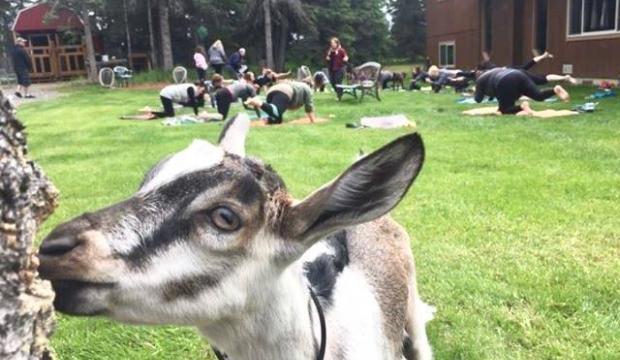
Harrison, the owner of the Yoga Yurt, introduced goat yoga to the peninsula. Her first goat yoga session was this weekend.

After her goat yoga experience at the fair, Harrison posted a photo to the Yoga Yurt’s Facebook page asking if anyone would be willing to rent their goats for a session. Liberty Alaskan Goat Farms, a hobby farm off of K-Beach Road, offered to supply Harrison’s class with some baby dwarf goats and a place to practice.

The sessions took place outside, in the backyard of Liberty Alaskan Goat Farm. Jennifer Enersen of Liberty Alaskan Goat Farm had a few of her Nigerian dwarf goats, and Barbra Wills of White Gold Farm provided a group of her Alpine/Nubian breed goats to entertain the yoga class.

“I had heard about [goat yoga] a few years ago,” Enersen said. “I always thought it would be so fun to do. I kind of joked with my husband about it. Eventually, I would love to get into therapy with goats. I’m a nurse by trade and a farmer on the weekend.”

Harrison said the main goal with goat yoga is just to have fun.

“The unpredictability of the animals is just entertaining,” Harrison said. “They have minds of their own. Sometimes they’ll just be nibbling on your hair, or sit by you or stare at you. Or they’ll be in a corner doing their own thing. There are even people who came that just sat and pet the goats. So it’s kind of also a petting zoo. … They’re adorable. Who doesn’t want to be around tiny adorable farm animals?”

LaRae Paxton attended the first session at noon. She said she watched numerous Youtube videos to prepare herself. It was her first time, and she said “it was great fun,” despite being the only person in the class who had her mat urinated on.

Katrina Cannava brought her two children, Parker and Anna, to try goat yoga for the first time.

“We loved it,” Cannava said. “We have an uncle who had done it before, so we were super excited to try it. It was great for the kids.”

The Yoga Yurt, which celebrates their second anniversary this week, offers a wide range of yoga classes and workshops. In the summer, Harrison does free yoga in the Soldotna Creek Park at 6 p.m. on Fridays and paddleboard yoga on local lakes in the summer and pools in the winter.

“I try to do more traditional structured yoga, of course,” Harrison said. “That’s the foundation of our studio. I think sometimes we get in our heads about what yoga is supposed to be.”

Harrison said their aerial fitness class, which uses hanging silks, is among her most popular courses.

“It’s really fun and people get intimidated because they think like, Cirque du Soleil. We do stuff like that, but most of it is more yogic,” Harrison said.

The yurt can fit around 27 people and features a ceiling window that allows natural light to pour into the space. Harrison said she plans on more goat yoga classes in the future.

The Yoga Yurt is located on East Poppy Lane, off K-Beach Road.


100 years ago, Spanish flu devastated Alaska Native villages

Alaska, Print, Uncategorized

Originally published in the Peninsula Clarion.

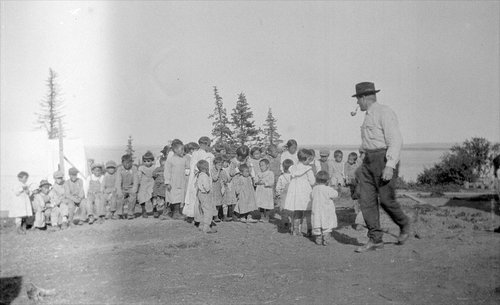
At the dawn of the 20th century, 15 people lived in the village of Point Possession on the northern tip of the Kenai Peninsula, according to census data. After the 1918 Spanish flu epidemic reached the small settlement and killed 10 people, a single family were all that was left of the Point Possession population.

A century later, the exact death toll from Spanish flu is unknown. Estimates place it between 20 million and 50 million people worldwide.

The Alaska Office of Vital Statistics reports nearly 3,000 deaths between 1918 and 1919 in the territory. Per capita, more people died in Alaska of the Spanish flu than anywhere else in the world other than Samoa.

Katie Ringsmuth, a history professor at the University of Alaska Anchorage and owner of public history consulting business Tundra Vision, said the epidemic represented total annihilation.

“This truly was as close to extinction as people experienced,” Ringsmuth said. “What’s shocking to me is that very few people are talking about this as the anniversary arrives … This was a demographic game-changer. Before, there were more native people than neo-Americans.”

Ringsmuth is working on restoring the Naknek cannery in the Bristol Bay region. She’s been compiling documents and records to tell the history of how the flu affected Alaska and the small fishing community of Naknek. Ringsmuth said it was the community’s most able-bodied that were affected by the flu.

“You tend to think it was the old people, the young, the weak, but it [wasn’t],”Ringsmuth said. “It killed the 30-year-olds, the strongest part of the community.”

Though the epidemic began in January 1918 in the rest of the world, the virus took a long time to reach Alaska. Historians believe it was likely carried by steamships and barges from Seattle and other ports. The first cases appeared in October in Juneau, and as ships and barges made their way around the state in the fall of 1918. The pandemic seeped into the state from the coasts. In October 1918, the S.S. Victoria docked in Nome, and the men on board unknowingly delivered mail carrying the virus, according to a 2015 Senior Voice article by Alaska historian Laurel Downing Bill. A month later, 31 of the men aboard the S.S. Victoria died heading south from Nome. Dog sled teams, explorers, missionaries and people in search of their family members brought influenza into Alaska’s more isolated areas.

In historian Alfred Crosby’s “The Forgotten Pandemic,” he writes about how Spanish flu affected the U.S., how the disease made its way from one side of the country to the other and why he believes the events of 1918 and 1919 are “largely forgotten.” In reference to how quickly and virulently influenza impacted the small villages of Alaska’s northwest corner, Crosby states in his book that “the Spanish flu did to Nome and the Seward Peninsula what the Black Death did to 14-century Europe.” Crosby estimated that 8 percent of the Alaska Native population died from the flu.

Tim Troll, a former Dillingham resident, used to the run the museum there. He’s also compiling a history of how the Spanish flu affected Alaska and the Bristol Bay area.

“This was a worldwide epidemic, and Alaska is always thought of being isolated and out of the way, but not enough to keep this sort of thing out,” Troll said.

At the time, the territorial government of Alaska was overwhelmed with the demand in medical care, and the federal government had exhausted services fighting the pandemic in the Lower 48 and providing for the war effort in World War I. Territorial Governor Thomas Riggs requested $200,000 in relief aid for the state. The request was reduced by half by the U.S. Senate and then voted down in the House of Representatives.

Other diseases not previously endemic to Alaska were also making their way into the state. Cases of smallpox, influenza, measles, tuberculosis, whooping cough and other communicable diseases cropped up in villages in Alaska from the 1830s–1920. The disease was carried to some of the state’s most remote locales, often by ship and dog sled. As villages became aware of the deadly infiltration, word of mouth was often times the only way to warn other communities. In a 2012 Anchorage Daily News article, author Tony Hopfinger describes how village leaders and doctors across Alaska ordered the closure of public spaces. Travel was prohibited between villages and armed guards positioned themselves outside some communities and were ordered to shoot anybody who tried to enter. One village, Shishmaref, was able to evade the flu completely.

“(The Spanish flu) epidemic, horrible as it was, occurred in the context of wave after wave of lethal diseases that decimated Alaska Natives,” Shana Loshbaugh, an independent scholar from Kenai who now lives in Fairbanks, said. “The only thing special about it was that, apparently, it was the last major scourge.”

The story was similar on the Kenai Peninsula. Record-keeping at the time was limited, but Alan Boraas, an anthropology professor at Kenai Peninsula College, said about half of the Dena’ina Alaska Native population in the Cook Inlet region died from the epidemic. From 1880–1920, at least eight Dena’ina villages were abandoned after too many people died for the villages to survive.

Places like Kalifornsky, Point Possession, Nikiski, Anchor Point and other villages across the inlet became too small after the epidemic. Boraas said the survivors came to Kenai, Tyonek or relocated further north to Eklutna.

Boraas said the nearest medical facility was in Seward, and that there may have only been one medical professional in Kenai at the time.

“People just suffered and it was terrible,” Boraas said.

By the summer of 1919, the disease was gone from the peninsula.

Today, there are few reminders of influenza’s effect on the peninsula. South of Kenai near Kasilof lies the old village site of Kalifornsky. Abandoned after the outbreak, a small graveyard inside a delicate white fence holds 16 unmarked graves, and one outside the fence, Dena’ina elder and writer Peter Kalifornsky’s resting place. The graves inside the fence belong to village members who perished from disease. The village’s survivors moved to Kenai, or across Cook Inlet to Tyonek.

In Alaska, more than just lives succumbed to what is widely considered one of the world’s worst influenza epidemics. Entire communities and cultures vanished in its wake.

“There was a loss of language, culture, formal schooling and more,” Boraas said.


French-with-orphans902177

Photo courtesy of Tim Troll


Movi found in Alaska caribou, moose

Alaska, News, Print, Uncategorized

Originally published in collaboration with Elizabeth Earl, and in the Peninsula Clarion

A harmful pathogen previously known only in goats and sheep has been found in healthy Alaskan moose and caribou.

Mycoplasma ovipneumoniae, commonly known as Movi, is a harmful bacterium known to cause pneumonia-like disease in both domestic goats and sheep and has caused die-offs in the Lower 48 wildlife populations. This is the first time it’s been detected in animals other than goats and sheep in Alaska, according to a Friday press release from the Alaska Department of Fish and Game. Outside the state, Movi was also found in a healthy bison in Montana, a mule deer in New Mexico and a sick white-tail deer in the upper Midwest.

Movi may have contributed to the death of a caribou in the Fortymile herd east of Fairbanks, according to Fish and Game. Lab tests confirmed the presence of Movi in the dead caribou’s lungs, the first time the bacterium had been connected to an actual case of respiratory disease in wildlife in the state, according to Fish and Game.

Bruce Dale, the director of the Division of Wildlife Conservation, said the dead caribou was also emaciated, which is not a known effect of Movi. Four herds in the state — from near Dillingham to the North Slope — have tested positive for the bacterium, but no sick individuals have been spotted. Archived samples from the Fortymile caribou herd from 2013–2014 have also tested positive for the bacterium, Dale said.

“It’s been around for awhile — it’s not like we’re expecting this to be rampantly present,” he said. “There’s been lots of cases of pneumonia in our caribou studies — never associated with Movi before, but always associated with being in poor condition.”

Movi is one of over 100 known mycoplasma species, which have varying degrees of virulence. The ability for Movi to cause respiratory illness is affected by other pathogens and other factors, as was the case with the caribou, according to the press release.

Individuals can carry Movi for some time without becoming sick, or may never become sick themselves. Environmental stressors, such as hunger, hard winters or other sickness, can open up the opportunity for Movi to manifest itself. Fish and Game does extensive tracking on the Fortymile herd and only one individual turned up susceptible to the disease, Dale said.

Movi was originally thought to have been only present in goats and sheep. State veterinarian Dr. Robert Gerlach said that it is unknown how the transfer between species occurred.

“The pathogen might be present in the wild and natural environment,” Gerlach said.

Nearly 400 of the estimated 1,500 domestic goats and sheep in the state have been tested for Movi, with around 4 percent testing positive, according to Fish and Game.

Statewide awareness of Movi began in early 2016 when the Board of Game considered a proposal to remove domestic goats and sheep from the “clean list,” an approved list that includes animals like domestic dogs and cats and allows them to be moved in and out of the state without a permit. The proposal would have required the goats and sheep to be individually tested, require permits and have double-fencing to prevent any nose-to-nose contact with any wild animals, in part because of the risk of Movi infection.

After public outcry about the burden of the permits, testing and fencing, the Board of Game agreed to delay the proposal for two years, giving goat and sheep owners time to work the issue out on their own with those concerned about the pathogen. In November 2017, the Board of Game was satisfied and turned down the proposalLess than three months later, Fish and Game found wild sheep and goats that tested positive for Movi, including some on the Kenai Peninsula.

Deanna O’Connor uses her blog, “If you Give a Girl a Goat,” to share stories and tips about raising goats that she’s learned running her hobby farm in Nikiski. She first got her goats tested for Movi in 2016, and then with the state veterinarian’s office in 2017. Her goats tested negative for Movi.

“Domestic owners are deeply invested in the health of their herds and flocks and are willingly the first line of defense when it comes to the spread of any illness to and from our animals,” O’Connor said. “We are more than happy to voluntarily participate in programs that keep animals — domestics and wilds alike — healthy, but we do not want to be regulated or permitted.”

With the news of moose and caribou carrying the pathogen, Wasilla resident Tina Judd is only a little concerned. She keeps a herd of 45 goats in Wasilla.

“We have a lot of moose near our property, but we have guardian dogs that keep them at bay,” Judd said.

Judd said she aims to keep up with the most recent science and keep wild and domestic animals separated. She and her husband are creating a support group called the Alaska Goat and Sheep Alliance, which she hopes can be a source for people to learn about and promote healthy herds and flocks.

For now, Judd said that future decisions regarding Movi should be based on science, not fear.

“Until the science is more developed, we shouldn’t look at the discovery of Movi in the wild population as the sky falling, but rather continue the testing of both domestic and wild animals and gathering facts,” Judd said.

Fish and Game plans to do more radio collaring on two wild sheep populations in the Brooks Range and in the Talkeetna Mountains, where animals tested positive for Movi before. Later, they’ll recapture some of those individuals and nearby animals to determine if the collared animal is still infected and if the others became infected, Dale said.

Upcoming Soldotna restaurant chooses ‘Alaska from Scratch’ author as new chef

Alaska, food, News, Print, Uncategorized

This story was originally published in the Peninsula Clarion.

For Maya Wilson, anything worth doing has been terrifying at first. Her newest endeavor on Whistle Hill is no exception.

Wilson, who launched her first cookbook “Alaska from Scratch” earlier this year, announced this week that she will be the head chef at the upcoming Soldotna restaurant Addie Camp Dining Car eatery and wine bar.

Wilson’s popular blog, Alaska From Scratch, began in 2011. She previously worked at The Flats Bistro in Kenai. Wilson said she thinks the new eatery is a great addition to the Soldotna food community.

“The vision for the restaurant was to do it as locally sourced as possible. To support local farmers, support our local vendors. I’m really pumped about that because that’s exactly what the food community needs and what Alaska needs,” Wilson said. “What I want, what I’ve always wanted, is for people to be well-fed and nourished, and this is just an extension of that.”

Peninsula residents may have seen the former train car jutting out from a building under construction atop a hill along the Sterling Highway on the way out of Soldotna toward Sterling. The train car and the building will be opening up as the new restaurant later this year.

The restaurant, owned by the Mary and Henry Krull, who opened Brew@602 in a neighboring former train car last year, will be offering dinner service and Sunday brunch.

The two-story building features large picture windows with views of Soldotna and the Kenai Mountains, two outdoor decks, a bar and plenty of inspiration from the railroad industry, including rail tie siding from the Alaska Railroad, and of course, the train car that will accommodate a more intimate dining experience.

The 1913 rail car, named Addie Camp, came from Addie Mine in Hill City, South Dakota. Wilson said the owners plan to preserve as much of the car’s original detail as possible. The Krulls rode in the car many times over the years before it was taken out of service in 2008. It was part of a tourist excursion in South Dakota. For Mary Krull, creating a restaurant came down to her and her husband’s love of good food.

“We like all things fresh and local,” she said. “We wanted to give Soldotna another option.”

The restaurant will also have its own hydroponic grow operation that will provide greens year-round, adding freshness to their dishes, even in the dead of winter.

Wilson has already started to meet with local farmers and vendors to partner with. She has begun to conceptualize the menu and said it will change with the seasons. Vegan and gluten-free options will also be available.

“It’s not fussy, it’s approachable. I really do try to focus on Alaska’s ingredients. I feel like that will be received well by the locals and the tourists, and I’m hopeful I will bridge that gap a little bit,” Wilson said.

Currently, the owners are working on acquiring a beer and wine license. The application process requires signatures from residents, 21 and older, in a one-mile radius of Addie Camp Dining Car eatery and wine bar. When open, the restaurant hopes to serve local beers on tap and fine wine.

“We need the community’s help to be the eatery and wine bar that we hope to be,” Wilson said.

Krull said they hope to open the restaurant this October.

“It’s a huge undertaking. It’s so exciting, and terrifying too. I’m most excited about for when we finally open and we get that food on the table,” Wilson said.

Gifted Students ‘Make the Most’ of School in Alaska

Alaska, News, Print, Uncategorized

This story was originally published on Education Week.

Glennallen, Alaska

This town of 500 people sits at the end of the Glenn Highway, 180 miles northeast of Anchorage, Alaska’s largest city. It’s a hub for travelers headed to the Copper River Valley, or farther, to Canada and the lower 48 states, and has much to offer in mountainscapes and a quiet way of life. For gifted students like Aric Cox, though, specialized educational resources are limited.

“I encourage him and his sister to make the most of what you got here. Yeah, it’s not as wonderful as … some other place, but we make the most of it,” Sherri Cox, Aric’s mother, said.

When it comes to providing advanced academic services, Glennallen shares many challenges with other rural schools across the country: too few specialized teachers, spotty internet access, underfunded districts, a lack of access to rigorous academic content.

Carolyn Callahan, a professor in the department of curriculum, instruction, and special education at the University of Virginia, said that rural gifted students have a particular disadvantage in schooling and that Alaska may be an extreme case because of its remoteness.

“Finding gifted kids in rural schools is difficult because personnel, and trained personnel, is limited,” she said. “In a rural school of 100 elementary students, you’d only have maybe five gifted kids, maybe one for every grade level. The opportunity for a teacher to create a whole enriched curriculum for one child becomes limited.”

Callahan said Aric is lucky in one respect: His academic ability, at least, was identified. Identifying gifted students in rural communities in the first place, she said, can be just as challenging as providing advanced content to that student when resources of all kinds are low.


Aric, who graduated from high school last month, has been living in Glennallen nearly his entire life and has attended Glennallen School since kindergarten. The K-12 school serves 286 students in all.

This year, the graduating class numbered 14.

Personalized Learning

And Glennallen School is the largest of the three schools in the Copper River school district, which serves fewer than 450 students in an area nearly the size of Ohio.

“I feel like larger schools would offer more variety of opportunities, but at the same time, in classes here, you get to know your teachers more,” Aric said. “In a bigger school, I don’t know if that would have been possible.”

That sentiment is shared by his school’s principal, Nick Schumacher, who said the small class sizes allow for more one-on-one attention.

“I feel like in smaller communities, you have to sort of take more initiative and go look for the opportunities,” Aric said.

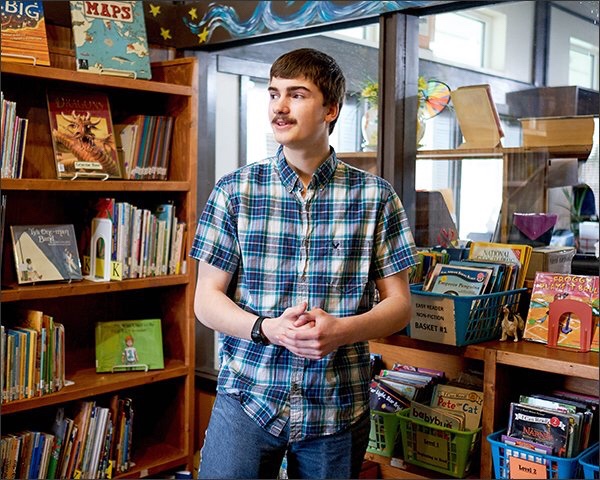
On his own search for opportunities, Aric discovered a passion for computer technology and helping people. He has been volunteering at the community library for the past seven years, where he sets up computers, puts books away, checks books in and out, and signs residents up for library cards, among other tasks.


After the local job center closed, Aric began working on a project to create a job-search database on one of the library’s computers. He also served as a student intern at Cross Road Clinic, the main medical facility in Glennallen where his parents both work. There, he installed TVs and a teleconference center, and helped with general information-technology work.

Aric burned through his school’s most challenging courses well before he was ready to graduate. Then he took online classes and video-teleconference classes to supplement the courses the district couldn’t offer him. Those classes were often based out of Prince William Sound College, which has an office in Glennallen, schools in Anchorage, and an online school on the U.S. East Coast, called the Potter’s School.

That ability to take online courses means Cox has been luckier than many of his peers in other parts of rural Alaska.

“The internet has been a boon in many, many cases because kids like Aric have access to it,” Callahan said. “Some schools don’t even have that option.”

Downside of Online Classes

But it’s also not been an ideal option, Aric noted.

“I’ve tried to take classes from teachers in school if I can, but if not, I would look at the online options and pick what was best,” he said. “[Online classes are] very impersonal. You get the content still, but you have to decide what you’re going to do with it. You don’t have a teacher to guide you along.”

Callahan agreed that the e-learning structure can be isolating for many students.

“You’re one student online, you’re not in a community. Nationally, it’s a problem and it’s something we’ve been dealing with by trying to get more gifted students identified,” she said.

The Copper River district is a member of the League of Innovative Schools, a nationwide coalition of more than 93 schools that focus on building opportunities for students through technology. Copper River and the Sitka school system are the only two Alaskan districts in the league. This coalition recognizes the districts for their use of a video-teleconferencing system that allows students to remotely take classes that are being offered at other schools in the district.

“If a teacher in our Kenny Lake School, which is 45 miles down the road, is offering a class in, let’s say, oceanography, a student in Glennallen that wants to take it can have access to it,” Copper River schools Superintendent Tamara Van Wyhe said.

The Copper River district offers e-learning options for gifted students like Cox through various partnerships with online education portals. In all, Van Wyhe said, the district is able to offer more 300 e-learning classes. Copper River students can also receive college credits and dual credit through a partnership with Prince William Sound College.

Moreover, independent study is an option for students who want to study something the district can’t provide.

That benefited Aric when he found an Advanced Placement Calculus class at an online school that wasn’t partnered with Copper River. His district offered financial support for the class, as well as a teacher to proctor the exam.

Teacher-Hiring Challenges

While the internet has helped make finding advanced classes for students like Cox less of a challenge, recruiting teachers who are skilled at meeting the needs of gifted students—and well-qualified educators in general—has become increasingly more difficult, Van Wyhe said.

“Ten years ago or more, it was pretty easy because all we had to say was, ‘Hey, we’re on the road system.’ People wanted to come here, but the pool of candidates has been declining so dramatically over the last five years,” Van Wyhe said. “There are not as many people interested in working in rural Alaska, so our road system draw isn’t quite what it used to be.”

Van Wyhe said it can be difficult for teachers to commit to wear all the hats required in a rural district.

“If you’re a high school English teacher, you’re not going to come to a rural district and just teach high school English. You’re going to teach English and social studies, and you might have a science class, and you might be asked to teach an art class, and you might coach cross-country, and be the adviser for student council and National Honor Society and a hundred other things,” Van Wyhe said.

Van Wyhe was a teacher in and around Anchorage for a couple of years before teaching in Copper River. While a small district in rural Alaska has its challenges, Van Wyhe said it’s the social and emotional benefits that have kept her there for more than 21 years.

“We have over 400 students in our school district, and I know every single one of them,” Van Wyhe said.

Meanwhile, in Quinhagak, a small, even more remote village on Alaska’s southwestern Bering Sea coast, Robby Strunk, a high school junior and gifted student, takes most of his classes online. His favorite subject is math, but his school’s most difficult math class is Algebra 2, which Strunk took as a freshman. Strunk said there are no teachers at his school who are trained to work with gifted children. He also said that because of budget reductions last year, his school had to cut a teacher position, leaving only two teachers at his 227-student high school.

College Transition

Strunk, however, has an opportunity to further his education through the Rural Alaska Honors Institute, an intensive college-preparatory program that brings rural, Alaskan Native high school juniors and seniors from across the state to the University of Alaska Fairbanks for six weeks.

Students can earn anywhere from eight to 11 college credits in one summer through the all-expenses-paid program.

Started in 1983, it is the oldest, continuously run program for academically promising rural students in Alaska.

The program was created in partnership with the University of Alaska and the Alaska Federation of Natives, with the goal of helping students ease the transition from village to town as they gear up for college.

The program, which nearly 1,800 students have attended since its inception, receives an average of 125 applicants each year and accepts 40 to 50 of them, according to RAHI program manager Denise Waters. Students must have a 3.0 GPA and have lived in Alaska most of their lives.

Strunk has been hearing about RAHI his whole life. His four older siblings went through it, and he was accepted to attend this summer, along with 41 other students from across the state. He said he is hoping to have similar experiences, and that the program will give him a jumpstart on college.

Over six weeks, students take classes from 8 a.m. to 5 p.m. and then work in a mandatory study hall from 7 p.m. to 9 p.m., five days a week.

“This is not a walk in the park,” Waters said.

Students choose from two course-study options. For those with an interest in the sciences, there is RAHI Research. Students must have taken some basic biology or chemistry classes and write two essays. This summer, six students will join university researchers, and, depending on the nature of the research the university is conducting, the students will be required to go into the field, collect data, assist with research, write a research paper, and give a final presentation about their findings.

Hard Work and Opportunity

The other track, the more traditional path, gears students up for managing college life. Those students take classes in college writing, library sciences, and study skills. In the afternoon, they choose from among four different classes: an appropriate level math class, chemistry, business, and a class that teaches the process and operations of refinery, chemical, and other industry manufacturing. In the evening, a physical education class is required; Alaska Native dance, karate, and yoga are the options.

The university and the Alaska Federation of Natives were able to entirely fund the program on their own when it began in the 1980s.

“This was during the [oil] pipeline days, and there was more money,” Waters said.

But in the last 10 years, external funding and partnerships were needed to continue the program.

The state of Alaska is grappling with a recession that has left districts, schools, and students with few resources, especially for the advanced content required to challenge gifted students.

This summer, while Strunk is attending RAHI, Aric will continue volunteering at the library and at Cross Road Clinic, as well as working with his school district to put together technology guides for teachers and students to work with the devices the school plans to start using next school year. In the fall, Aric will be leaving Glennallen, and Alaska, to study computer technology at Grove City College in Pennsylvania.

Strunk’s longterm goal? He hopes to return to Quinhagak after college and possibly teach math at this local high school.

Coverage of the experiences of low-income, high-achieving students is supported in part by a grant from the Jack Kent Cooke Foundation, at www.jkcf.org. Education Week retains sole editorial control over the content of this coverage.

Victoria Petersen is an Alaskan journalist, working as the education reporter for the
Photos by Young Kim