For ADN- At Lucky Kitchen, a sampling of Filipino comfort food

Alaska, food, Print, Uncategorized

Originally published in Alaska Dispatch News

After staying in the Philippines for a month in 2014, I’ve had a craving for classic Filipino dishes, like ube, adobo and lumpia — and you’d think it’d be easy to find them at a good Filipino restaurant in Anchorage.

After all, there’s a big Filipino population here — about half of Asian-Americans in Alaska trace their heritage back to the Philippines, according to 2014 statistics from the Alaska Department of Labor and Workforce Development. Yet the food of the Philippines has remained largely under the radar in Anchorage’s dining scene.

Then, through several of my Filipino friends, I heard about Lucky Kitchen. It’s a small, cafeteria-style restaurant attached to Lucky Market on the corner of International Airport Road and Arctic Boulevard, and I decided to give it a chance to curb my cravings.

For a restaurant that’s part of a grocery store, it’s surprisingly spacious, with comfortable seating for about 30 people. It was clean and well lit, and on a recent visit the smell of freshly made adobo filled the room. Lucky Kitchen features a mix of buffet-style Filipino, Thai and Chinese food, as well as made-to-order options.

On my first visit I brought three friends, one whom was familiar with Filipino cuisine. We ordered a two-entree combo, which comes with fried rice or lo mein, two main dishes and either a vegetable egg roll or a longanisa sausage ($9.49). We also ordered a whole pompano fish ($6.99), longanisa sausage (89 cents each) and lechon (deep-fried side pork, $11.99 a pound).

The combo was a pretty good deal, considering it was enough for two people. Ours consisted of fried rice, sesame chicken, pork adobo and a longanisa sausage. The sesame chicken was fine, basically the typical Chinese-American style of the dish. The pork adobo, on the other hand, propelled me straight back to Cebu City.

The two entree combo included steamed rice, longanisa sausage, pork adobo and sesame chicken. 

The two entree combo included steamed rice, longanisa sausage, pork adobo and sesame chicken.

Adobo, the national dish of the Philippines, is typically pork or chicken cooked with vinegar and soy sauce. The dish should be sweet, sour and salty, with none of the flavors overpowering the others. That was how it tasted at Lucky Kitchen, and the peppercorns, my favorite part, were abundant and gave the saucy pork dish a punch of sharp flavor.

The pompano fish was fried and served whole, with just about everything but the eyes. A small fish, the pompano looks similar to tilapia and barely filled the Styrofoam plate we were eating on. Peeling back the skin of the fish revealed a surprising amount of white meat. With our plastic forks, we pulled the meat from the bones and ate the whole thing very carefully. The flavor of the fish was buttery and mild like cod, but slightly fishier.

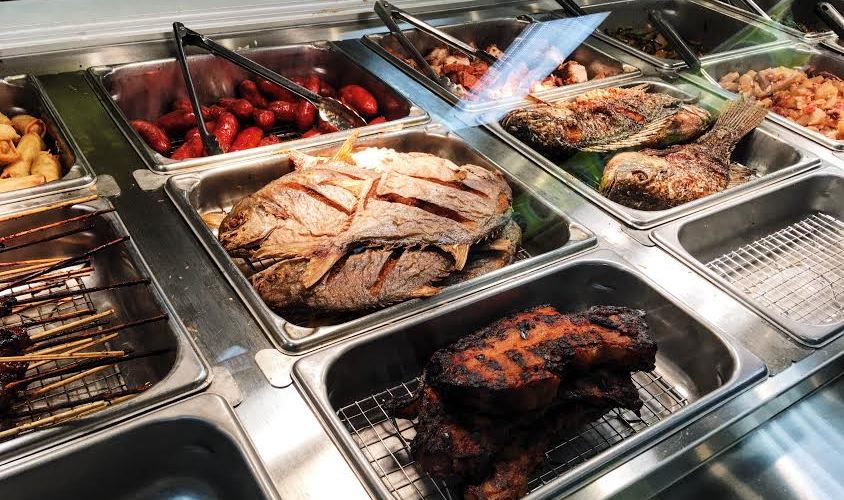
Pompano fish, tilapia, longanisa sausage and lechon are just few of the grab-and-go items you can get at Lucky Kitchen.

Pompano fish, tilapia, longanisa sausage and lechon are just few of the grab-and-go items you can get at Lucky Kitchen.

Everyone ordered a small longanisa sausage to try. Longanisa is a good representation of Spanish influence in the Philippines; it’s a sausage similar to chorizo, but sweeter and can be made with chicken, beef or even tuna. The sausage varies from region to region, but at Lucky Kitchen it tasted like pork sausage and was more sweet than spicy. My lunch dates fell in love with the tiny sausages.

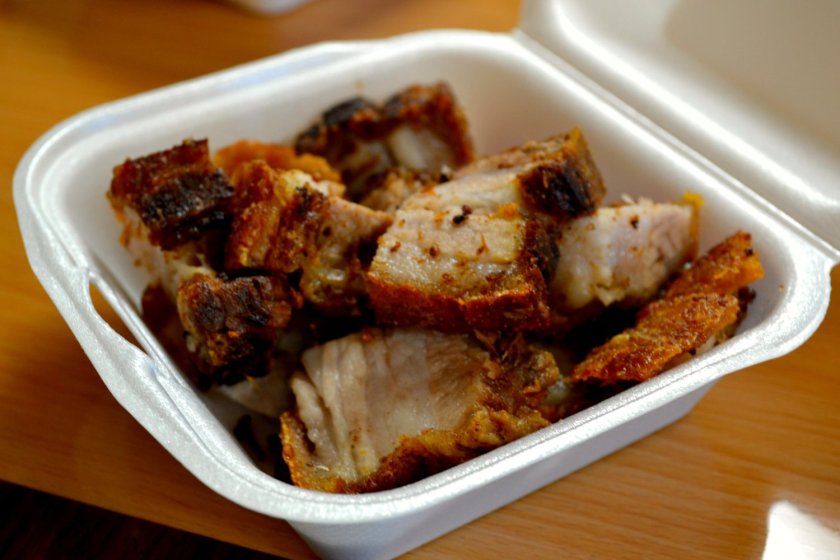
For a snack to share we got an order of lechon from the buffet table. Chopped into bite-sized pieces, the fried outer layer of this dish is extremely crunchy at first and then gives way to juicy, fatty pork. Lechon should ideally be eaten piping hot and accompanied with a dipping sauce of some sort — this lechon, unfortunately, was not hot enough. However, on a follow-up visit I got it made-to-order, and it came out just right. So for the optimal lechon experience at Lucky Kitchen, make sure to ask for sweet and sour sauce and order it made fresh.
Lechon, or deep fried side pork.

Lechon, or deep fried side pork.

Other Filipino dishes Lucky Kitchen brings to the table are pinakbet (a mix of vegetables steamed in fish or shrimp sauce), ginisang upo (bottle gourd sauteed in garlic, onions and tomatoes with pork), ginataang kalabasa (shrimp and vegetable dish cooked in coconut milk) and ginisang ampalaya (sauteed bitter melon). All were $11.99 for a large entree portion.

The most convenient thing about Lucky Kitchen is that if you find something you love in the deli, you can walk next door to Lucky Market and buy what you need to make it at home. For a Philippines-inspired meal or snack, visit the market for a package of longanisa sausage, calamansi juice or even ube cake.

Lucky Kitchen

Hours: 11 a.m.-8 p.m. Monday-Saturday, 12 a.m.-6 p.m. Sunday.

Location: 5011 Arctic Blvd. Suite B.

$$

***

Contact: 907-929-2229 or look on Facebook for “Lucky Kitchen”

For Edible Alaska: Made in Alaska – Ranch Dressing

Alaska, food, Print, Uncategorized

Originally published in Edible Alaska

Invented by plumber-turned-entrepreneur Steve Henson, ranch dressing can trace its origins all the way to rural Alaska. Fulfilling their own version of manifest destiny, Henson and his wife, Gayle, moved from Nebraska to the last frontier in 1949, where he found himself working as a plumbing contractor in the Alaska bush. Because of the remote location, Henson pulled double duty as a cook in order to feed his crew. In an effort to get them to enjoy the salads they were being served, he made an experimental dressing with ingredients he had on hand: buttermilk, mayonnaise, and a handful of herbs and spices. Sure enough, the workers ate their vegetables.

“It’s tough to feed men up in those bush jobs. If they don’t like something, they’re as likely to throw it at the cook as they are to walk out cursing. I had to come up with something to keep them happy,” Henson told Los Angeles Times’ Sergio Ortiz in a 1999 interview about the conception and history of ranch dressing. “And it was then, in Alaska, that what’s now known as ranch dressing came into being.”

Today this quintessentially American condiment that is equal parts creamy and tangy has been used on salads, as dips, and even on pizzas, for nearly 50 years.

Henson and his wife lived and worked in Alaska for three years before moving on to California, where they purchased Sweetwater Ranch in 1954. Changing the name to Hidden Valley, the dude ranch became a popular gathering place where the Hensons served food accompanied by Steve’s crew-pleasing, dairy-rich concoction. The condiment grew so popular at Hidden Valley that Steve and Gayle began charging 75 cents for powdered ranch-mix envelopes that were in high demand all across the country.

Today Hidden Valley Ranch, whose commercials depict a sort of promised land where children frolic in fields of green and eat their vegetables with enthusiasm, is owned by Clorox.  But there’s no doubt the utopian ideal that Hidden Valley has created is still alive for some children who can’t get enough of the gooey, dairy-packed dressing. Henson sold the brand and product for $8 million in 1973 and the dressing was made shelf-friendly, allowing it to be sold in stores across the country and become an American staple.

Ranch dressing, as American as white picket fences and baseball, is America’s go-to for all things dipped and smothered. As the number one dressing shipped to U.S. food service outlets, ranch flavor nearly doubles the volume of the runner up (blue cheese), according to a report published in 2014 by The NPD Group, a leading global consumer market research firm.

Of course ranch dressing(along with seemingly just about everything else these days) has a day dedicated to it. If you’re looking to celebrate, March 10 is the day to indulge by smothering your spring greens in the creamy, piquant, and thick Alaskan-born creation that is ranch.

Homemade Buttermilk Ranch Dressing

It’s easy to create your own tangy and creamy ranch dressing. Perfect for topping fresh greens and spring salads. Fresh herbs and good-quality dairy products enhance this recipe, giving you a more refined and sophisticated take on America’s favorite salad dressing.

Ingredients:

  • 1/2 cup mayonnaise
  • 1/2 cup sour cream
  • 3 tablespoons of fresh minced parsley
  • 1 1/2 teaspoons of fresh minced dill
  • 1/2 teaspoon apple cider vinegar
  • 1/2 teaspoon Worcestershire sauce
  • 1/2 teaspoon garlic powder
  • 1/4 teaspoon onion powder
  • 1/4 teaspoon salt
  • Freshly ground black pepper, to taste
  • 1/2 cup buttermilk

Preparation:

  1. In a large bowl, thoroughly mix all ingredients except for buttermilk.
  2. Once ingredients are mixed well, slowly add in buttermilk. Stir until all buttermilk has been added and all ingredients are combined.
  3. Refrigerate for approximately two hours, then taste and adjust seasonings as necessary before serving. Seal and refrigerate for up to one week.

For ADN: Puddles the clown is in Anchorage to sing pop music covers

Alaska, Beyond Alaska, Print, Uncategorized

Originally published in Alaska Dispatch News

As the clown behind Puddles Pity Party, Mike Geier has chosen not to speak. If Puddles has something to say, it will be sung.

Photo courtesy of Puddles Pity Party for Alaska Dispatch News

Photo courtesy of Puddles Pity Party for Alaska Dispatch News

“I don’t like to talk too much because I always seem to put my big foot in my big mouth. That being said, I find it exhilarating to communicate in ways that don’t involve speaking. (It) forces us to get creative and also keeps us focused on the heart of the matter,” Geier wrote in an email.

Mike Geier is the man behind Puddles Pity Party.

Standing 6 feet 8 inches tall, Geier’s signature look consists of a white clown costume with three big, fluffy black buttons — reminiscent of Pagliacci, the most famous of sad clowns — a crooked gold crown with the letter “P” written on it atop his head, whiteface makeup and a perpetual frown.

In a rich, baritone voice, Puddles sings pop anthems and ballads alike, from “Royals” by Lorde to “My Heart Will Go On,” in a melancholy, cabaret style.

“Even though a lot of the songs I sing are sad, there are also moments of celebration and joy throughout the show. I think sadness and joy go together. Tears and laughter. Laughter and tears. It’s all so cathartic,” Geier said. His repertoire includes covers of Billy Idol, The Beatles, Metallica and ABBA, among others.

“I tend to sing songs that hit ya right in the ticker. Songs that conjure the feels. It’s all about the feels,” Geier said. “And I like a good sing-along, too. I always encourage folks to sing along.”

Puddles the character started in 1998, Geier said, when he was performing karaoke in a flea market. In ’99, he continued the character for his Atlanta band Greasepaint (he also performs as Big Mike Geier in the band Kingsized, also in Atlanta).

In 2013, Puddles’ distinctive voice and unusual act got a bigger audience when he was featured on Scott Bradlee’s Postmodern Jukebox video series, covering the song “Royals” by Lorde. Today the video has reached nearly 18 million views. Geier did several more collaborations with the Postmodern Jukebox, then branched out on his own international tour.

“I feel very fortunate to be able to travel and sing and make new friends. What a world,” Geier said.

What can Anchorage expect from this unusual performer? “Togetherness, fellowship and free cuddles for anybody that wants ’em.”

For ADN: WindSync wants to change the way you think about wind quintets

Alaska, Beyond Alaska, Print, Uncategorized

Originally published in Alaska Dispatch News

Radiohead and Billy Joel might not come to mind when you think of a wind quintet performance, but WindSync is on a mission to expand and modernize the repertoire with new arrangements that span genres.

Each musician, from the flutist to the bassoon player, helps modify the source music — which might have been originally written for a full orchestra, singers, piano or even a rock band.

“We put it all together and we end up with something that sometimes is poppy, sometimes has jazz influence, often draws heavily on the classical tradition, but it’s sort of a different spin on that tradition. It takes extra work, but it’s well worth it,” said Kara LaMoure, WindSync bassoonist.

WindSync has gotten a lot of their recognition from videos of their performances of popular music, especially covers of Billy Joel’s “And So It Goes” and George Gershwin’s “Summertime.” In addition to new and popular music, WindSync also dips into jazz, folk and musical theater.

“For us, if we program top-40 music or anything that’s considered a more popular genre of music it’s because it’s really a key component of our programming. So for us they’re few and far between, but they are important because we do want to celebrate all genres,” LaMoure said.

“We don’t say, ‘Oh, we’re classical musicians so we’ll never play pop music.’ We think of it as just part of our programming.”

LaMoure said WindSync is influenced by American composers like Leonard Bernstein and Aaron Copland, who incorporated different musical traditions in their work.

“We’re really inspired by any music that tells a story or that can relate to a very wide demographic,” LaMoure said. “We’re exploring music that does that with a wide variety of influences: Melodies that can connect across wide audiences.”

The original ensemble was born out of the Rice University music program. Two of the original members — Garrett Hudson on the flute and Anni Hochhalter on the horn — still perform with the group today. Based out of Houston, the current ensemble also includes Emily Tsai on the oboe, Julian Hernandez on the clarinet and Kara LaMoure on the bassoon. Eight years after getting their start, WindSync spends about 100 days out of the year touring across the U.S. and internationally.

“We are dedicated to expanding the quintet repertoire and making a difference in the communities we perform in,” LaMoure said.

WindySync will be performing for students in the Anchorage School District. LaMoure said they want to engage the students through participation in their performance.

“We do ‘Peter and the Wolf’ in elementary schools all the time. When we do it we act out the story, we’re running around the stage. We are even playing our instruments while we’re running around the stage, so that gets crazy and intense,” LaMoure said.

“We also introduce them to how sound is produced on our instruments. We want them to have the beginnings to the idea of how music works.”

WindSync often strays from classical music performance decorum, something LaMoure said is intentional.

“In classical music there’s a lot of issues of ‘don’t clap between the movements,’ wear this specific kind of dress, or, you know, there’s a certain etiquette that’s expected,” LaMoure said. “But for us we kind of want that connection with the music to be more immediate and personal. So if the response is organic then we’re really happy.”

Overall, the ensemble hopes to create a visual experience as well as a listening one.

“Even the most seasoned wind quintet fans will see something new and interesting to them,” LaMoure said.

WindSync

When: 7:30 p.m. Friday

Where: Discovery Theatre

Tickets: $40.25-$54.75 at alaskapac.centertix.net